

L'Ami Louis on Rue du Vertbois is Paris's most argument-provoking bistro: a century-old room in the 3rd arrondissement where portions run enormous, prices run higher, and the wine cellar draws as much attention as the roast chicken. Ranked in the World's 50 Best in 2004 and consistently tracked by Opinionated About Dining, it occupies an almost singular position between neighbourhood bistro form and luxury-tier ambition.
Pearl is the En Primeur Club membership app — saves, bookings, and concierge access live there. Same editors, same standards.
- Address
- 32 Rue du Vertbois, 75003 Paris, France
- Phone
- +33 1 48 87 77 48
- Directions
- Get directions
 Saves & bookings on Pearl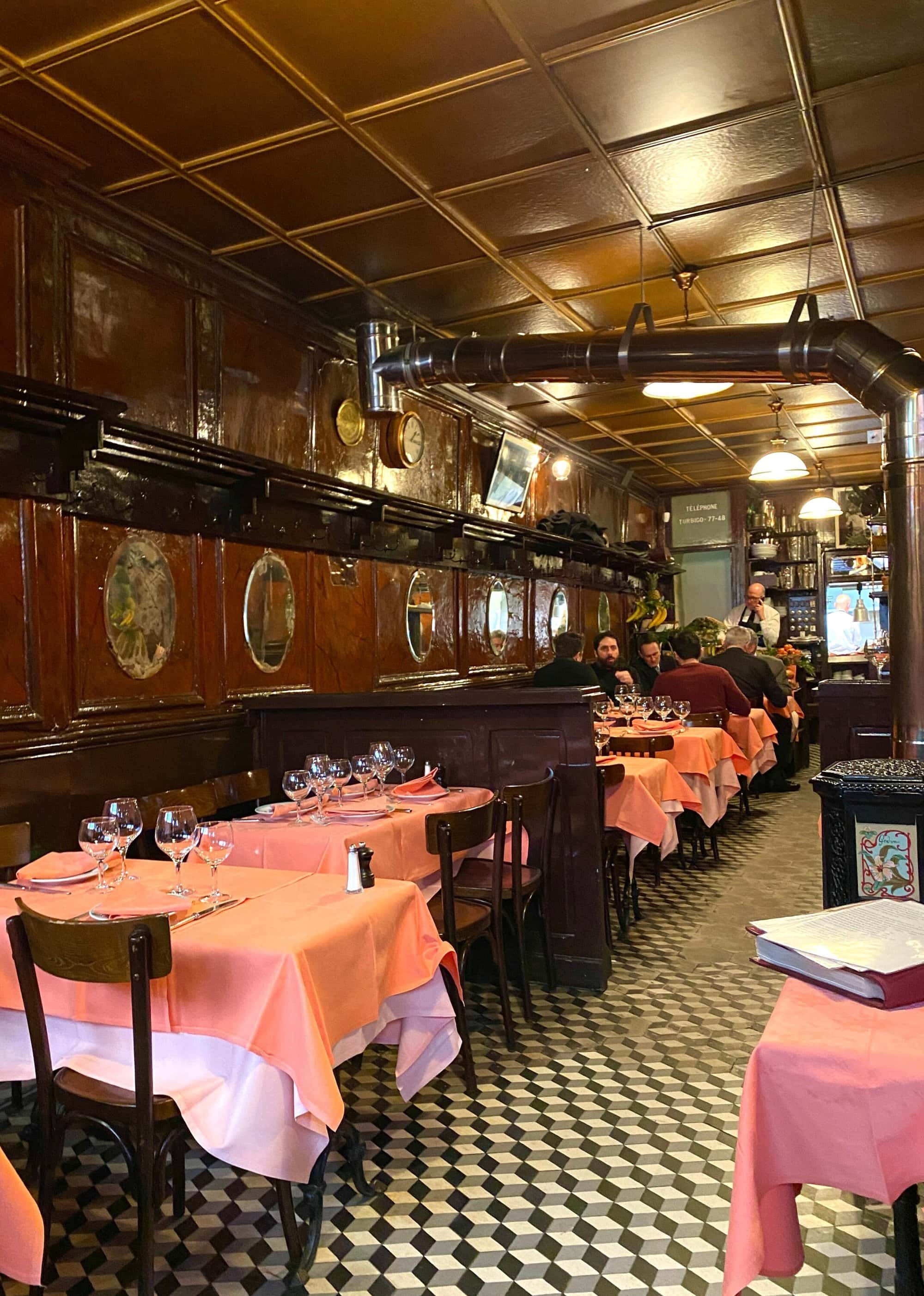
A Room That Resists Renovation
The 3rd arrondissement has changed considerably over the past two decades: the lower Marais absorbed concept restaurants, natural wine bars, and a wave of international interest that reordered its dining hierarchy. Through all of it, 32 Rue du Vertbois has looked more or less the same. The ceiling at L'Ami Louis is dark with age. The banquettes are worn in the way that only decades of use produce. The lighting is low without being theatrical. This is not a room that has been styled to evoke a bygone era; it is simply a room that has not been replaced. In a city that cycles through aesthetic revivals, brasserie revival, zinc-bar revival, cave à manger revival, that kind of stillness has become its own form of distinction.
The bistro format in Paris has split into at least three legible tiers. At one end sit the neighbourhood stalwarts: affordable, unreconstructed, often without reservations. At the other end, a cluster of addresses that wear the bistro label loosely while operating at grand-restaurant prices and ambition. L'Ami Louis occupies the latter position with unusual confidence. It does not attempt to bridge the gap; it simply prices and operates at the summit of the range and lets the room's age and the kitchen's reputation do the rest.
What the Kitchen Actually Does
Menu here is short and deliberate. The foie gras portion is, by most accounts, one of the more aggressive in the city, served in a quantity that would constitute a main course elsewhere. The roast chicken arrives whole, or close to it, with the kind of crust that comes from high heat and a minimal intervention approach. The pommes sarladaises, potatoes cooked in duck fat, function as a side dish in name only; in practice, they anchor the meal. These are not dishes that evolve with the season or respond to a chef's mood. They are fixed points around which the restaurant has built its entire identity.
That fixity is worth taking seriously as an editorial position. Much of contemporary Paris dining, from the creative end of the spectrum at addresses like Alléno Paris au Pavillon Ledoyen and Arpège to the refined classicism of L'Ambroisie, operates under a logic of continuous refinement: menus shift, tasting formats evolve, and the chef's developing point of view is the implicit subject of each visit. L'Ami Louis operates under the opposite logic. The implicit subject is constancy. You return because you want the same thing again, not because you want to see what has changed.
The Wine Cellar as a Separate Argument
The editorial angle that separates L'Ami Louis most clearly from its bistro-category peers is the wine list. Paris bistros at the affordable end of the market have largely moved toward natural wine programs: low-intervention producers, short lists, often available by the glass or pichet. The restaurant does not operate in that register. The cellar here skews classical and deep: Burgundy dominates, with vertical depth in producers that do not appear on most restaurant lists. Bordeaux is present at levels of maturity that require long-term buying and proper cellaring infrastructure.
For a room of this physical character, worn wood, close tables, no architectural pretension, the wine list represents a significant curatorial investment. It is the clearest signal that the kitchen's apparent simplicity is a considered position, not a limitation. A restaurant that can sustain a cellar of this depth is, by definition, operating with a different financial and operational logic than a neighbourhood bistro, even if it shares the same aesthetic vocabulary. The sommelier function here matters in a way that it does not at most addresses in the same apparent style bracket.
This places the restaurant in a comparable set that is somewhat unusual. For the style of the room, the comparison set would include Joséphine "Chez Dumonet", another Parisian address where classical technique and serious wine coexist in an unpretentious physical space. For the price level and the cellar ambition, the comparison set shifts toward addresses that operate with considerably more architectural investment. The restaurant sits at the intersection of those two groups without fully belonging to either.
The Awards Record and What It Signals
The recognition profile here spans different critical systems. The World's 50 Best placed the restaurant at number 17 in 2004, a ranking that reflected a broader critical moment when the list was still consolidating its methodology and French classical addresses carried significant weight in its voting base. That ranking is now two decades old, and the list has changed substantially in composition and geography since. More recent recognition comes from Opinionated About Dining, which listed the restaurant at number 235 in its Casual Europe ranking in 2024 and as Highly Recommended in its Classical Europe category in 2023. The OAD system, which aggregates ratings from a pool of serious restaurant-goers rather than professional inspectors, provides a different signal: it reflects sustained engagement from a travelling, food-focused audience rather than a single critic's assessment.
The absence of Michelin recognition is worth noting without over-reading it. Several Paris restaurants in the bistro and brasserie register operate without stars and are not disadvantaged by that absence in terms of reputation or demand. The OAD presence in both a casual and a classical category simultaneously is a more precise description of what the restaurant actually is: a kitchen operating in a classical French register, housed in a casual physical format, priced above the casual tier.
For comparison, the formal three-star addresses in Paris, including Kei and the previously mentioned L'Ambroisie, operate with a different service architecture, room investment, and menu logic. The restaurant is not competing with those addresses on their terms. It is competing on its own terms, in a category of one.
The Polarisation Problem
7 from 552 reviews is unusually low for a restaurant with this level of critical recognition, and it deserves a direct explanation. The restaurant is polarising in a structurally predictable way. Visitors who arrive expecting a Paris bistro experience at Paris bistro prices encounter something different: portions calibrated for sharing, a bill that reflects the wine list rather than the room, and a level of service formality that can read as indifference to diners outside the regulars' orbit. The reviews that push the average down tend to reflect a mismatch between expectation and delivery, not a failure of the kitchen on its own terms.
This is a pattern that appears at other address operating in the same register globally: restaurants with strong critical followings and divided public-platform ratings, where the critical case rests on something the casual visitor does not necessarily come prepared for. Le Bernardin in New York, while operating in a completely different format, faces a version of the same dynamic at the summit of its review distribution. The gap between critic consensus and aggregated public rating is itself a form of information.
Planning a Visit
The restaurant is closed Monday and Tuesday. Service runs Wednesday through Sunday, with a lunch sitting from 12:30 to 1:15 pm and an evening sitting from 7:30 to 10:30 pm. The address is 32 Rue du Vertbois in the 3rd arrondissement.
| Venue | Format | Lunch Service | Evening Service | Critical Recognition |
|---|---|---|---|---|
| The restaurant | Luxury Bistro | 12:30 to 1:30 pm (Wed–Sun) | 7:30 to 11 pm (Wed–Sun) | OAD Casual Europe #235 (2024), OAD Classical Highly Recommended (2023), W50B #17 (2004) |
| Joséphine "Chez Dumonet" | Classic Bistro | Yes | Yes | OAD tracked, Paris bistro reference |
| L'Ambroisie | French Classic | Yes | Yes | Michelin 3 Stars |
| Alléno Paris | Creative | Yes | Yes | Michelin 3 Stars |
Flocons de Sel in Megève, Mirazur in Menton, Troisgros in Ouches, Auberge de l'Ill in Illhaeusern, Bras in Laguiole, and Paul Bocuse in Collonges-au-Mont-d'Or.
Recognition Snapshot
Comparable venues nearby, for context on price, style, and recognition.
| Venue | Cuisine | Price | Awards | Notes |
|---|---|---|---|---|
| L'Ami LouisThis venue — the venue you are viewing | Classic French Bistro | $$$$ | World's 50 Best #17 | Not listed |
| Blanc | Modern French Fine Dining | $$$$ | Michelin 2 Star | Paris central |
| Marsan par Hélène Darroze | Modern French Fine Dining | $$$$ | Michelin 2 Star | Notre-Dame-des-Champs |
| Les Ambassadeurs | Classic French Bistro | $$$$ | World's 50 Best #45 | Faubourg Saint-Honoré |
| L'Orangerie | Modern French Pescatarian Fine Dining | $$$$ | Michelin 2 Star | Île Saint-Louis |
| Alléno | Modern French Fine Dining | $$$$ | Michelin 3 Star | 8e Arr. – Élysée |
Recognition history
Dated appearances from independent guides and award organizations, with the underlying list record or original source where available.
Opinionated About Dining Casual in Europe Recommended
Opinionated About Dining
Opinionated About Dining Casual in Europe Ranked #235
Opinionated About Dining
Opinionated About Dining Classical in Europe Highly Recommended
Opinionated About Dining
World's 50 Best Best Restaurants #17
World's 50 Best
Continue exploring
More in Paris
Restaurants in Paris
Browse all →
Bars in Paris
Browse all →
Hotels in Paris
Browse all →



At a Glance
- Classic
- Well Known
- Cozy
- Rustic
- Special Occasion
- Date Night
- Business Dinner
- Historic Building
- Extensive Wine List
Current opening hours
- Monday
- Closed
- Tuesday
- Closed
- Wednesday
- 12:30–1:15 PM, 7:30–10:30 PM
- Thursday
- 12:30–1:15 PM, 7:30–10:30 PM
- Friday
- 12:30–1:15 PM, 7:30–10:30 PM
- Saturday
- 12:30–1:15 PM, 7:30–10:30 PM
- Sunday
- 12:30–1:15 PM, 7:30–10:30 PM
Hours can change for holidays and private events. Last verified .
Dark, dramatic, and atmospheric with a 1950s Parisian feel, white-jacketed servers, and closely packed tables creating a festive yet traditional vibe.