La Cigale occupies one of Nantes' most recognisable Belle Époque interiors, a brasserie at Place Graslin whose tiled walls and ornate ceiling have made it a fixture of the city's public life since 1895. The menu follows a classic French brasserie architecture, seafood plateaux, grilled meats, regional staples, positioned as a reliable anchor in a dining scene that now runs from neighbourhood naturals to Michelin-recognised modern kitchens.
Pearl is the En Primeur Club membership app — saves, bookings, and concierge access live there. Same editors, same standards.
- Address
- 4 Pl. Graslin, 44000 Nantes, France
- Phone
- +33251849494
- Website
- lacigale.com
- Directions
- Get directions
 Saves & bookings on Pearl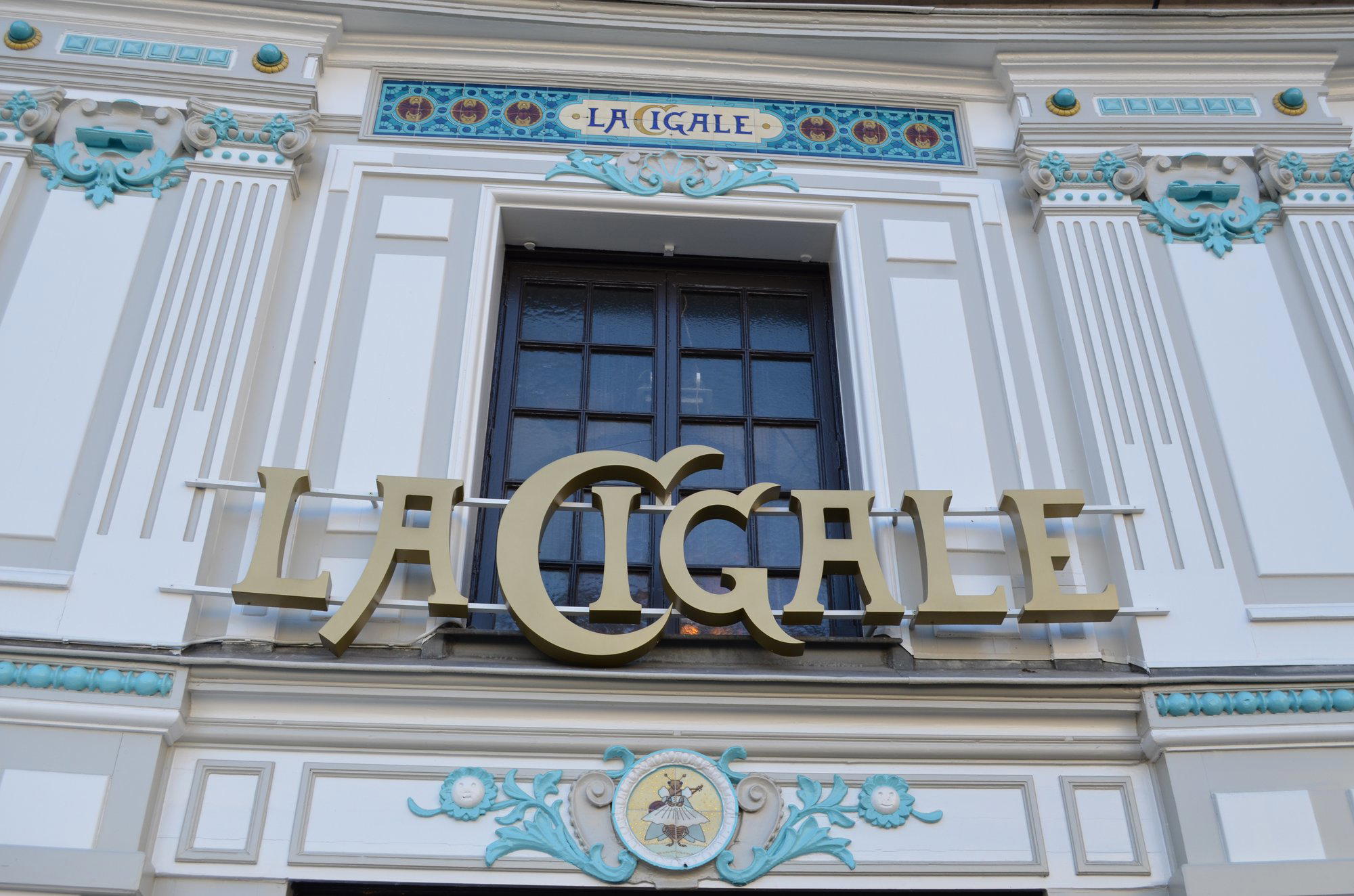
Place Graslin and the Brasserie as Civic Institution
There is a particular kind of French restaurant that functions less as a destination and more as a piece of urban infrastructure. La Cigale, at 4 Place Graslin in Nantes, belongs firmly to that category. The square itself frames the encounter: the neoclassical facade of the Graslin theatre sits directly opposite, and the surrounding blocks make up one of the city's most architecturally coherent quarters. Before you reach the door, the building announces its own age. The exterior tilework and gilded lettering date to 1895, and the interior continues that logic without interruption, a ceiling freighted with painted panels, mirrored walls, carved mahogany, and mosaic floors that have absorbed a century and a quarter of local life. This is the physical environment that defines the meal before a single dish arrives.
Belle Époque brasserie interiors of this completeness are rarer in France than the travel shorthand suggests. Many were stripped or partially modernised in the mid-twentieth century. La Cigale's survival more or less intact gives it a documentary quality: the room functions as evidence of how Nantes ate and gathered at the turn of the last century, when Place Graslin was the social centre of the bourgeois city. Eating here without registering that context is to miss the point of the room.
How the Menu Is Built, and What It Signals
The menu architecture at a brasserie of this type is not incidental. It reflects a set of assumptions about what a room like this is for, who arrives, when, and with what expectations. La Cigale's structure follows the logic of the classic grand brasserie format: a seafood section anchored by plateaux of oysters and shellfish, a grillades section covering meats cooked simply and served with clean accompaniments, and a rotation of regional and seasonal plates that acknowledge the Atlantic larder sitting an hour west. That proximity to the Loire-Atlantique coast, and to the oyster beds of the Pays de la Loire, gives the seafood section a geographic credibility that inland brasseries cannot replicate.
This menu architecture tells you something about the restaurant's self-positioning. It is not reaching toward the tasting-menu format that has become the marker of ambition at the upper end of Nantes dining. Venues like L'Atlantide 1874 - Maison Guého and LuluRouget occupy that register. La Cigale operates in a different mode: à la carte, accessible across multiple courses or a single dish, open across service hours in a way that tasting-menu rooms are not. The format is a statement about hospitality breadth rather than a concession to lower ambition.
Within Nantes' broader dining map, that breadth matters. Freia and Les Cadets represent the creative and modern-bistro registers that have grown through the city in recent years. Le Manoir de la Régate anchors the formal end of the riverine dining corridor. The restaurant does not compete with any of these directly. It occupies the specific position of the historic grand brasserie: a format that France built, exported, and now maintains in only a handful of authentic examples. The room is the offer, and the menu supports it.
The Brasserie in the French Dining Tradition
To understand what the restaurant represents, it helps to place the grand brasserie in its national context. The format came to prominence in the late nineteenth century, driven partly by Alsatian restaurateurs who moved west after 1871 and partly by the expansion of railway networks that made urban dining a middle-class habit. The brasseries that survived that era and held their interiors are now, in effect, monuments with kitchens. France's most cited examples, Bofinger and La Coupole in Paris, Brasserie Georges in Lyon, draw visitors as much for the rooms as for the food. The restaurant occupies a comparable position in Nantes, without the national profile those Parisian addresses carry.
The French culinary tradition that restaurant represents is distinct from the fine-dining lineage tracked by institutions like Michelin. It runs through the civic brasserie rather than the chef-driven tasting room. For reference, the ambitious tasting-menu end of French cuisine in 2024 runs from Mirazur in Menton to Troisgros in Ouches, from Flocons de Sel in Megève to Alléno Paris au Pavillon Ledoyen, and from Bras in Laguiole to AM par Alexandre Mazzia in Marseille. The restaurant does not belong to that conversation, and positioning it there would misrepresent what it is. It belongs to a different, equally French tradition, one where the room, the hour, and the ritual of a long lunch or post-theatre dinner are the organising principle.
That tradition has its own distinguished lineage, and Nantes fits within it. The city's relationship with Atlantic produce, its oysters, its fish, its proximity to the muscadet vineyards, gives the brasserie format here a regional specificity that a Paris grand brasserie, drawing from a more diffuse supply chain, cannot always claim. A plateau de fruits de mer at the restaurant has a direct geographic argument behind it that the room alone does not supply.
Planning a Visit
The restaurant sits on Place Graslin in central Nantes, within walking distance of the main tram lines and the historic centre. The brasserie format means the room operates across broader hours than most destination restaurants in the city, making it viable for lunch, late afternoon, or post-theatre dinner, the Graslin theatre opposite runs an active programme. For visitors building a broader Nantes dining itinerary, the full Nantes restaurants guide maps the city's different registers, from the bistro tier up through the modern and fine-dining rooms.
Beyond Nantes, the French brasserie tradition has its counterparts in the broader canon of French dining heritage. Auberge de l'Ill in Illhaeusern, Au Crocodile in Strasbourg, and Paul Bocuse - L'Auberge du Pont de Collonges represent the Alsatian and Lyonnais currents of French classical dining that share a historical thread with the grand brasserie format. For context in a different cultural register, the French seafood focus at the fine-dining level finds its American parallel in Le Bernardin in New York City, while the experimental edge of modern tasting menus is tracked by Atomix in New York City and Assiette Champenoise in Reims in France.
Recognition Snapshot
Comparable venues nearby, for context on price, style, and recognition.
| Venue | Cuisine | Price | Notes |
|---|---|---|---|
| La CigaleThis venue — the venue you are viewing | Classic French Brasserie | $$ | Not listed |
| La Bourriche | French Seafood Oyster Bar | $$ | Graslin |
| Pilgrim | French Fusion Bistro with Global Street Food | $$ | Graslin |
| Battos | Modern French Bistro | $$ | Hauts-Pavés |
| Le Transition | Modern French Bistronomique | $$ | Centre Ville |
| La Passagère | French Tea House & Bistro | $$ | Graslin |
Continue exploring
More in Nantes
Restaurants in Nantes
Browse all →
Bars in Nantes
Browse all →
Hotels in Nantes
Browse all →

At a Glance
- Romantic
- Classic
- Well Known
- Date Night
- Business Dinner
- Casual Hangout
- Historic Building
- Extensive Wine List
- Local Sourcing
Current opening hours
- Monday
- 7:30 AM–12 AM
- Tuesday
- 7:30 AM–12 AM
- Wednesday
- 7:30 AM–12 AM
- Thursday
- 7:30 AM–12 AM
- Friday
- 7:30 AM–12 AM
- Saturday
- 7:30 AM–12 AM
- Sunday
- 7:30 AM–12 AM
Hours can change for holidays and private events. Last verified .
Exuberant Art Nouveau interior featuring colorful ceramics, mirrors, romantic paintings, and gilded 19th-century opulence.