Our verdict
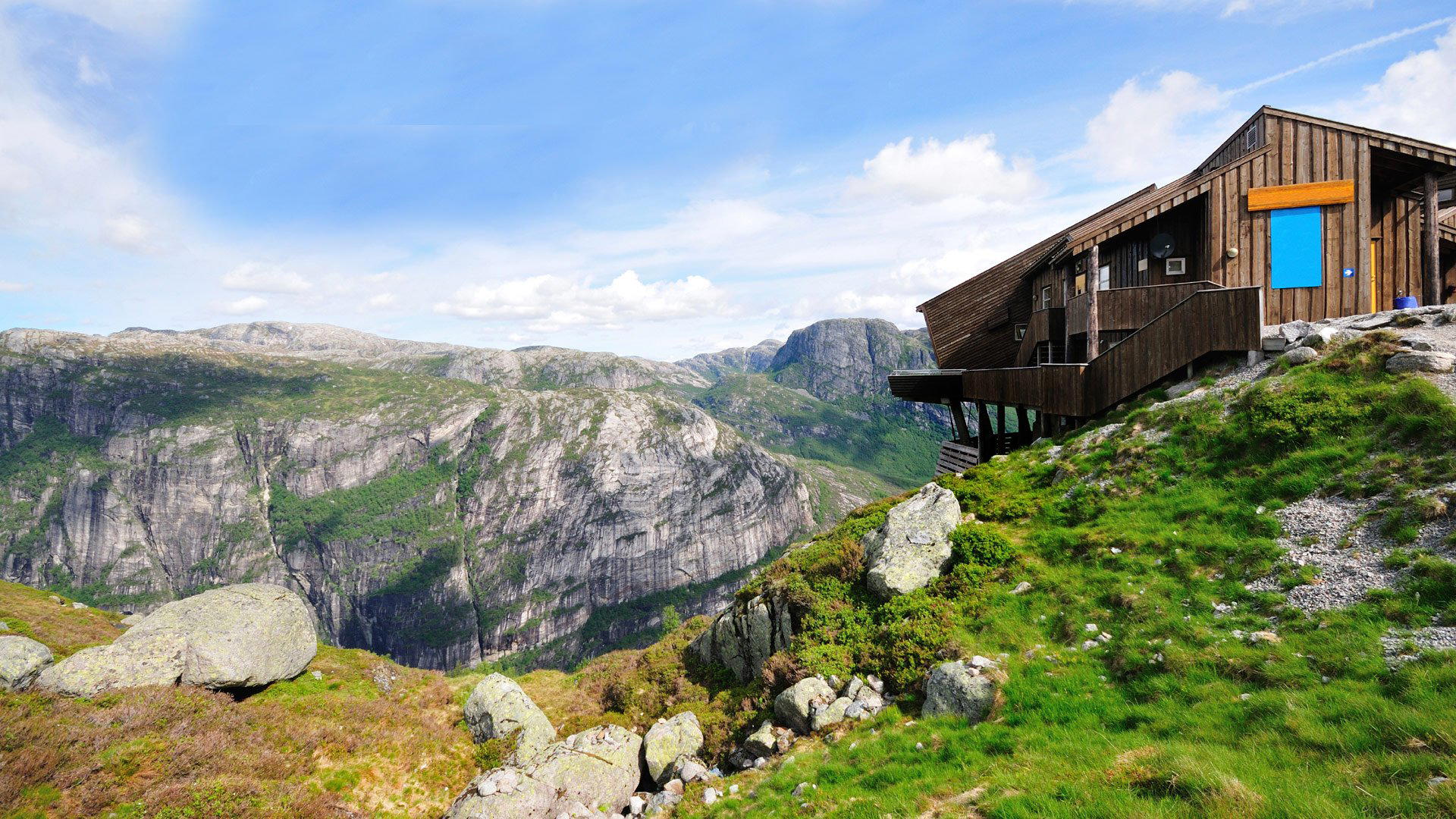
Kjerag Panoramic Restaurant sits at Rv500 in Lysebotn, the remote fjord settlement at the foot of the Kjerag plateau in western Norway. Where most dining rooms compete on technique or provenance, this one competes on position: Lysefjorden stretches below, and the surrounding terrain sets the conditions for what arrives on the plate. For travellers already committed to one of Norway's most demanding natural approaches, it is the logical place to eat.

Pearl is the En Primeur Club membership app, where members save venues, book tables and use the concierge.
The menu
What to order
- Salmon soup
- Burgers
Where the Fjord Sets the Terms
Lysebotn sits at the very end of Lysefjorden, roughly 40 kilometres of water that narrows as it pushes inland through near-vertical granite walls. The road in, Rv500, descends through a series of hairpin bends from the plateau above, and by the time you reach the valley floor, the scale of the surrounding topography has already reordered your sense of proportion. Kjerag Panoramic Restaurant occupies that threshold moment. The setting is not incidental to the experience here; it is structural. The fjord, the altitude, and the seasonal extremes of this part of Rogaland county shape what can be grown, caught, and transported to this address, which in turn shapes what ends up in front of you.
Norway's most serious kitchens, the New Nordic rooms at Maaemo in Oslo and RE-NAA in Stavanger, operate within a sourcing ideology that traces ingredients to specific farms, coastlines, and foragers. At that level, geography is a branding argument. In Lysebotn, geography is simply a constraint: the settlement is small, the access road is seasonal, and the supply chain is short by necessity rather than by philosophy. That distinction matters when reading any menu that arrives here.
Ingredient Logic at the End of the Road
Western Norway's fjord system is one of the most productive cold-water environments in the world. The temperature differential between the deep fjord water and the surface, combined with the tidal exchange with the open North Sea, supports cod, saithe, mackerel, and in season, a range of shellfish that require no long-distance hauling to reach a kitchen in Lysebotn. The mountains above the restaurant contribute something equally important: lamb. Norwegian fjord lamb, particularly from Rogaland, has a reputation built on the specific mineral character of mountain grass and coastal air. Animals that graze at altitude on the plateau terrain surrounding Kjerag develop a density and lean quality that distinguishes them from lowland equivalents.
This is the sourcing logic that underpins dining in remote Norwegian settlements more broadly. Restaurants such as Hardanger House in Jondal and Gaptrast in Bergen operate within the same regional ingredient ecology, drawing on Vestland and Rogaland produce. What distinguishes Lysebotn is the compression: the farm-to-table distance is not a marketing claim but a physical reality of operating where supply options are genuinely limited by road and season.
Norway's coastal dining tradition, visible at places like Anita's Sjømat in Lofoten and Fiskekrogen in Henningsvær, has always positioned fresh-landed fish as the central argument. In Lysebotn, that argument doesn't need making explicitly. The fjord is visible through the window. The fish came from somewhere in that direction. The logic is self-evident.
Context Within Norway's Remote Dining Scene
Norway has developed a scattered but coherent category of restaurants that function as destination dining in remote natural settings. Under in Lindesnes, submerged below the sea surface on Norway's southernmost tip, represents the architectural extreme of this format. Further north, venues like Aurora Restobar in Kirkenes, Underhuset Restaurant in Reine, and Karoline Restaurant in Ramberg follow a similar logic: the journey is part of the proposition, and the setting frames every decision the kitchen makes.
Kjerag Panoramic Restaurant belongs to this group in geographic terms, though its position is among the most extreme. Lysebotn has no through road. You arrive by the switchback descent from the plateau or, seasonally, by ferry along the fjord from Stavanger and Forsand. Either approach takes commitment. The dining room is not a stop on the way to somewhere else; it is a destination that requires deliberate planning.
For comparison, the technically demanding Nordic tasting menus at FAGN in Trondheim or Brasserie 8622 in Mo i Rana serve travellers who have already made significant journeys. The difference at Lysebotn is that the journey itself deposits you into the ingredient source rather than into a city that processes ingredients from elsewhere. That inversion is worth noting.
Planning the Visit
Lysebotn operates on a tight seasonal calendar. Rv500 from Sinnes closes in winter, typically between November and May, depending on snowpack. The ferry service from Stavanger operates a seasonal schedule, making summer and early autumn the viable window for most international travellers. Anyone planning around the Kjerag hike, which draws significant numbers of visitors to the area from late May through September, will find the restaurant in its operational window. Rv500's 27 hairpin bends are not suitable for large vehicles, and the descent requires full attention. Budget the approach into your schedule. For context on Norway's broader restaurant geography, our full Lysebotn restaurants guide maps the settlement's dining options against seasonal access conditions.
Restaurants in this category of remote Norwegian dining serve both day visitors who have arrived for the hike and overnight guests. Neither group should expect a relaxed extended tasting menu format as the default. The practical rhythm of the location, arrival by ferry or mountain descent, activity, then eating, shapes what service looks like. For those accustomed to the structured pace of Atomix in New York City or Le Bernardin in New York City, the register here is considerably different: what matters is produce quality and setting rather than technical elaboration.
Venues like Experience Restaurant in Steinkjer and Umami Harstad in Harstad operate within Norwegian towns that have year-round infrastructure. Lysebotn does not. Confirm current operating status and seasonal hours before travelling, particularly outside the June to September peak. No phone number or booking platform for Kjerag Panoramic Restaurant is publicly listed in available data, so direct verification via local tourism channels for Lysefjorden is advisable. The Børsen Spiseri in Svolvær offers a useful comparison point for understanding how remote Norwegian coastal restaurants manage seasonal operations.
Frequently asked questions
Would Kjerag Panoramic Restaurant be comfortable with kids?
Lysebotn is a working endpoint of a serious mountain road, Rv500 from Sinnes involves switchbacks and seasonal closures, which sets the tone for the visit. The restaurant's remote position at the end of Lysefjorden means travel logistics take planning regardless of group composition. Children who can handle longer journeys and minimal amenity infrastructure will be fine; those expecting conventional family-restaurant conveniences will find this setting demanding. The experience is shaped by the fjord, not by family-friendly programming.
What is the atmosphere like at Kjerag Panoramic Restaurant?
Kjerag Panoramic Restaurant sits where Lysefjorden terminates, flanked by near-vertical granite walls rising from the water. The atmosphere is almost entirely dictated by geography: roughly 40 kilometres of fjord channel frames every sightline. Crowds depend heavily on the season, given that Lysebotn is accessible by road only from roughly May to November and by ferry on a limited schedule. The setting is dramatic in a literal, geological sense.
When is Kjerag Panoramic Restaurant open, and how do you get there?
The restaurant operates seasonally, tied to access conditions at Lysebotn, which sits at the end of Lysefjorden on Rv500. The mountain road from Sinnes is typically closed from November through May depending on snowpack, while ferry service from Stavanger provides an alternative route during the operating season. Visiting outside summer months requires confirming current road and ferry schedules before making plans. The address is Rv500, 4127 Lysebotn, Norway.
What do regulars order at Kjerag Panoramic Restaurant?
Expect the menu to reflect what the surrounding landscape makes available rather than urban import chains. For exact current dishes, the restaurant itself is the right point of contact given the seasonal nature of Lysebotn's operating window.
How do I find Kjerag Panoramic Restaurant?
Kjerag Panoramic Restaurant is located at Rv500, 4127 Lysebotn, Lysebotn.
Should I book Kjerag Panoramic Restaurant in advance?
Yes. Lysebotn operates on a compressed seasonal calendar, Rv500 typically closes between November and May depending on snowpack, and ferry access adds a further scheduling constraint. The number of visitors reaching the valley on any given day is limited by those logistics, which means seating at the restaurant fills within a predictable window. Booking ahead is straightforward planning given the journey involved in reaching Rv500, 4127 Lysebotn.
What makes Kjerag Panoramic Restaurant worth seeking out?
The restaurant occupies one of the most geographically committed positions in Norwegian dining: the terminus of Lysefjorden, accessible only via a mountain road closed for roughly half the year or by seasonal ferry. Norway has a coherent category of remote destination restaurants that function because the natural setting is the primary draw, and Kjerag Panoramic sits at an extreme end of that spectrum. The effort of reaching Lysebotn is part of the proposition, this is not a restaurant you pass on the way to somewhere else.
How It Stacks Up
| Venue | Cuisine | Price | Awards | Notes |
|---|---|---|---|---|
| Kjerag Panoramic RestaurantThis venue (the venue you are viewing) | Norwegian Cafe Fare | Not listed | Not listed | Not listed |
| Maaemo | New Nordic Fine Dining | $300–500 | 3 Michelin Stars · World's 50 Best #47 | New Nordic, Modern Cuisine |
| RE-NAA | Modern Nordic Coastal Tasting Menu | $500+ | 3 Michelin Stars · La Liste Top Restaurants | New Nordic, Creative |
| Kontrast | Modern Nordic Fine Dining | $200–300 | 2 Michelin Stars · La Liste Top Restaurants | New Nordic, Scandinavian |
| FAGN | Modern Nordic Fine Dining | $200–300 | 1 Michelin Star · Star Wine List | Nordic, Modern Cuisine |
| Speilsalen | Contemporary Norwegian Seafood Fine Dining | $200–300 | 1 Michelin Star · Star Wine List | Nordic, Contemporary |
Details
- Scenic
- Rustic
- Quiet
- Casual Hangout
- Panoramic View
- Standalone
- Mountain
- Waterfront
- A La Carte
- Vegan Options
Casual, scenic mountain-cafe atmosphere focused on the dramatic fjord and plateau views rather than formal dining.