Our verdict
Børsen Spiseri sits at Gunnar Bergs vei 2 in Svolvær, the commercial heart of the Lofoten Islands, where the working waterfront and the dining table have always operated in close proximity. The kitchen draws from one of Norway's most productive fishing grounds, positioning it within a regional tradition where ingredient provenance is not a selling point but a structural fact of the menu.

Pearl is the En Primeur Club membership app, where members save venues, book tables and use the concierge.
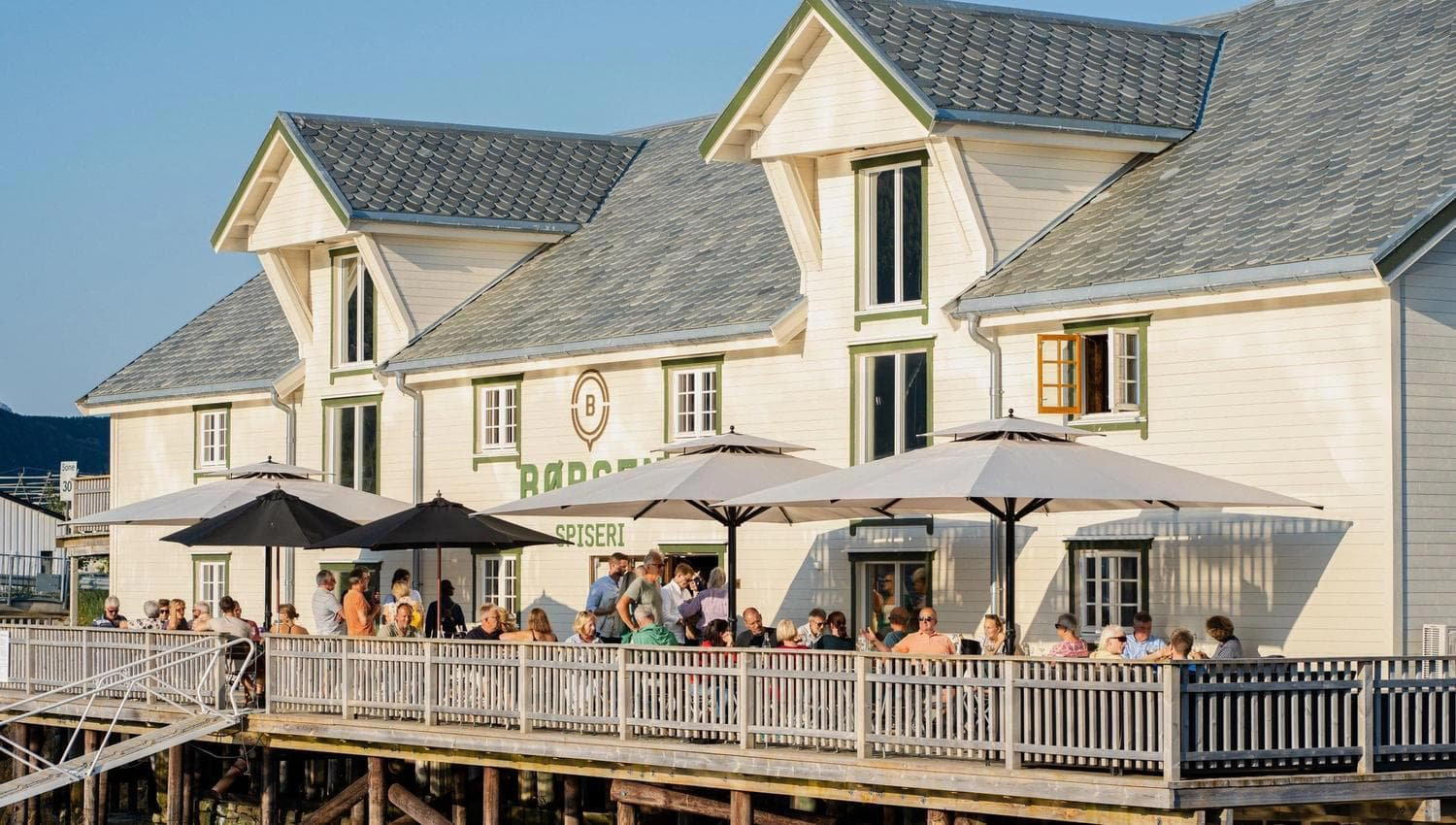
Fishing Grounds at the Table: Svolvær's Waterfront Dining Tradition
Few places in Norway make the connection between sea and plate as literal as Svolvær. The town sits at the centre of the Lofoten archipelago, a chain of islands that has supplied cod, skrei, and Arctic char to European markets for over a thousand years. Restaurants operating here do not source from distant suppliers and market it as provenance storytelling; the fish landed at Svolvær's docks can reach a kitchen within hours. Børsen Spiseri, at Gunnar Bergs vei 2, occupies a position inside that tradition. For context on the full range of dining options in the area, see our full Svolvær restaurants guide.
The building itself sets the tone before you sit down. Lofoten's waterfront architecture tends toward the functional: timber warehouses, harbour equipment, working structures that predate the tourism economy. Dining rooms carved from these spaces carry a particular atmosphere that purpose-built restaurants rarely replicate. The sense of place is material, not decorative.
What Lofoten Puts on the Menu
The ingredient story at a Lofoten restaurant begins offshore. Skrei, the migratory Northeast Arctic cod that travels from the Barents Sea to spawn in Lofoten waters between January and April, is arguably Norway's most important seasonal ingredient. It has a firmer, leaner texture than year-round cod, and the fishery has operated under strict quotas since the late twentieth century. A kitchen in Svolvær that uses skrei in season is working with material that restaurants elsewhere in Norway, let alone Europe, receive days later and at a grade or two removed.
Beyond cod, the archipelago produces king crab from the northern waters, scallops from the cold fjord beds, and a range of smaller species that tend not to travel well. This creates a natural menu structure that is seasonal by necessity rather than by fashion. What the week's catch delivers is, to a meaningful degree, what the week's menu reflects. Compare this with the New Nordic canon at places like Maaemo in Oslo or RE-NAA in Stavanger, where the sourcing ambition is structurally similar but the geography demands more complex logistics. Lofoten restaurants operate closer to the source by default.
That proximity shapes not just what appears on the plate but how it is prepared. When the raw material is this fresh, aggressive technique becomes counterproductive. The cooking traditions of northern Norway lean toward approaches that preserve rather than transform: light curing, smoking over local wood, and preparations that let temperature and texture carry the dish. Whether Børsen Spiseri follows this pattern closely or diverges from it is something the menu itself would confirm, but the context it operates in makes restraint a logical default.
Svolvær's Place in Norway's Dining Geography
Norway's serious restaurant culture has historically concentrated in its four largest cities. Speilsalen in Trondheim, Lysverket in Bergen, and the Oslo new Nordic tier represent the award-recognised end of the spectrum. But a second geography has been developing along the coast and in the fjord towns, where the sourcing conditions that urban restaurants strain to achieve exist as a baseline. Under in Lindesnes, Glime Restaurant in Hardanger Fjord, and MiraBelle by Ørjan Johannessen in Bekkjarvik all operate within this coastal tier, where the argument for destination dining rests on ingredient access rather than urban critical mass.
Closer to Svolvær, Restaurant 1893 in Stokmarknes represents the Vesterålen equivalent, and the broader northern Norwegian dining scene includes addresses across a wide geographic spread. The pattern holds: small towns, working harbours, kitchens that draw their authority from what comes off the boats rather than from imported prestige. For wider Norwegian context, the range extends south to spots like Buer Restaurant in Odda, Vianvang in Vågå, and Hvelvet in Lillehammer, each operating within their own regional sourcing logic.
Approaching the Address
Svolvær is accessible by ferry from the Norwegian mainland or by short-haul flight to Svolvær Airport Helle, which receives connections from Bodø. The town is compact enough that most harbour-area addresses are walkable from central accommodation. Gunnar Bergs vei runs along the waterfront, and the surrounding area carries the character of an active fishing port that has adapted, rather than reinvented itself, for visitors. The neighbouring restaurant Ni Hao represents the diversity of the local dining offer, reflecting how even small Lofoten towns now carry a range of kitchen traditions alongside the local seafood core.
Svolvær rewards visits timed to the skrei season, roughly January through April, when the fishing activity is at its peak and the menus of harbour restaurants reflect the best of what the waters produce. Summer brings the midnight sun and a different character entirely, with longer days drawing a larger visitor population and a shift in the seasonal ingredients available. Winter dining here has a particular quality that summer cannot replicate: fewer tourists, a working-town atmosphere, and a menu shaped by one of the most significant fish migrations in the North Atlantic.
Where Børsen Spiseri Sits in the Picture
A waterfront address in a working Lofoten harbour does not require the same infrastructure as a tasting-menu restaurant in Oslo or the kind of technical precision tracked at places like Le Bernardin in New York City or Lazy Bear in San Francisco. What it requires is a kitchen that does not squander what arrives at the door. The competitive set for Børsen Spiseri is not the Michelin-starred Norwegian tier; it is the community of harbour-town restaurants that have learned to let geography do the work. That is a different discipline, but not a lesser one.
For visitors building a broader Norwegian itinerary, the Lofoten stop sits naturally alongside other destination-driven addresses. Inland options such as Boen Gård in Tveit, Smag & Behag Grimstad in Grimstad, or Lily Country Club in Kløfta each make their own case within their regional context. But for a table where the fish on the plate was swimming in sight of the windows a few hours earlier, Svolvær's waterfront addresses hold a structural advantage that itinerary-planning makes difficult to ignore.
Frequently asked questions
Can I bring kids to Børsen Spiseri?
Børsen Spiseri sits at Gunnar Bergs vei 2 in Svolvær, a working harbour town rather than a formal dining destination, which generally signals a more relaxed atmosphere suited to families. The Lofoten seafood context, cod, Arctic fish, harbour views, tends to engage younger visitors with a direct connection to the fishing culture outside the window. check the venue's official channels to confirm any specific arrangements for children before your visit.
What's the overall feel of Børsen Spiseri?
The address on Gunnar Bergs vei places the restaurant within Svolvær's working waterfront, and that setting shapes the tone: this is a harbour-side dining room in one of Norway's most active fishing communities, not a tasting-menu environment built around formality. Lofoten's restaurant culture draws from the sea first, and the atmosphere at a venue like this reflects that directness. Expect a setting where the proximity to the source of the ingredients is the defining characteristic.
Is Børsen Spiseri a good base for eating well during a skrei season trip to Lofoten?
Svolvær is the commercial and logistical centre of the Lofoten archipelago, making it the most practical base for a skrei-focused visit to the region, the cod arrives to spawn in Lofoten waters between January and April, and local restaurants source it directly from the fleet. Børsen Spiseri's waterfront position on Gunnar Bergs vei places it within the harbour activity that defines that season. For travellers building an itinerary around Arctic cod at its source, Svolvær and its restaurants represent the most direct access point in Norway.
What do regulars order at Børsen Spiseri?
Svolvær sits at the centre of the Lofoten archipelago, where skrei, the migratory Northeast Arctic cod that travels from the Barents Sea to spawn, is the defining seasonal ingredient and the dish any serious repeat visitor tracks. Beyond skrei season, the broader Arctic seafood supply means the menu rotates around what the surrounding waters produce. For current dishes and availability, checking directly with the restaurant is the most reliable approach.
Where is Børsen Spiseri located?
Børsen Spiseri is located at Gunnar Bergs vei 2, 8300 Svolvær, Norway, Svolv R.
Can I walk in to Børsen Spiseri?
Svolvær is a small town and Børsen Spiseri at Gunnar Bergs vei 2 is a known waterfront address, but Lofoten's visitor numbers spike sharply in summer and during skrei season in late winter and spring, when demand at local restaurants outpaces capacity. Walk-in availability is plausible outside peak periods; during high season, advance booking reduces risk significantly. check the venue's official channels to confirm current reservation policy.
Comparable Spots, Quickly
Comparable venues nearby, for context on price, style, and recognition.
| Venue | Cuisine | Price | Notes |
|---|---|---|---|
| Børsen SpiseriThis venue (the venue you are viewing) | Norwegian Seafood with Stockfish Specialty | Not listed | Not listed |
| Ni Hao | Chinese and Asian | Not listed | Svolvær |
| Restaurant Bro | Modern Norwegian Coastal Gastronomy | Not listed | city center |
| Renaa: Restauranten | Modern New Nordic Seafood Tasting | Not listed | downtown |
| Gabba Restaurant | Arctic Nordic Grill | $50–100 | Kirkenes |
| Fiskeriet | Norwegian Seafood | $20–30 | Gardermoen Airport |
Continue exploring
More in Svolvær
Restaurants in Svolvær
All restaurants in Svolvær →
Hotels in Svolvær
Browse all →
Details
- Historic
- Rustic
- Cozy
- Scenic
- Family
- Group Dining
- Special Occasion
- Historic Building
- Waterfront
- Local Sourcing
- Waterfront
- A La Carte
- Set Menu
- Gluten Free Options
Current opening hours
- Monday
- 5–9 PM
- Tuesday
- 5–9 PM
- Wednesday
- 5–9 PM
- Thursday
- 5–9 PM
- Friday
- 5–9 PM
- Saturday
- 5–9 PM
- Sunday
- 5–9 PM
Hours can change for holidays and private events. Hours as of .
Historic atmosphere preserved from 1828 warehouse with aroma of tar and rope, providing a rustic and authentic Lofoten fishing heritage feel.