Our verdict
In Kirkenes, where the Barents Sea meets the Russian border, Aurora Restobar occupies a position at Dr. Wessels gate 7 that few dining rooms in Norway can match for sheer geographic drama. The kitchen draws from one of Europe's most remote larders: Arctic fish, Sami-influenced preservation traditions, and a supply chain shaped more by season and ice than by any distributor's catalogue. For a town of fewer than 4,000 people, the ambition is quietly serious.

Pearl is the En Primeur Club membership app, where members save venues, book tables and use the concierge.
Where the Arctic Larder Begins
Most Norwegian restaurant conversations start in Oslo and work outward. Our full Kirkenes restaurants guide makes the case that the reverse journey is worth attempting: that the far northeast, pressed against Finland and Russia at the 70th parallel, operates by a different set of ingredient rules than anything available to a kitchen in Bergen or Stavanger. Aurora Restobar, at Dr. Wessels gate 7 in Kirkenes, sits inside that logic. The food here is not an approximation of New Nordic as it is practised further south. It is a direct consequence of what the Barents Sea, the surrounding tundra, and the Sami food traditions of Finnmark actually produce.
Kirkenes itself is a border town in the full sense: goods, people, and food cross between Norway and Russia here with a frequency that shapes local culture visibly. The fish market vocabulary is different. The smoking and fermentation traditions carry Central and Northern European inflections that you will not find in Lysverket in Bergen or Speilsalen in Trondheim. A restobar format in this context is not a casual hedge; it is a practical response to a small population that needs a room to function across lunch, dinner, and the long evening that polar darkness encourages.
Arctic Sourcing and Why It Shapes Everything
The editorial case for taking ingredient sourcing seriously in Kirkenes is stronger than almost anywhere in Norway. The Barents Sea yields some of the most sought-after cold-water species on the European market: king crab, Atlantic cod, haddock, and wolf fish are caught at volumes and in conditions that give them a density and flavour profile noticeably different from warmer-water equivalents. Norwegian king crab, introduced to the Barents in the 1960s by Soviet scientists and now a fixture of the local economy, is available to Kirkenes kitchens at a proximity that southern restaurants cannot replicate. When Maaemo in Oslo or RE-NAA in Stavanger build dishes around Arctic seafood, that product has already travelled. In Kirkenes, the supply chain is measured in hours and kilometres rather than days.
Beyond seafood, Finnmark's reindeer herding culture, still primarily Sami-managed, puts high-altitude, slow-grazed meat into local kitchens that carry a provenance specific to this latitude. The growing season is short and extreme, which concentrates flavours in root vegetables, berries, and foraged greens in ways that lower-latitude produce does not. Cloudberries, crowberries, and Arctic thyme are not imported ingredients here; they are seasonally gathered within the region. A kitchen that understands this supply geography does not need to perform sourcing credentials. They are simply unavoidable.
This is the sourcing context that frames what Aurora Restobar can offer that comparable restobar formats elsewhere in Norway cannot straightforwardly replicate. The comparison with ambitious small-town Norwegian restaurants such as Restaurant 1893 in Stokmarknes or Vianvang in Vågå is instructive: each operates in a regional larder with distinct character, but Kirkenes occupies the most extreme and the most geopolitically particular of those larders.
The Room and the Format
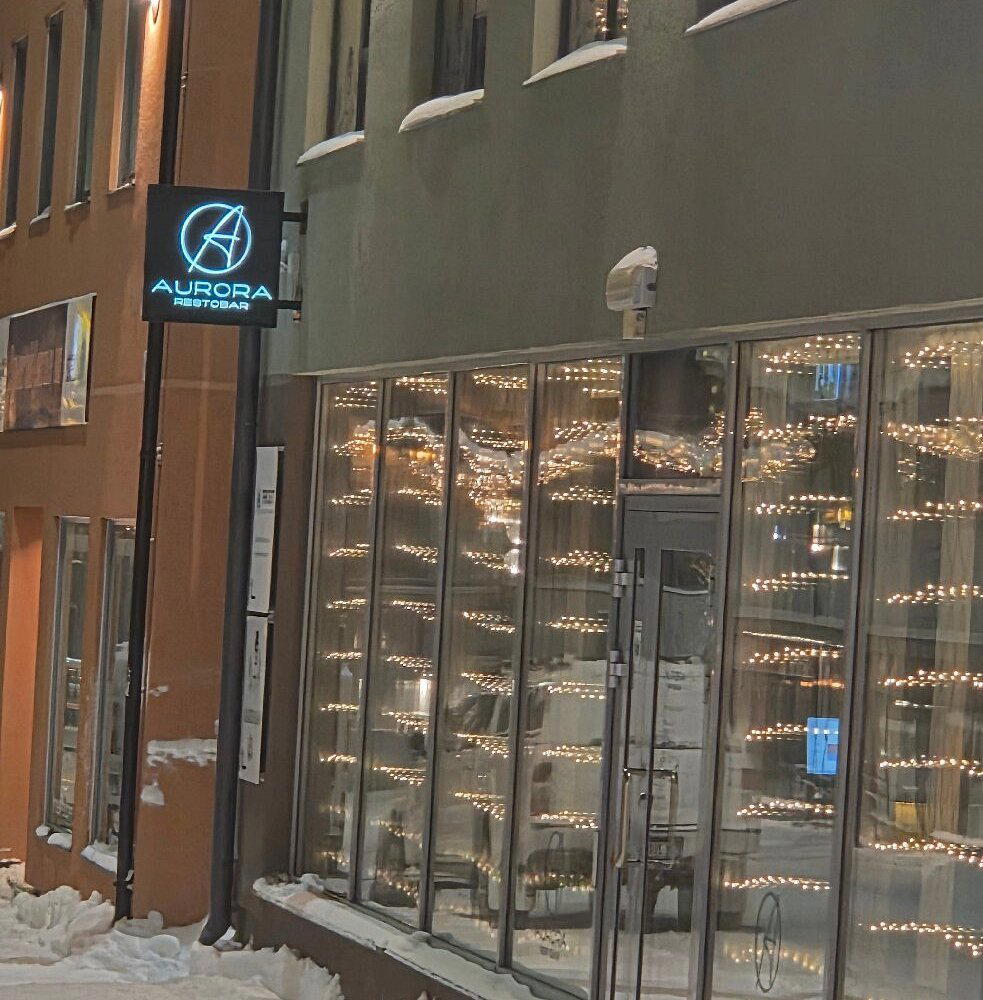
Approaching Dr. Wessels gate 7 in winter, Kirkenes communicates its latitude without subtlety. Darkness settles by early afternoon between November and January, and the aurora borealis is a functional weather event rather than a tourist abstraction. The naming is literal. A restobar format, with its implied flexibility between drinking and eating, suits a town where the evening is long and the population small enough that rigid seatings and tasting-menu formality would narrow the audience to an impractical degree.
Norway's most decorated restaurants, from Under in Lindesnes to Glime Restaurant in Hardanger Fjord, have demonstrated that serious cooking does not require an urban address. What they share with a venue like Aurora Restobar is a dependence on a specific geography for their identity. The format difference, a restobar rather than a destination tasting counter, reflects a different set of operational and community constraints rather than a lower level of culinary seriousness.
For the visiting traveller, the restobar model offers practical flexibility. You are not committing to a multi-hour prix-fixe sequence. You can eat at the bar, order in parts, or build an evening around drinks and a few plates rather than a structured progression. In a remote Arctic town where your other evening options are limited, that flexibility is a feature of the format rather than a compromise.
Kirkenes in the Norwegian Dining Picture
Norway's restaurant conversation has expanded significantly in the past decade. The concentration of Michelin attention in Oslo, Bergen, and Stavanger is giving way to recognition that serious cooking exists across the country, from MiraBelle by Ørjan Johannessen in Bekkjarvik to Buer Restaurant in Odda and Hvelvet in Lillehammer. Kirkenes sits at the furthest edge of that expanding map. It does not position itself within the decorated circuit; it operates in a category defined by geography rather than by awards infrastructure.
The closest peer in Kirkenes's immediate dining environment is Gabba Restaurant, which serves the same small-city market and draws from the same regional larder. The two venues together constitute the upper tier of Kirkenes dining, a thin bracket by southern Norwegian standards but a genuine one given the town's scale. Visitors with reference points from high-end Scandinavian dining at places like Lily Country Club in Kløfta or Boen Gård in Tveit will find the register different rather than lesser. Kirkenes formats their ambition around a different set of constraints and a different kind of ingredient access.
For travellers arriving from beyond Norway, Aurora Restobar occupies a bracket that has no direct international equivalent. The combination of Barents Sea access, Sami food culture, and Russian border geography produces a sourcing context that distinguished restaurants from Le Bernardin in New York City to Lazy Bear in San Francisco can reference but cannot replicate.
Planning Your Visit
Kirkenes is served by Widerøe and SAS from Oslo and Tromsø, with Kirkenes Airport (KKN) placing the town centre within a short transfer. The town itself is compact enough that Dr. Wessels gate 7 is reachable on foot from the main accommodation cluster. The practical window for combining a Kirkenes visit with aurora viewing runs from late September through March, when darkness is sufficient and solar activity is unobstructed by the midnight sun. Visiting during this period also aligns with the peak season for king crab safaris, a regional draw that has built Kirkenes a tourism identity beyond its military and border history. For a dining visit, the restobar format means that advance booking requirements are likely more relaxed than at tasting-menu-only venues further south, though Kirkenes's limited total accommodation stock means that travel planning, rather than table availability, is typically the binding constraint.
Frequently asked questions
Is Aurora Restobar child-friendly?
Nothing in the venue's publicly documented profile explicitly addresses a children's menu or family seating policy. That said, Kirkenes at Dr. Wessels gate 7 is a small Arctic town rather than a metropolitan dining destination, and restobar formats in comparable Norwegian towns generally accommodate families outside peak evening service. check the venue's official channels to confirm arrangements before visiting with younger guests.
Is Aurora Restobar formal or casual?
Aurora Restobar sits in Kirkenes, a working Arctic town at Norway's northeastern edge, which sets the tone: expect a relaxed register rather than a formal dining room. The restobar format signals a hybrid of restaurant and bar, typically favouring a come-as-you-are approach. Dress codes are not documented so erring toward comfortable layers appropriate for the Arctic climate is practical.
Does Aurora Restobar make sense as a dinner stop when visiting Kirkenes for northern lights tours?
Aurora Restobar's address at Dr. Wessels gate 7 places it in central Kirkenes, within straightforward reach of the town's main accommodation and tour departure points. Northern lights tour operators typically run late evening departures, making an early dinner in Kirkenes centre a logical pre-tour anchor. The restobar format suggests food and drinks service rather than a lengthy tasting-menu commitment, which suits the timing constraints of aurora-chasing itineraries.
What do regulars order at Aurora Restobar?
Given Kirkenes's position on the Barents Sea, a kitchen drawing on local sourcing would logically feature regional seafood, including cod and king crab, which define the Finnmark larder. Verify the current menu with the venue directly.
Where is Aurora Restobar located?
Aurora Restobar is located at Dr. Wessels gate 7, 9900 Kirkenes, Norway, Kirkenes.
What's the best way to book Aurora Restobar?
Phone and website details are not currently listed in Aurora Restobar's public profile. For a town of Kirkenes's size, arriving in person or reaching out through the venue's social media presence are practical starting points. Given that Kirkenes sees concentrated visitor traffic during northern lights season, reservations ahead of peak winter months are advisable.
Fast Comparison
Comparable venues nearby, for context on price, style, and recognition.
| Venue | Cuisine | Price | Notes |
|---|---|---|---|
| Aurora RestobarThis venue (the venue you are viewing) | Scandinavian Fusion Gastropub | Not listed | Not listed |
| Gabba Restaurant | Arctic Nordic Grill | $50–100 | Kirkenes |
| Krambua Restaurant | Scandinavian | $20–30 | Trondheim |
| Brasserie Posten | Norwegian Brasserie | $30–50 | Geiranger sentrum |
| Ni Hao | Chinese and Asian | Not listed | Svolvær |
| Thai City Wok | Asian Fusion Wok & Grill | Not listed | Alesund |
Continue exploring
More in Kirkenes
Restaurants in Kirkenes
All restaurants in Kirkenes →
Details
- Cozy
- Trendy
- Casual Hangout
- Date Night
- Craft Cocktails
- Local Sourcing
- A La Carte
- Cocktails
- Vegetarian Friendly
Current opening hours
- Monday
- Closed
- Tuesday
- 3–10 PM
- Wednesday
- 3–10 PM
- Thursday
- 3–10 PM
- Friday
- 3–11 PM
- Saturday
- 3–11 PM
- Sunday
- Closed
Hours can change for holidays and private events. Hours as of .
Friendly and welcoming atmosphere with good service.