Our verdict
A running sushi and wok restaurant on Jernbanegade in central Roskilde, King Running Sushi & Wok draws a loyal local crowd to its continuous belt format and wok-cooked dishes. The format rewards patience and repeat visits: regulars develop a working knowledge of the rotation that first-timers lack. For Roskilde's mid-range dining scene, it occupies a practical, familiar niche.

Pearl is the En Primeur Club membership app — saves, bookings, and concierge access live there. Same editors, same standards.
- Address
- Jernbanegade 3D, 4000 Roskilde, Denmark
- Phone
- +4552525268
- Hours
- Daily 12–10 PM
- Website
- king4000.dk
- Directions
- Get directions
- Booking
- Book on the venue's website
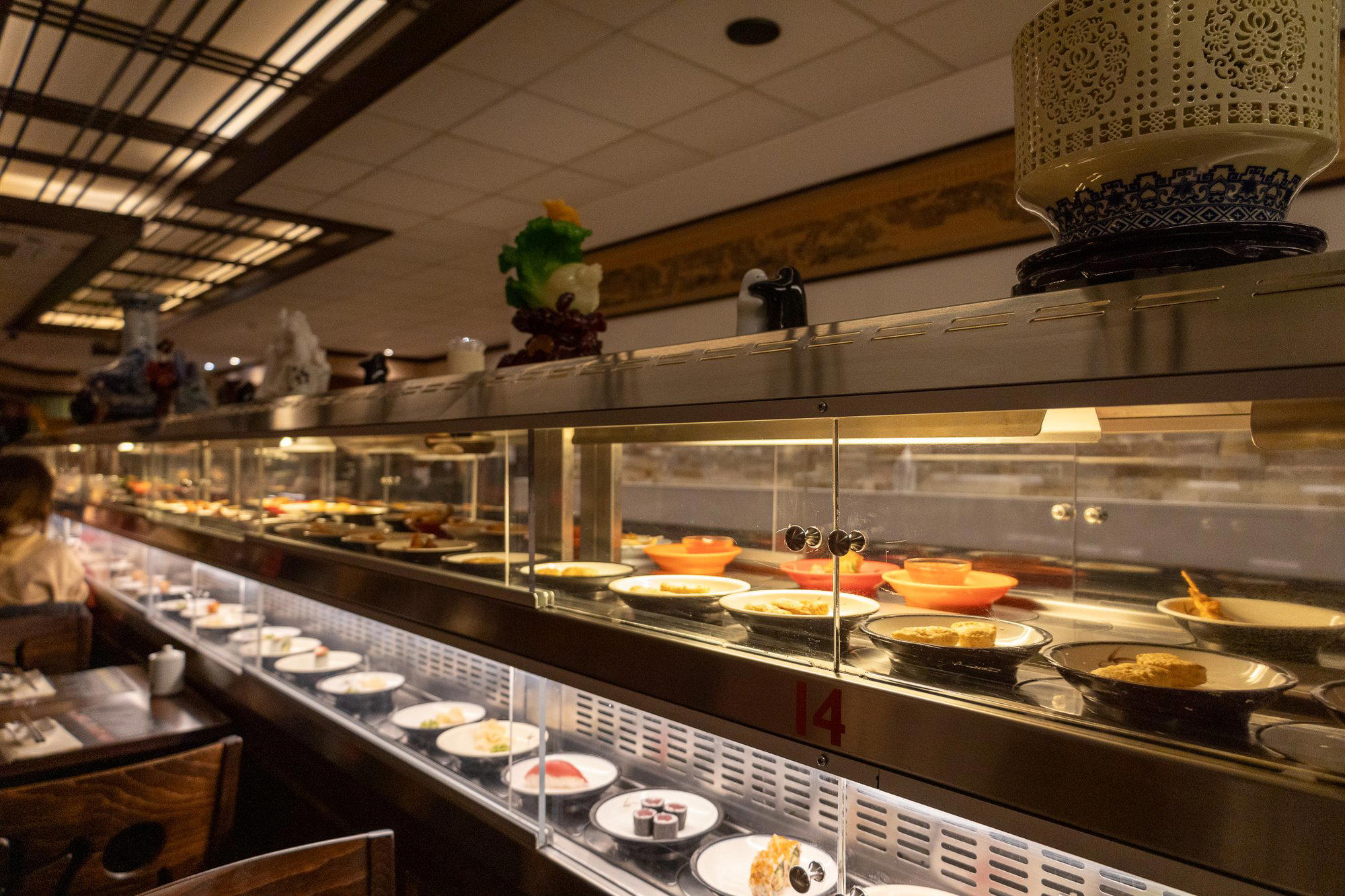
The Belt, the Bowl, and the Return Visit
Running sushi — the conveyor-belt format that originated in postwar Japan and spread across Scandinavia through the 1990s and 2000s — rewards a particular kind of diner: one who shows up more than once. The format is democratic by design, pricing and pacing both set by the rotation, but the regulars at any given running sushi restaurant hold an invisible advantage. They know which plates cycle fastest, which combinations work leading together, and at what point in the evening the kitchen sends out its more considered preparations. At King Running Sushi & Wok on Jernbanegade in central Roskilde, that accumulated knowledge is exactly what keeps a core clientele returning.
Roskilde's dining scene sits at a distance from the Michelin attention concentrated in Copenhagen, where restaurants like Geranium in Copenhagen and Jordnær in Gentofte command international recognition. Provincially, Denmark's award circuit extends to places like Frederikshøj in Aarhus, Alimentum in Aalborg, and ARO in Odense. Roskilde, a cathedral city of around 50,000 residents roughly 30 kilometres west of central Copenhagen, operates in a different register entirely, one defined less by destination dining and more by the practical rhythms of a local population that wants reliable, affordable meals within the city's relatively compact restaurant corridor.
What Regulars Already Know
The running sushi format creates its own subculture of return visitors. Unlike a static menu where a first-time diner can scan the whole offer in minutes, a conveyor belt reveals itself over time: the rotation changes, the kitchen's pace shifts across a service, and the wok-cooked dishes add a parallel track that operates outside the belt entirely. Regulars at running sushi restaurants across Scandinavia tend to develop what might be called an informal mental map, an understanding of which stations on the belt correspond to what comes next, and which wok dishes pair well with a lighter plate from the conveyor.
King Running Sushi & Wok combines these two formats under one roof, a pairing common enough in Denmark's Asian-influenced casual dining sector but one that expands the effective choice considerably. The wok component introduces hot, freshly cooked preparations into a format otherwise defined by room-temperature and chilled plates. For regulars, the ability to move between belt and wok, treating them as two distinct registers within the same meal, is part of the appeal. For first-timers, that same flexibility can feel unfocused until the logic of the combination becomes clearer.
Roskilde has several points of comparison in the mid-range and casual dining tier. Aji Sushi offers a more conventional sushi-focused format, while An No covers Vietnamese and broader Asian ground. Bash Burger & Grill and Basilico anchor the casual Western side of the local offer, and Bella Capri covers Italian. Within that field, the running sushi format occupies a specific niche: it is inherently social and communal, suited to groups and families, and its pricing structure makes it accessible for repeat visits in a way that à la carte dining is not.
Format as the Experience
The conveyor belt is worth taking seriously as a dining format, not simply as a delivery mechanism. In Japan, kaiten-zushi (the original rotating sushi format, introduced at Osaka's Mawaru Genroku Sushi in 1958) was designed to lower barriers to sushi consumption by removing the one-on-one dynamic of counter ordering. The format spread globally precisely because it transferred control to the diner: no interaction required, no menu literacy needed, no awkwardness about pace. Scandinavian running sushi restaurants adapted the format for local tastes through the 1990s, broadening the selection beyond strictly Japanese preparations and often combining it with buffet or wok elements to increase volume and variety.
That evolution is visible in venues like King Running Sushi & Wok, where the wok component represents the Scandinavian adaptation of the format rather than a departure from it. The combination has proven durable in Danish casual dining because it addresses a practical problem: the belt alone may not satisfy every appetite or preference at a table, particularly in a group with mixed tastes. Adding a wok section raises the floor on what the kitchen can offer without abandoning the simplicity and self-paced nature that makes the belt format popular in the first place.
For a broader perspective on destination-level dining across Denmark, venues such as Henne Kirkeby Kro in Henne, Dragsholm Slot Gourmet in Hørve, Frederiksminde in Præstø, LYST in Vejle, and Domæne in Herning represent the fine dining and gourmet tier. The contrast matters: running sushi venues operate in an entirely different economy of scale, expectation, and occasion. Internationally, the gap between casual belt formats and high-end Japanese counter dining is even starker, as evidenced by the tasting-menu world represented by venues like Le Bernardin in New York City or the Korean fine dining precision of Atomix in New York City. King Running Sushi & Wok makes no claim to that tier and is not positioned against it.
Planning a Visit: What to Know Before You Go
King Running Sushi & Wok is located at Jernbanegade 3D in central Roskilde, within walking distance of Roskilde Station, which sits on the main rail line between Copenhagen Central Station and Odense, making it direct to reach from Copenhagen in under 30 minutes by regional train. For visitors already in Roskilde for the cathedral, the Viking Ship Museum, or the annual Roskilde Festival, the address puts it conveniently within the city's commercial centre.
As with most running sushi venues in Denmark, this is not a restaurant where advance booking is likely to be the primary constraint. The format is built for walk-in traffic and group visits, and the communal, continuous nature of the belt makes it naturally accommodating to varying group sizes. Those planning a visit during peak evening hours, particularly on weekends or during the Roskilde Festival period in late June and early July when the city's population temporarily increases, may find queues or a wait for larger tables. Coming earlier in the evening or mid-week removes that variable entirely.
For a fuller picture of what Roskilde's dining scene offers across cuisines and price points, the full Roskilde restaurants guide covers the city's range from casual to more considered options.
Frequently asked questions
How do I find King Running Sushi & Wok?
King Running Sushi & Wok is located at Jernbanegade 3D, 4000 Roskilde, Denmark, Roskilde.
Is King Running Sushi & Wok a good option for groups visiting Roskilde?
The kaiten format at King Running Sushi & Wok on Jernbanegade 3D suits groups well because each diner self-selects from the belt rather than agreeing on a shared order. Its position in central Roskilde, within walking distance of Roskilde Station, makes it a practical stop for groups arriving by rail from Copenhagen or elsewhere on the main line. No chef tasting-menu commitment is required, which keeps the format flexible for varied appetites.
What should I eat at King Running Sushi & Wok?
The format at Jernbanegade 3D combines two distinct tracks: sushi plates circulating on the conveyor belt and wok-prepared hot dishes. In a running sushi setting, the practical approach is to pace yourself across both sides of the menu rather than loading up on the first plates that pass. The wok section typically offers a counterpoint to the cold belt items, useful for rounding out the meal.
How far ahead should I plan for King Running Sushi & Wok?
King Running Sushi & Wok is located at Jernbanegade 3D in central Roskilde, close to Roskilde Station, which makes it accessible without advance logistical planning. Walk-in capacity varies by day and time, so evenings and weekends typically warrant earlier arrival.
What's King Running Sushi & Wok best at?
The conveyor-belt format is the defining feature here: it allows diners to sample broadly across the menu at their own pace rather than committing to a fixed set. That structure suits groups with mixed preferences, since each person selects independently from the rotating belt. The addition of a wok component gives the menu a hot-dish dimension that most sushi-only belt restaurants in Scandinavia omit.
Cuisine and Recognition
Comparable venues nearby, for context on price, style, and recognition.
| Venue | Cuisine | Price | Notes |
|---|---|---|---|
| King Running Sushi & WokThis venue — the venue you are viewing | Running Sushi & Asian Buffet | $20–30 | Not listed |
| Zhiki Sushi | Japanese Sushi | Not listed | Ro's Torv |
| Sushi2500 Roskilde | Contemporary Sushi | $20–30 | central Roskilde |
| Umamii Sushi | Japanese Sushi Fusion | Not listed | Roskilde |
| Namaste | Authentic North Indian Cuisine | $20–30 | Roskilde city center |
| Nua Mama's Secret | Authentic Thai | $20–30 | Roskilde |
Continue exploring
More in Roskilde
Restaurants in Roskilde
Browse all →
Bars in Roskilde
Browse all →
Hotels in Roskilde
Browse all →
Wineries in Roskilde
Browse all →
Details
- Lively
- Casual
- Family
- Group Dining
- Casual Hangout
- Buffet
- Vegetarian Friendly
Current opening hours
- Monday
- 12–10 PM
- Tuesday
- 12–10 PM
- Wednesday
- 12–10 PM
- Thursday
- 12–10 PM
- Friday
- 12–10 PM
- Saturday
- 12–10 PM
- Sunday
- 12–10 PM
Hours can change for holidays and private events. Last verified .
Relaxed and casual atmosphere next to the train station with a lively buffet setup.