
Tabelog 100 #76
Our verdict
A low-cost udon address near Kushida Shrine, Karo No Uron sits in Fukuoka’s everyday noodle culture rather than its special-occasion dining circuit. Tabelog selected it for the 2024 Udon WEST 100, and the appeal is practical: wheat noodles, rice balls and soba in a small, cash-only room where the bill stays under JPY 999.

Pearl is the En Primeur Club membership app, where members save venues, book tables and use the concierge.
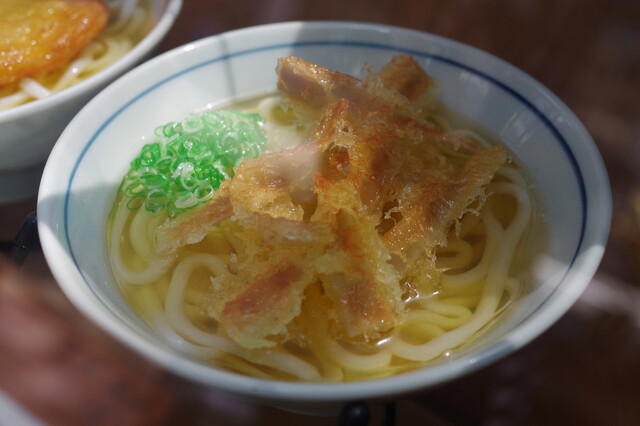
The menu
What to order
- Gobo-ten udon (burdock tempura udon)
- Hakata-style soft udon in clear dashi broth
Approaching Karo No Uron as a Fukuoka stop, the dining register changes quickly: everyday meals, local routines and travelers looking for a simple pause all fit into the city’s noodle circuit. This is where udon in Fukuoka makes a strong argument for value. The meal is quick, the format is plain, and the spend sits closer to an everyday lunch than to the city’s reservation-led restaurants.
Karo No Uron belongs to that functional category of Japanese dining where the room matters less than locality, repeat use and a clear specialty. It is not trying to compete with Fukuoka’s evening restaurants such as Daitou en Honten, Seimon Barai or Jidoriya Amon, where the occasion is different. It occupies a separate lane: a noodle house with udon, onigiri and soba, recognised in the Tabelog Udon WEST 100 for 2024, and priced at a level that keeps it in the city’s everyday eating economy.
Fukuoka udon as value, not ceremony
Fukuoka is often discussed through a few famous food shorthand categories, but udon has its own local pull. Noodle eating here can prize speed, warmth and accessibility over theatrical presentation. In that context, the value proposition is not simply that a bowl costs little. It is that the format gives a visitor a working view of how the city eats between errands, transit hops and casual detours.
The under-JPY 999 price band is meaningful in Fukuoka because it separates daily-use noodle shops from destination dining. A soba specialist such as Shinshu Soba Murata sits in a different bracket, while Hakata Meidai Yoshizuka Unagiya occupies another category entirely, with unagi changing the occasion. Karo No Uron’s advantage is not luxury compressed into a small bill; it is cultural clarity at a low spend. The restaurant’s Tabelog 3.68 score and 2024 Udon WEST 100 selection give it a public quality signal without altering the basic proposition.
That distinction matters for travelers building a food itinerary. A city like Fukuoka rewards contrast: one serious reservation, one dinner at another local dining room, one local bar, and at least one inexpensive noodle meal that does not feel like a compromise. For broader planning, Our full Fukuoka restaurants guide maps the restaurant side of that equation, while Our full Fukuoka bars guide, Our full Fukuoka hotels guide, Our full Fukuoka experiences guide and Our full Fukuoka wineries guide cover the rest of the trip architecture.
A Fukuoka room with strict practical logic
The room is best understood through purpose rather than spectacle. Karo No Uron’s appeal comes from the clarity of the format: udon, onigiri and soba at a low listed spend, backed by a public Tabelog quality signal. That format suits the food. Udon shops at this level depend on rhythm, not ceremony, and the strongest move is to treat the meal as a precise stop rather than a long lunch.
There are practical consequences to that kind of restaurant. The safest approach is to keep expectations simple, check current service details before going, and plan as you would for a popular everyday noodle shop rather than a formal destination room. The value lies in the directness of the meal: a focused category, a modest budget and a reason to pause inside Fukuoka’s daily eating economy.
Access also reinforces its usefulness. The location is Fukuoka, which makes the restaurant most useful when it can be folded into a day already moving through the city. In a place where short distances and quick decisions often define the quality of a day’s eating, this is the kind of stop that can sit between larger plans rather than requiring its own evening.
How to use it in a Fukuoka eating day
The strongest case for Karo No Uron is at lunch or as an early-day reset, especially when the rest of the itinerary is heavier. Fukuoka’s dining range is broad enough that not every meal should carry the same weight. A low-cost udon stop leaves room for a higher-spend dinner, a bar reservation, or a second part of the city later in the day. That is value in the practical sense: the meal does a specific job and does not distort the rest of the schedule.
For travelers comparing casual Japanese formats across cities, it also belongs to a wider national pattern. Small specialists often reveal more about everyday appetite than restaurants built around tasting-menu progression. In Fukuoka, that might mean pairing Karo No Uron with other unnamed local counters or casual dining rooms, depending on whether the day is built around noodles, fried food, set meals or a more substantial dinner later on.
The same logic travels beyond Fukuoka. Japan’s casual dining culture is full of narrow-format places where the decision is less about grandeur than fit: noodle shops, grilled-food counters, rice-ball specialists, curry rooms and everyday set-meal places can each anchor a meal without turning it into an occasion. Outside Japan, that same appetite for compact, specific food culture appears in casual dining scenes where the format is clear and the spend stays controlled.
The editorial verdict is simple: this is a low-spend Fukuoka udon stop with enough recognition to justify attention and enough practical simplicity to reward a little planning. Treat it as an everyday noodle meal rather than a reservation-based experience, and let the low price shape the rest of the day. In a Fukuoka itinerary, it works because it gives the city’s noodle culture a clear, affordable slot.
Frequently asked questions
Is Karo No Uron okay with children?
Plan for Karo No Uron as a practical, casual noodle stop in Fukuoka rather than a formal dining room. Check current house policies before visiting if children are part of the group.
How would you describe the vibe at Karo No Uron?
It reads as a functional Fukuoka noodle restaurant focused on udon, onigiri and soba. The tone is low-key, which suits its Tabelog Udon WEST 100 2024 selection and under-JPY 999 listed price band.
Is Karo No Uron expensive?
Pricing at Karo No Uron is listed as - JPY 999.
What are the operating hours at Karo No Uron?
Specific operating hours are not included in the provided venue facts. Check the current listing before visiting Karo No Uron in Fukuoka.
Reputation Context
Nearby venues at a similar price tier for orientation.
| Venue | Cuisine | Price | Awards | Notes |
|---|---|---|---|---|
| Karo No UronThis venue (the venue you are viewing) | Traditional Hakata udon | $1–10 | Tabelog 100 #76 | Not listed |
| Tanakadashiki Seafood Shokudo Uochu | Tanakadashiki-style seafood set-meal diner | $20–30 | Tabelog 100 #71 | Chūō |
| Bomber Kitchen Yakuin honten | Japanese-style Western set meals (yoshoku) | $10–20 | Tabelog 100 #22 | Chūō |
| Hakata Gion Tetsu Nabe | Hakata izakaya & iron-pan gyoza | $10–20 | Tabelog 100 #94 | Hakata |
| Miyake | Traditional Hakata Udon | $1–10 | Tabelog 100 #74 | Hakata |
| SACHiA Beef stroganoff | Beef stroganoff-focused Yoshoku (Japanese-style Western) | $10–20 | Tabelog 100 #41 | Higashi |
Recognition history
Dated appearances from independent guides and award organizations, with the underlying list record or original source where available.
Tabelog 100 #76 · No. 76
Tabelog · Tabelog 100 - Udon - WEST - 2024
Continue exploring
More in Fukuoka
Restaurants in Fukuoka
All restaurants in Fukuoka →

Details
- Classic
- Well Known
- Cozy
- Solo
- Family
- Casual Hangout
- After Work
- Historic Building
- Standalone
- Street Scene
- A La Carte
- Counter Dining
Current opening hours
- Monday
- 11 AM–5 PM
- Tuesday
- Closed
- Wednesday
- Closed
- Thursday
- 11 AM–5 PM
- Friday
- 11 AM–5 PM
- Saturday
- 11 AM–5 PM
- Sunday
- 11 AM–5 PM
Hours can change for holidays and private events. Hours as of .