
Michelin Plate
Our verdict
A Michelin Plate-recognised address in the 1st arrondissement, Kapara brings Sephardic culinary traditions into a room built for noise and conviviality. The menu, steered by chef Zohar Sasson under the Assaf Granit partnership, draws on spices, chickpeas, and the loose, generous cooking that runs along the eastern Mediterranean. Expect a deconstructed kebab, a full dining room, and little interest in quiet evenings.

Pearl is the En Primeur Club membership app, where members save venues, book tables and use the concierge.
The menu
What to order
- Octopus fondant
- Lamb chops
- Fattoush salad
- Deconstructed kebab
Where Rue d’Alger Gets Loud
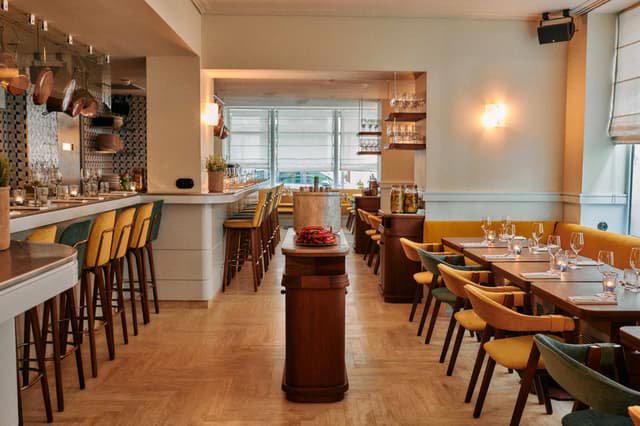
Walk into 9 Rue d’Alger on a busy evening and the first thing that registers is the sound. Groovy background music competes with laughter from a kitchen brigade that appears to be genuinely enjoying itself. The room’s interior recalls its predecessor, Balagan, almost exactly: the same visual energy, the same density, the same sense that the decor is set dressing for the human theatre happening inside it. Paris’s 1st arrondissement is not short of festive dining rooms, but few of them feel this specific about where they’re drawing from.
That specificity is the point. Kapara is not a generically ‘Mediterranean’ restaurant in the broadest geographic sense. It operates in a more precise register: the Sephardic culinary tradition, shaped by centuries of movement across the Ottoman world, North Africa, and the Levant. That tradition is defined less by a single national cuisine than by the crossroads it came from, and Kapara’s menu reflects those layered origins directly in its use of spices, legumes, and cooking methods that read across multiple coasts at once.
The Sephardic Thread Running Through the Menu
The eastern Mediterranean is not a single cuisine but a conversation between them. Sephardic cooking, as a tradition, absorbed Iberian, Ottoman, North African, and Levantine influences over several centuries, producing a food culture that moves freely between those registers. Chickpeas appear in forms that would be recognisable from Istanbul to Marrakech to Thessaloniki. Spice combinations reference trade routes, not borders. The act of cooking for a crowd, loudly and generously, is itself a cultural marker.
Chef Zohar Sasson works within this frame. Her cooking is described as ‘loosely inspired’ by these traditions, which is the honest way to frame it: the dishes draw on that heritage without being reconstructionist or museum-piece. Several items from the Balagan menu have carried over, including the deconstructed kebab that became a reference point for the original restaurant’s regulars. That continuity is not nostalgia for its own sake; it signals which flavour directions the kitchen has committed to over time.
The menu reads as a ‘colourful culinary anthology’ in Michelin’s own framing, which is a precise description. It ranges across influences without trying to resolve them into a single culinary argument. That approach places Kapara in a specific niche within Paris’s wider scene of Mediterranean-leaning restaurants, distinct from the more curated, austere end of the spectrum and from the looser, pan-Mediterranean catch-all format.
Where Kapara Sits in Paris’s Mediterranean Moment
Paris has accumulated a serious cluster of Mediterranean and Middle Eastern-influenced restaurants over the past decade. The Granit-Lanzman partnership, which also operates other addresses in the city, represents one approach to that tradition: exuberant, social, and grounded in the kitchen’s own cultural biography rather than in French-Mediterranean fusion logic. Other addresses take different positions. Adraba and Alluma represent further points on that continuum, each handling the Levantine and Mediterranean influence with a different register of formality and focus.
Further afield, the Mediterranean as a cooking reference produces very different results. Mirazur in Menton treats the coast as a framework for hyper-seasonal precision; Arnaud Donckele at Louis Vuitton in Saint-Tropez approaches it through haute cuisine formality; La Brezza in Ascona draws on Alpine-Mediterranean proximity. Kapara belongs to none of those categories.
At €€€, it prices below Paris’s multi-starred rooms, including the four-star tier occupied by Alléno Paris au Pavillon Ledoyen and Paul Bocuse’s Auberge du Pont de Collonges. It is not competing with those addresses. Its recognition, a Michelin Plate in 2025, signals kitchen quality without the formality overhead. That positioning is deliberate and makes the room accessible to a different kind of evening than a Michelin-starred tasting menu would permit.
The Room and the Experience
The atmosphere at Kapara is a structural feature of the experience, not incidental to it. Sephardic hospitality traditions are communal by nature: eating together, eating generously, eating with noise. The room’s energy functions as a signal about what kind of meal this is. You are not here for whispered tasting notes or choreographed service sequences. You are here for dishes that arrive with momentum, a table that fills up quickly, and a kitchen that performs with visible pleasure.
That energy can register as a drawcard or a deterrent depending on what you’re looking for. For solo diners wanting contemplative dining, or for guests who find high ambient volume a strain, this is not the room. For groups, for celebratory meals, for the kind of evening where the conversation is as important as the food, it fits a specific need that quieter, more reverent restaurants in the same price tier cannot meet.
For a broader map of what Paris’s dining scene offers across styles and price points, the full Paris restaurants guide covers the range. Those planning a longer visit will also find direction in the Paris hotels guide, Paris bars guide, and Paris experiences guide.
Planning Your Visit
| Detail | Kapara | Comparable alternatives |
|---|---|---|
| Address | 9 Rue d’Alger, 75001 Paris | Various 1st and 2nd arrondissement |
| Price tier | €€€ | €€€ at Marso & Co, Kalank |
| Recognition | Michelin Plate 2025 | |
| Atmosphere | High energy, communal, loud | Variable by venue |
| Cuisine focus | Sephardic Mediterranean | Levantine, pan-Mediterranean |
| Booking | Reservations recommended; walk-ins possible at bar or off-peak | Policies vary |
For further reference on the French dining scene beyond Paris, the guides to Flocons de Sel in Megève, Troisgros in Ouches, Auberge de l’Ill in Illhaeusern, and Bras in Laguiole provide context on where the country’s formal dining tradition sits, against which Kapara’s register feels deliberately oppositional. Also see Brach for a different kind of Paris energy at a similar price point. The Paris wineries guide is available for those building a fuller itinerary.
Frequently asked questions
What do regulars order at Kapara?
Do they take walk-ins at Kapara?
In Context: Similar Options
A compact comparison to help you place this venue among nearby peers.
| Venue | Cuisine | Price | Awards | Notes |
|---|---|---|---|---|
| KaparaThis venue (the venue you are viewing) | Modern Israeli & Middle Eastern | $50–100 | Michelin Plate | Not listed |
| Alléno Paris au Pavillon Ledoyen | Modern French Fine Dining | $150–200 | 3 Michelin Stars · World's 50 Best #79 | Creative |
| Kei | Modern French with Japanese Influences | $300–500 | 3 Michelin Stars · World's 50 Best #93 | Contemporary French, Modern Cuisine |
| L'Ambroisie | Classic French Haute Cuisine | $300–500 | 2 Michelin Stars · World's 50 Best #23 | French, Classic Cuisine |
| Le Cinq - Four Seasons Hôtel George V | Modern French Fine Dining | $300–500 | 3 Michelin Stars · World's 50 Best #24 | French, Modern Cuisine |
| Plénitude | Modern French Sauce-Led Fine Dining | $300–500 | 3 Michelin Stars · World's 50 Best #14 | Contemporary French |
Recognition history
Dated appearances from independent guides and award organizations, with the underlying list record or original source where available.
Michelin Plate
Michelin
Full recognition history (2 entries)
Michelin Plate
Michelin
Continue exploring
More in Paris
Restaurants in Paris
All restaurants in Paris →
Bars in Paris
All bars in Paris →
Hotels in Paris
All hotels in Paris →



Details
- Lively
- Trendy
- Energetic
- Group Dining
- Celebration
- Date Night
- Open Kitchen
- Extensive Wine List
- Craft Cocktails
- A La Carte
- Small Plates
- Vegan Options
Lively and cheerful with lively music, eclectic decor, plush banquettes, and an energetic vibe evoking Mediterranean nights and family gatherings.