
Tabelog 100 #64
Our verdict
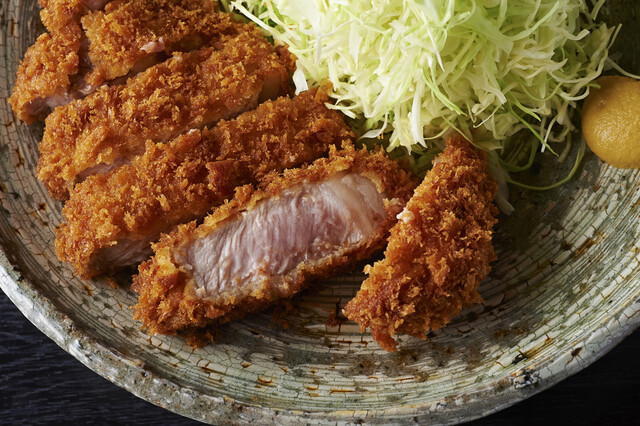
Jinenbo belongs to Tokyo’s serious tonkatsu conversation without the Ginza polish or department-store sheen. Its Tabelog 100 Tonkatsu selections in 2024 and 2026, 30-seat layout, counter-and-tatami mix, and sake-shochu-wine program point to a neighbourhood restaurant working at a specialist level rather than a quick cutlet stop.

Pearl is the En Primeur Club membership app, where members save venues, book tables and use the concierge.
The menu
What to order
- Tonkatsu set meal
- Hire-katsu (fillet cutlet)
- Rosu-katsu (loin cutlet)
- Seasonal fried dishes
Residential Tokyo changes the tonkatsu register before the first order is placed. The tempo drops, the room becomes part dining room and part local gathering point, and the meal is judged less by spectacle than by consistency, timing, and how well the kitchen and floor keep a fried-pork format from becoming heavy. In Tokyo, Jinenbo sits inside that quieter branch of the city’s dining culture: a tonkatsu house with bento and izakaya functions, recognised by Tabelog 100 Tonkatsu in 2026, but shaped for repeat local use rather than destination theatre.
Tokyo’s tonkatsu scene is not one market. There are counter specialists built around single-cut precision, casual shops for lunch traffic, and hybrid rooms where cutlets share space with drinking snacks, rice sets, and a longer evening rhythm. Jinenbo belongs to the last category. That matters because the experience depends on coordination across the team: the kitchen has to land the fry, the broader format has to make sense with pork rather than sit as decoration, and the room has to handle different kinds of diners without turning the meal into a queue-management exercise.
Tokyo tonkatsu with an izakaya pulse
The useful way to read this restaurant is through format. Tonkatsu is the anchor, but the category listing also includes bento and izakaya, which changes the expectations around pacing and breadth. A pure cutlet counter asks diners to focus on breading, fat, rice, cabbage, sauce, and little else. A hybrid izakaya-tonkatsu room asks a different question: can the fried centrepiece hold its authority while the rest of the table behaves more flexibly?
The awards answer part of that question. Tabelog’s Hyakumeiten lists are category-specific, so a 2026 Tonkatsu selection places the restaurant in a defined conversation rather than a general popularity pool. The listed Tabelog score of 3.66 also signals the difficult middle ground in Tokyo: high enough to matter among attentive local diners, not inflated into the luxury omakase economy. Alongside Tonkatsu Enraku and other Tokyo tonkatsu reference points, the draw here is the combination of cutlet focus with a broader bento and izakaya frame.
That team dynamic is the point. The kitchen’s remit is broader than pork cutlet alone because the restaurant is also listed for bento and izakaya use. Those details are not decorative. In Tokyo, tonkatsu can become monotonous when the wider table is treated as an afterthought; an izakaya-adjacent orientation gives the restaurant more room to steer the meal, especially at dinner. It also places Jinenbo closer to the city’s mature everyday dining culture than to the quick-service fry shop model.
A room built for repeat use, not ceremony
The format explains much of the mood. The restaurant is not framed here as a ceremonial luxury counter; it reads as a practical Tokyo room where tonkatsu remains central while bento and izakaya functions broaden the occasions for visiting. Different diners may approach the restaurant differently, but the appeal rests on the same premise: a specialist fried-pork meal that can still behave like everyday dining rather than a single-purpose event.
This is also where Tokyo matters. The city does not operate only through internationally familiar dining shorthand or hotel-driven destination routes. Dining here is often less about a single trophy reservation and more about how specialised cooking survives in ordinary urban patterns. Tokyo’s food culture is unusually good at this: a restaurant can operate outside the obvious luxury axes, keep prices in a relatively accessible bracket, and still appear on a category list watched by committed diners.
For readers mapping a broader Tokyo trip, the contrast is useful. Tokyo itineraries often pull toward high-volume areas, but the city’s restaurant intelligence improves when less formal meals are mixed in. For range, compare Jinenbo with other Tokyo dining rooms, other specialist counters, casual curry shops, yakitori rooms, and seafood-led drinking venues. The point is not to turn every meal into a trophy stop, but to understand how Tokyo’s restaurant culture moves between category precision and everyday use. For citywide planning, use Our full Tokyo restaurants guide alongside Our full Tokyo hotels guide, Our full Tokyo bars guide, Our full Tokyo wineries guide, and Our full Tokyo experiences guide.
How to place it in a Japan dining itinerary
The strongest case for Jinenbo is not that it competes with Tokyo’s luxury counters. It fills a different slot: a specialist tonkatsu meal with enough breadth and everyday utility to work when the day does not call for a formal tasting menu. The better comparison is with Japan’s broader regional specificity. A traveller moving beyond Tokyo might read it against other unnamed local specialists: comfort restaurants, cafés, contemporary dining rooms, curry shops, and minimalist counters that each express a narrower piece of local dining culture.
For overseas readers, the category also travels well. Japanese comfort formats abroad often flatten tonkatsu into a generic set meal, while drinking rooms and rice specialists carry different fragments of the same culture. In international cities, those pieces are often separated into different venues. Back in Tokyo, the Jinenbo version is more integrated: pork cutlet, bento usefulness, izakaya flexibility, and local dining rhythm working as one restaurant system.
The editorial verdict is simple: choose this for a Tokyo meal where craft matters, but ceremony is not the goal. The Tabelog 100 Tonkatsu 2026 selection provides the trust signal; the izakaya-adjacent structure provides the reason to linger. In a city that often separates specialist counters from everyday rooms, Jinenbo shows how those modes can overlap without losing the cutlet as the centre of gravity.
Peers You’d Cross-Shop
Comparable venues by cuisine and price in the same metro.
| Venue | Cuisine | Price | Awards | Notes |
|---|---|---|---|---|
| JinenboThis venue (the venue you are viewing) | Tonkatsu & Japanese dishes | $30–50 | Tabelog 100 #64 | Not listed |
| THE LIVING | Cafe / Dessert Cafe | Not listed | Tabelog 100 #68 | JPY 2,000 - JPY 2,999 |
| pizzeria fabbrica 1090 | Neapolitan Pizza | $20–30 | Tabelog 100 #83 | JPY 4,000 - JPY 4,999 JPY 1,000 - JPY 1,999 |
| Natsuya no Chuka Soba | Japanese Ramen | $1–10 | Tabelog 100 #99 | JPY 1,000 - JPY 1,999 |
| PondyBhavan Musashi nitta | Traditional South Indian restaurant | $10–20 | Tabelog 100 #52 | JPY 2,000 - JPY 2,999 - JPY 999 |
| Tonkatsu Enraku | Traditional Tonkatsu & Katsu-don | $20–30 | Tabelog 100 #30 | Tonkatsu |
Recognition history
Dated appearances from independent guides and award organizations, with the underlying list record or original source where available.
Tabelog 100 #64 · No. 64
Tabelog · Tabelog 100 - Tonkatsu - 2026
Continue exploring
More in Tokyo
Restaurants in Tokyo
All restaurants in Tokyo →


Bars in Tokyo
All bars in Tokyo →


Details
- Cozy
- Classic
- Solo
- Family
- Group Dining
- After Work
- Casual Hangout
- Standalone
- Design Destination
- Sake Program
- Beer Program
- Local Sourcing
- A La Carte
- Set Menu
- Sake
- Beer
Current opening hours
- Monday
- 11:30 AM–3 PM, 5–10 PM
- Tuesday
- 11:30 AM–3 PM, 5–10 PM
- Wednesday
- Closed
- Thursday
- 11:30 AM–3 PM, 5–10 PM
- Friday
- 11:30 AM–3 PM, 5–10 PM
- Saturday
- 11:30 AM–3 PM, 5–10 PM
- Sunday
- 11:30 AM–3 PM, 5–10 PM
Hours can change for holidays and private events. Hours as of .
Warm, intimate neighborhood spot in a residential area with a classic feel, counter and table seating, and food presented on handmade Karatsu ware that gives the room an understated, traditional atmosphere rather than a polished modern look.