Hu's Szechwan Restaurant
Our verdict
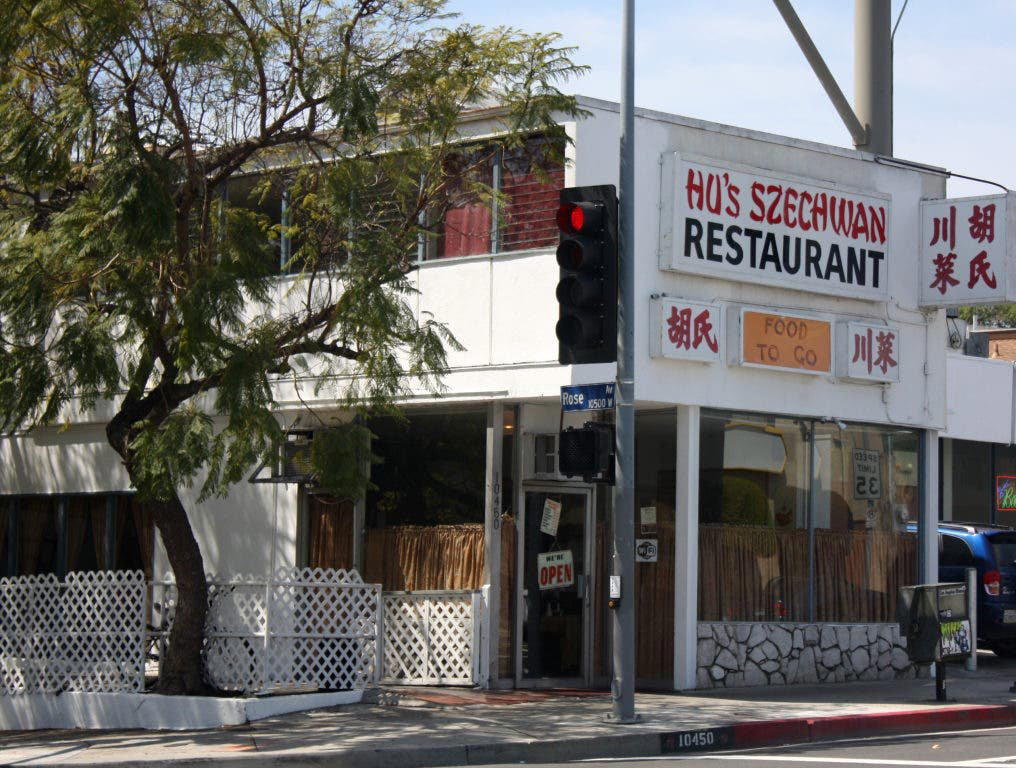
On a quiet stretch of National Boulevard in West Los Angeles, Hu's Szechwan Restaurant has held its ground as one of the city's longstanding addresses for Sichuan cooking. In a city where Chinese regional cuisine has grown considerably more stratified, Hu's represents the neighbourhood-institution tier: unpretentious in setting, consistent in execution, and rooted in a culinary tradition that rewards repeat visits and genuine curiosity.

Pearl is the En Primeur Club membership app — saves, bookings, and concierge access live there. Same editors, same standards.
- Address
- 10450 National Blvd, Los Angeles, CA 90034
- Phone
- (310) 837-0252
- Hours
- Mon ClosedTue–Fri 11:30 AM–2:15 PM, 5–8:45 PMSat 12–2:15 PM, 5–8:45 PMSun 5–8:45 PM
- Website
- husrestaurant.com
- Directions
- Get directions
The menu
What to order
- Szechwan Wonton
- Our Famous String Beans
- Cheng Pi Chicken
Sichuan in Los Angeles: A Culinary Tradition With Deep Roots
The story of Sichuan cuisine in Los Angeles is, in part, a story of migration, adaptation, and slow recognition. For decades, the San Gabriel Valley absorbed waves of Chinese immigrants who brought regional cooking traditions far more specific than the Cantonese-American hybrid that had defined "Chinese food" for most of the city's non-Chinese residents. Sichuan cooking arrived with its own distinct logic: the interplay of dried chilies and Sichuan peppercorns that produces the mala sensation — simultaneously numbing and hot — along with fermented black beans, doubanjiang paste, and slow-braised proteins that bear almost no resemblance to stir-fry-centric Americanised menus.
Hu's Szechwan Restaurant, at 10450 National Boulevard in the Palms neighbourhood of West Los Angeles, occupies a different geography from the San Gabriel concentration. That positioning matters. West LA has historically been a thinner market for serious regional Chinese cooking, which means Hu's has served a neighbourhood audience rather than an ethnic-enclave one, a distinction that shapes both clientele and context. Venues in this position tend to be bridge institutions: introducing Sichuan flavour profiles to diners who might not make the drive east, while retaining a core of regulars who return for consistency.
What Sichuan Cooking Actually Demands
To assess any Sichuan restaurant with seriousness, it helps to understand what the cuisine requires. Sichuan peppercorns (huajiao) are not simply a spice; they contain hydroxy-alpha-sanshool, a compound that triggers a tingling, numbing sensation on the lips and tongue distinct from the heat of capsaicin. When the two sensations are calibrated together, as in a properly made mapo tofu or a Chongqing-style dry-fried dish, the result is a flavour architecture unlike anything in European or most other Asian culinary traditions. Poorly sourced peppercorns, or ones that have been sitting too long, lose their numbing quality almost entirely. The difference between a dish made with fresh huajiao and stale ones is not subtle.
This is why Sichuan cooking is a useful test of a restaurant's sourcing discipline. Unlike cuisines where technique can partially compensate for ingredient quality, mala cooking depends on chemical compounds that degrade with time and improper storage. Restaurants that take this seriously tend to signal it through dish consistency across seasons and years rather than through marketing language.
Los Angeles has seen its Sichuan options multiply considerably since the early 2000s, with the San Gabriel Valley developing a dense cluster of regionally specific Chinese restaurants that now draw comparisons to immigrant-food corridors in New York and the Bay Area. In that context, a Sichuan address in West LA like Hu's occupies a specific and durable niche: accessible geography for the Westside, with a format that prioritises familiarity and regularity over theatrical presentation.
The West LA Chinese Restaurant as Neighbourhood Institution
Los Angeles restaurant culture has a particular category of venue that doesn't map neatly onto the prestige-dining frameworks applied to places like Providence, Kato, or Somni. These are neighbourhood institutions: restaurants that have outlasted trends, built repeat-customer bases, and maintained a consistent identity over years or decades in a city where restaurant turnover is among the highest in the country. They are not trying to compete with Hayato or Osteria Mozza. They are operating in a different register entirely.
Hu's fits that category. A Sichuan restaurant that has maintained a presence in Palms-adjacent West LA is not a casual achievement. The neighbourhood sits at a crossroads of Culver City's growing dining scene and the older Westside residential fabric, drawing a demographically mixed crowd that skews local. That context shapes the experience: this is a place where regulars eat on weekdays, not a destination diners photograph on weekends.
For visitors oriented toward the high-end tier of LA dining, the omakase counters, the tasting menus, the chef-driven formats featured alongside venues like Lazy Bear in San Francisco, Alinea in Chicago, or The French Laundry in Napa, Hu's represents a complementary register. Serious eaters in any city benefit from knowing which neighbourhood institutions hold their ground over time; those are often the meals that give texture to a trip that might otherwise be defined entirely by reservation-required, occasion-dining formats.
Situating Sichuan on the LA Chinese Dining Map
LA's Chinese dining scene is not monolithic. Cantonese dim sum, Shanghainese soup dumplings, Taiwanese beef noodle, and Sichuan mala cooking each operate within distinct culinary logics, and the city's leading examples of each tend to cluster geographically. Sichuan specifically has benefited from the post-2010 wave of more mainland-oriented Chinese immigration into the SGV, which raised baseline expectations for dishes like dan dan mian, twice-cooked pork, and fish-fragrant eggplant.
A Sichuan restaurant operating outside that SGV cluster, on the Westside, closer to Santa Monica than Monterey Park, will always face the question of audience calibration. Is it serving Sichuan to diners who know the cuisine well, or introducing it to those who don't? The most durable venues in this position do both simultaneously, maintaining enough authenticity to satisfy the former while keeping the ordering experience clear enough for the latter. That balance is harder to achieve than either extreme.
For context on how LA's Chinese-influenced cooking intersects with broader American fine dining trends, Kato's New Taiwanese format and the wider Asian-American dining conversation visible in venues like Atomix in New York City are useful reference points, though Hu's operates at a different price register and format entirely.
Across the US, the neighbourhood Chinese restaurant has faced sustained pressure from both ends: fast-casual chains on one side and increasingly ambitious chef-driven Chinese concepts on the other. The ones that survive tend to do so through community loyalty and consistent execution rather than adaptation or reinvention. That staying power, in a city as competitive and trend-sensitive as Los Angeles, is itself a form of credibility. For more on the full range of LA dining, see our full Los Angeles restaurants guide.
Know Before You Go
| Detail | Information |
|---|---|
| Address | 10450 National Blvd, Los Angeles, CA 90034 |
| Neighbourhood | Palms / West Los Angeles |
| Cuisine | Sichuan (Chinese regional) |
| Phone | |
| Hours | Verify directly before visiting; hours |
| Booking | Walk-in or call ahead; reservation requirements not confirmed |
| Price range | Not confirmed; neighbourhood-institution format typically runs moderate |
Frequently asked questions
Can I walk in to Hu's Szechwan Restaurant?
Neighbourhood-format Chinese restaurants in Los Angeles at this tier typically accommodate walk-ins, particularly on weeknights. Weekends in a location adjacent to Culver City's growing dining corridor may draw more foot traffic.
How does Hu's Szechwan Restaurant fit into West LA's Chinese dining scene?
West Los Angeles has historically had fewer dedicated Sichuan options than the San Gabriel Valley, which makes a longstanding Sichuan address in the Palms neighbourhood something of an outlier in positive terms. Hu's has maintained a presence at 10450 National Boulevard for a sustained period, serving a Westside audience for whom the SGV drive is not always practical. In a city where Chinese regional dining has become considerably more geographically concentrated to the east, a Westside Sichuan institution occupies a genuinely distinct position on the map.
Cuisine Context
Comparable venues nearby, for context on price, style, and recognition.
| Venue | Cuisine | Price | Notes |
|---|---|---|---|
| Hu's Szechwan RestaurantThis venue — the venue you are viewing | Classic Szechwan Chinese | $10–20 | Not listed |
| Yang Chow | Mandarin & Szechuan Chinese | $20–30 | Chinatown |
| Foo-Chow Restaurant | Classic Chinese | $20–30 | Chinatown |
| Hop Li | Authentic Cantonese Seafood | $20–30 | West L.A. |
| Super Peach | Chinese-American-Korean Fusion | Not listed | Century City |
| Liu’s Cafe Westwood | Taiwanese & Hong Kong Comfort Food | $20–30 | Westwood |
Continue exploring
More in Los Angeles
Restaurants in Los Angeles
Browse all →
Bars in Los Angeles
Browse all →
Hotels in Los Angeles
Browse all →
Wineries in Los Angeles
Browse all →
Details
- Classic
- Cozy
- Family
- Casual Hangout
- Standalone
- A La Carte
Current opening hours
- Monday
- Closed
- Tuesday
- 11:30 AM–2:15 PM, 5–8:45 PM
- Wednesday
- 11:30 AM–2:15 PM, 5–8:45 PM
- Thursday
- 11:30 AM–2:15 PM, 5–8:45 PM
- Friday
- 11:30 AM–2:15 PM, 5–8:45 PM
- Saturday
- 12–2:15 PM, 5–8:45 PM
- Sunday
- 5–8:45 PM
Hours can change for holidays and private events. Last verified .
Clean, unassuming storefront with a quiet, welcoming family atmosphere.