Our verdict
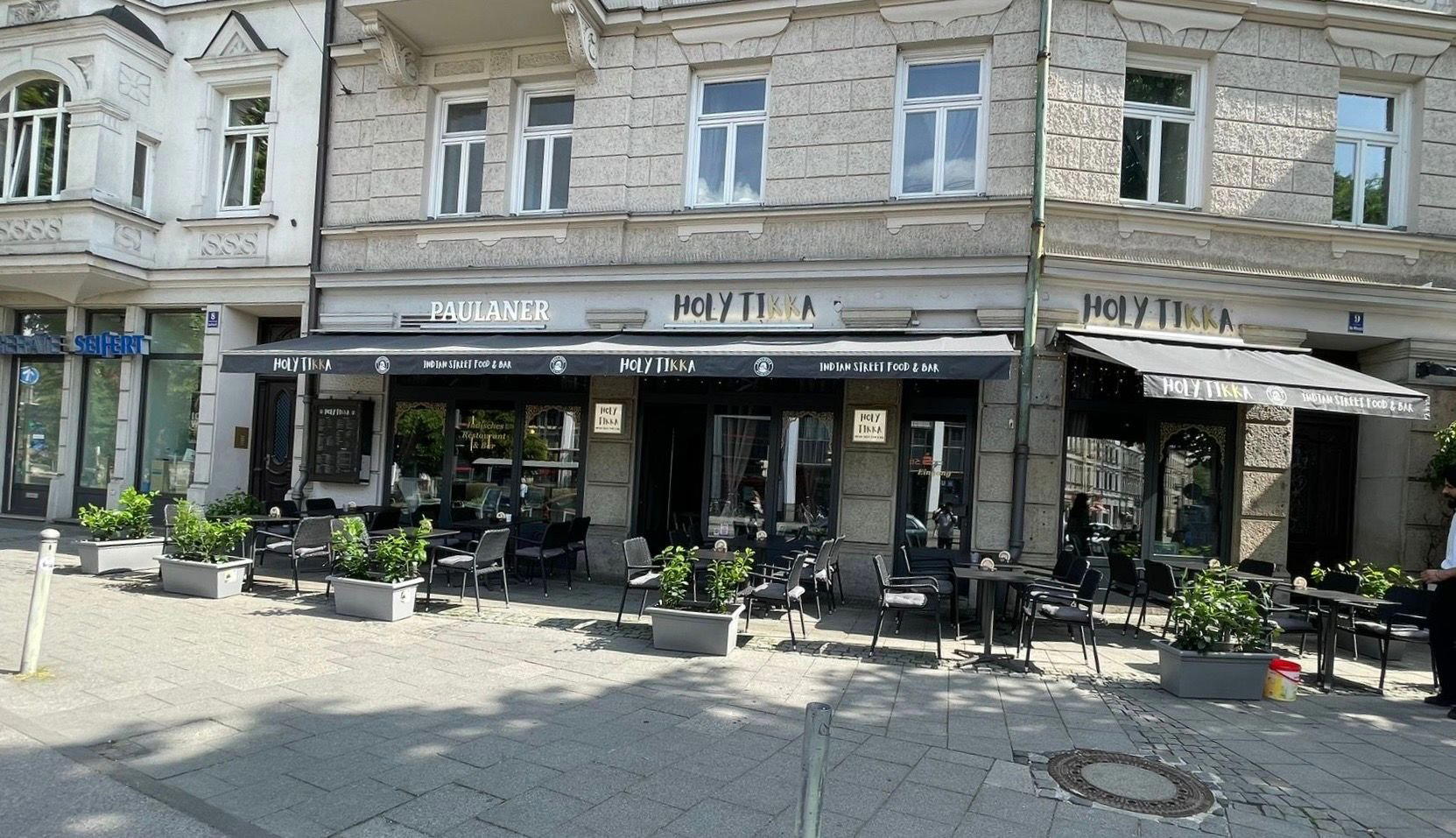
Holy Tikka sits at Max-Weber-Platz in Munich's Haidhausen quarter, bringing Indian street-food traditions into a neighbourhood better known for Bavarian regulars than subcontinental cooking. Where Munich's fine-dining circuit runs toward French and modern German formats, Holy Tikka positions itself in the city's growing tier of casual, cuisine-specific specialists. The address alone signals an audience that knows where to look.

Pearl is the En Primeur Club membership app — saves, bookings, and concierge access live there. Same editors, same standards.
- Address
- Max-Weber-Platz 9, 81675 München, Germany
- Phone
- +494989472210
- Hours
- Daily 11:30 AM–10 PM
- Website
- holytikka.de
- Directions
- Get directions
- Booking
- Book on the venue's website
The menu
What to order
- Chicken Tikka Masala
- Butter Chicken
- Dal Makhani
Indian Street Food in a City Built for French Technique
Munich's restaurant identity has long been anchored by the grand formal dining rooms: the old-school authority of Tantris, the Franco-German precision of Atelier, the studied creativity of JAN. Against that backdrop, the city's appetite for casual, cuisine-specific specialists has been slower to develop than in Berlin or Hamburg, which makes each new entry in that tier worth tracking. Holy Tikka, at Max-Weber-Platz 9 in the Haidhausen district, occupies a position that Munich's dining map has historically underserved: Indian cooking, presented not as an all-encompassing subcontinent survey, but through the specific, high-repetition logic of the tikka format.
That specificity is the editorial point. The broader Indian restaurant category in German cities tends toward generalist menus, covering biryani, dal, tandoor, and curry in a single sweep. A focused approach — where the menu architecture centres on a single technique or preparation family — demands more from the kitchen and signals more clearly to the guest. It is the same logic that separates a ramen-ya from a generic Japanese noodle house, or a taco specialist from a full Tex-Mex operation. When a restaurant commits its menu to one category of preparation, every dish becomes a direct comparison against every other dish on the same list.
What the Menu Structure Reveals
The tikka tradition is worth understanding on its own terms before arriving. In Indian cooking, tikka refers to marinated pieces of meat, paneer, or vegetables cooked at high heat in a tandoor oven, with the marinade doing the structural work: yoghurt for tenderising, spice blends for depth, acid for brightness. The format is inherently modular. A kitchen that centres its menu on tikka variations is essentially designing a platform: the protein or vegetable changes, the heat source stays constant, the marinade is the variable that carries the kitchen's argument.
This is a more disciplined structural choice than it first appears. It means the menu can scale laterally, more proteins, more marinade profiles, more accompaniments, without losing coherence. It also means that a guest who orders two or three items across a visit will understand the kitchen's logic intuitively, even without a server explaining it. Compare this to the generalist Indian menu, where the architecture is additive and encyclopaedic: more dishes, less internal logic. Holy Tikka's format, at least by name and address positioning, suggests the former approach. That is a meaningful signal in a city where Indian cooking has rarely been presented with this degree of format discipline.
For context on how format-specific menus operate at the fine-dining end of the German spectrum, CODA Dessert Dining in Berlin runs an entire tasting menu organised around dessert logic applied to savoury courses, a format commitment that similarly defines everything else about the experience. At the casual end, the logic is the same even if the price point is not.
Haidhausen as Context
Max-Weber-Platz sits in Haidhausen, the neighbourhood east of the Isar that Munich locals have gradually gentrified without entirely displacing its older, working-class character. The square itself is a transit node, U-Bahn and tram lines converge here, which means foot traffic is consistent and varied in a way that the more residential or tourist-heavy parts of the city are not. Restaurants at this address draw from a cross-section of Munich rather than a single demographic, which tends to produce a more honest read of whether a concept is working.
Haidhausen's dining has historically been neighbourhood-casual rather than destination-led, making it a different competitive environment from the Maxvorstadt or Altstadt restaurants that cluster near Munich's major institutional and hotel infrastructure. The Michelin-weighted rooms, Alois - Dallmayr Fine Dining, Tohru in der Schreiberei, operate in a different register entirely.
| Venue | Format | Price Tier | Location |
|---|---|---|---|
| Holy Tikka | Indian specialist (tikka-focused) | Not published | Haidhausen, Max-Weber-Platz |
| Tantris | Modern French | €€€€ | Schwabing |
| Atelier | Creative French | €€€€ | Maxvorstadt |
| Alois - Dallmayr Fine Dining | Creative | €€€€ | Altstadt |
The table above illustrates how separate Holy Tikka's competitive set is from Munich's decorated fine-dining tier. The city's formal restaurants cluster around French and creative European formats at the leading price point. Holy Tikka, by contrast, operates in a format category that Munich's premium dining circuit has not meaningfully addressed. That gap is the opportunity, and also the challenge, since format-specific casual restaurants succeed or fail based on execution consistency rather than occasion-driven spending.
For reference points on Indian cooking presented with more structural ambition elsewhere in the world, Atomix in New York City demonstrates what happens when a non-European cuisine tradition is presented through a format-disciplined fine-dining lens, though at a price point and formality level that Holy Tikka does not appear to target. The more relevant comparison is simply whether the tikka format, applied consistently, produces a menu with internal logic that rewards repeat visits.
Planning a Visit
Holy Tikka's address at Max-Weber-Platz 9 is directly accessible by U-Bahn (U4/U5, Max-Weber-Platz station) and several tram lines, making it one of the more direct transit connections in Munich's eastern neighbourhoods. For a broader view of Munich's dining options across price tiers and formats, see our full Munich restaurants guide.
Readers planning a longer trip through Germany's restaurant circuit may also want to cross-reference venues in other cities: Restaurant Haerlin in Hamburg, Aqua in Wolfsburg, Schwarzwaldstube in Baiersbronn, Vendôme in Bergisch Gladbach, ES:SENZ in Grassau, Victor's Fine Dining by Christian Bau in Perl, Waldhotel Sonnora in Dreis, Schanz in Piesport, and Bagatelle in Trier.
Frequently asked questions
Where exactly is Holy Tikka?
Holy Tikka is located at Max-Weber-Platz 9, 81675 München, Germany, Munich.
Is Holy Tikka in Munich's Haidhausen neighbourhood worth a dedicated trip from the city centre?
Max-Weber-Platz 9 sits in Haidhausen, east of the Isar, and is a direct U4/U5 ride from Munich's central districts — typically under ten minutes from Marienplatz. For a city where serious Indian cooking occupies a smaller share of the restaurant scene than French-influenced or Bavarian formats, a venue working the tikka tradition with specificity is worth the short transit. The neighbourhood itself has accumulated enough independent restaurants and cafés to make the area worth an extended visit.
What's the must-try dish at Holy Tikka?
EP Club's confirmed venue data for Holy Tikka does not include verified menu specifics, so naming a single dish with authority isn't possible here. What the tikka format does reliably offer across its tradition are marinated preparations cooked at high heat — chicken tikka and paneer tikka being the structural pillars of any serious operation in this category. Arriving with that framework in mind is a reasonable starting point for Max-Weber-Platz 9.
How far ahead should I plan for Holy Tikka?
Holy Tikka operates in the casual street-food tier, which in Munich generally means walk-in access is realistic rather than the weeks-out booking windows that apply to the city's decorated dining rooms. Max-Weber-Platz is directly served by the U4 and U5 U-Bahn lines, which makes a spontaneous visit logistically straightforward. Peak evening hours on weekends are the one window where arrival timing matters.
A Minimal comparable set
Comparable venues nearby, for context on price, style, and recognition.
| Venue | Cuisine | Price | Notes |
|---|---|---|---|
| Holy TikkaThis venue — the venue you are viewing | Indian Street Food | $20–30 | Not listed |
| Ganesha Indisches Restaurant | Authentic North Indian | $20–30 | Haidhausen, Authentic North Indian |
| Wirtshaus in der Au | Traditional Bavarian with Innovative Dumplings | $20–30 | Au, Traditional Bavarian with Innovative Dumplings |
| Haguruma | Authentic Japanese Sushi & Hot Kitchen | Not listed | Isarvorstadt, Authentic Japanese Sushi & Hot Kitchen |
| HANS IM GLÜCK - MÜNCHEN Türkenstrasse | Gourmet Smash Burgers | $20–30 | Schwabing, Gourmet Smash Burgers |
| The Potting Shed Bar & Kitchen | Gourmet Burgers & Peruvian Tapas | $30–50 | Schwabing, Gourmet Burgers & Peruvian Tapas |