Harrods Food Halls
Few retail food destinations in Europe carry the historical weight of the Harrods Food Halls. Spread across the ground floor of the Knightsbridge department store, the halls function less like a supermarket and more like a curated sequence of specialist counters, charcuterie, patisserie, fishmongers, chocolatiers, each operating at a level that positions the whole as a serious rival to London's standalone specialist food destinations.
Pearl is the En Primeur Club membership app — saves, bookings, and concierge access live there. Same editors, same standards.
- Address
- Food Halls, GROUND FLOOR, Harrods, 87-135 Brompton Rd, London SW1X 7XL, United Kingdom
- Phone
- +44 20 7730 1234
- Website
- harrods.com
- Directions
- Get directions
 Saves & bookings on Pearl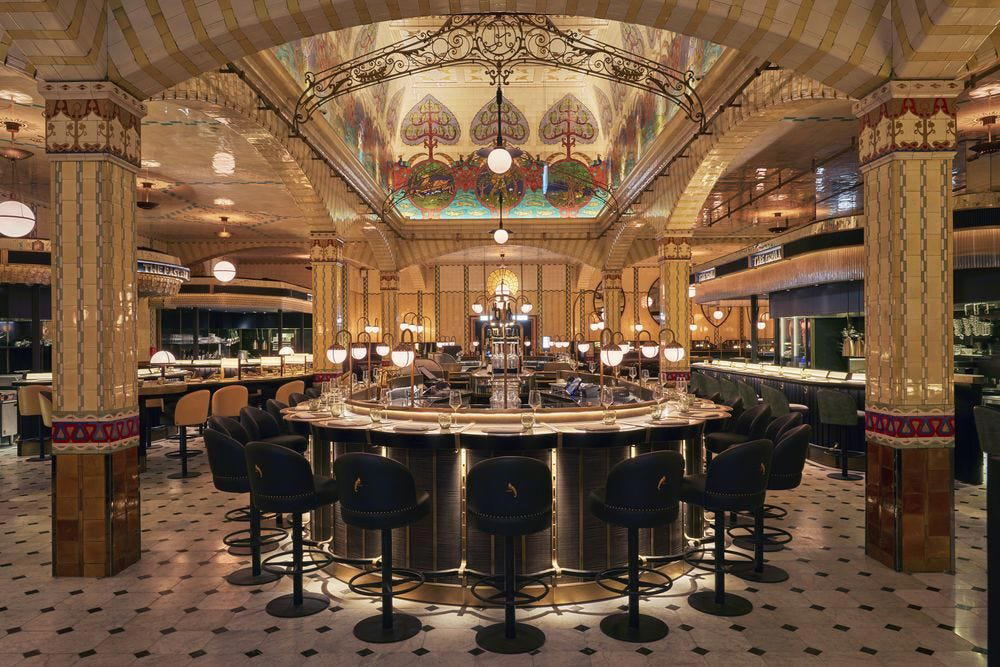
Knightsbridge's Ground Floor as a Food Itinerary
The approach along Brompton Road tells you something before you reach the doors. Knightsbridge, bounded by Hyde Park to the north and Chelsea to the south, has long operated as one of London's highest-density concentrations of serious hospitality, Dinner by Heston Blumenthal is a short walk west, and the neighbourhood draws the same visitor cohort that books six weeks ahead at CORE by Clare Smyth or The Ledbury. The Food Halls sit on the ground floor of the main store, and the architectural context matters: the tiled ceilings, mosaic friezes, and period display cases were not retrofitted for atmosphere, they are the building's original bones. That continuity of setting shapes how everything inside it is read.
What the halls offer, structurally, is closer to a progressive tasting sequence than to conventional retail browsing. The layout moves visitors through distinct zones, fresh fish, aged meat, patisserie, cheese, confectionery, in a way that maps roughly onto the logic of a formal meal. You do not need to plan the route; the architecture does it for you. That progressive structure is what separates this format from a premium supermarket: each counter operates as a self-contained specialist, with depth of product that places it against standalone London destinations rather than grocery competitors.
The Sequence: Counter by Counter
The fish and seafood display is especially theatrically presented section and, for many visitors, disorienting in a productive sense. Whole fish on ice, sourced through established UK and European supply chains, sit alongside shellfish that would be unremarkable at a coastal French market but are genuinely scarce at this level of presentation in central London. The scale and curation place it in a different register from even well-regarded fishmongers in Notting Hill or Borough Market. For context, London's standing as a serious fish market city was built on wholesale infrastructure at Billingsgate, not on retail theatre, what the Food Halls do is translate that wholesale seriousness into a format designed for consumption on the spot or the same afternoon.
The meat and charcuterie counters operate on similar logic. Aged beef, whole cuts, and an imported charcuterie selection that leans heavily on French and Spanish producers reflect a curatorial approach more typical of specialist butchers in Paris's covered markets than of department store retail. The cheese room, a distinct temperature-controlled environment, holds a range broad enough to function as an independent affineur's offering. British territorial cheeses appear alongside French and Italian selections at stages of maturity that require active management, this is not a display case of pre-cut wedges under plastic.
Patisserie and confectionery bring the sequence toward its natural close. The chocolate counter draws on international producers and house production at a level that positions it against London's standalone chocolatiers. The bakery output, pastries, breads, celebration cakes, represents the same logic: category-depth that would sustain a specialist shop on its own terms, here assembled into a single floor. Visitors treating the halls as a single progressive visit rather than a targeted errand will find the cumulative effect considerably more coherent than the individual counter counts suggest.
Where It Sits in London's Food Scene
London's premium food retail has never been a single category. Borough Market functions as a producer-led farmers' market with a strong craft food identity. Fortnum and Mason on Piccadilly operates as a heritage brand with a narrower, more gift-oriented range. Selfridges Food Hall in Oxford Street positions itself toward accessible luxury and convenience. The Harrods Food Halls sit apart from all three: larger in total floor area than most, more internationally sourced in profile, and more explicitly positioned toward the visitor who arrives with specific acquisition intent rather than browsing habit.
That distinction matters for how you use the visit. The comparison set for a serious buyer at the fish counter is not other department stores, it is the restaurants around the same postcode. Sketch, The Lecture Room and Library and Restaurant Gordon Ramsay are both in the same tier of London dining; the product standards at the Food Halls are calibrated to the same expectation. That calibration is what justifies the price differential over conventional retail, not prestige signalling, but actual product quality in categories where sourcing depth is verifiable.
Planning the Visit
The Food Halls are accessible without a booking, which makes them different in logistical terms from the seated restaurant destinations in London's top tier. The practical challenge is timing: the halls draw substantial visitor volume throughout the day, and the counters are most fully stocked and least congested in the morning hours. A weekday morning visit allows slower engagement with counter staff, who carry more detailed product knowledge than the foot traffic suggests. The address is 87-135 Brompton Road, SW1X 7XL, with Knightsbridge station on the Piccadilly line immediately adjacent.
Visitors with dietary requirements should address these directly at individual counters rather than expecting a consolidated allergen resource; the multi-operator format means that information is held at the counter level. Cross-contamination risk is real in an environment handling fish, meat, dairy, nuts, and gluten within the same floor, the physical proximity of different counters makes that a practical consideration for anyone with serious allergies.
Compact Comparison
Comparable venues nearby, for context on price, style, and recognition.
| Venue | Cuisine | Price | Notes |
|---|---|---|---|
| Harrods Food HallsThis venue — the venue you are viewing | Brompton, Luxury Food Hall | $$$$ | Not listed |
| 2018 OAD Top 100+ European Restaurants | other | $$$$ | Not listed |
| Amaro | Not listed | $$$ | Kensington Palace Gardens, Cocktail Bar with Light Sicilian Plates |
| Above | Bow, Modern British Fine Dining | $$$$ | Not listed |
| Josh Wood Atelier | Not listed | $$$$ | Notting Hill, Hair Salon & Beauty Atelier |
| Bolivar at Annabel’s | Mayfair, South American Steakhouse | $$$$ | Not listed |
Continue exploring
More in London
Restaurants in London
Browse all →
Bars in London
Browse all →
Hotels in London
Browse all →



At a Glance
- Ornate
- Elegant
- Well Known
- Sophisticated
- Casual Hangout
- Family
- Brunch
- Historic Building
- Open Kitchen
Current opening hours
- Monday
- 10 AM–9 PM
- Tuesday
- 10 AM–9 PM
- Wednesday
- 10 AM–9 PM
- Thursday
- 10 AM–9 PM
- Friday
- 10 AM–9 PM
- Saturday
- 10 AM–9 PM
- Sunday
- 11:30 AM–6 PM
Hours can change for holidays and private events. Last verified .
Ornate and bustling with carefully curated displays, historic elegance, and lively energy from numerous dining counters.