Gotham West Market
Gotham West Market occupies a sprawling food hall footprint at 600 11th Ave in Hell's Kitchen, positioning itself as a multi-vendor alternative to the single-kitchen dining format that dominates Midtown Manhattan. The space draws from a neighbourhood undergoing sustained residential densification, where demand for casual but considered eating has grown alongside the population. It operates at a different price register than the tasting-menu tier represented by venues like Le Bernardin or Per Se.
- Address
- 600 11th Ave, New York, NY 10036
- Phone
- +1 212 582 7940
- Website
- gothamwestmarket.com
- Directions
- Get directions
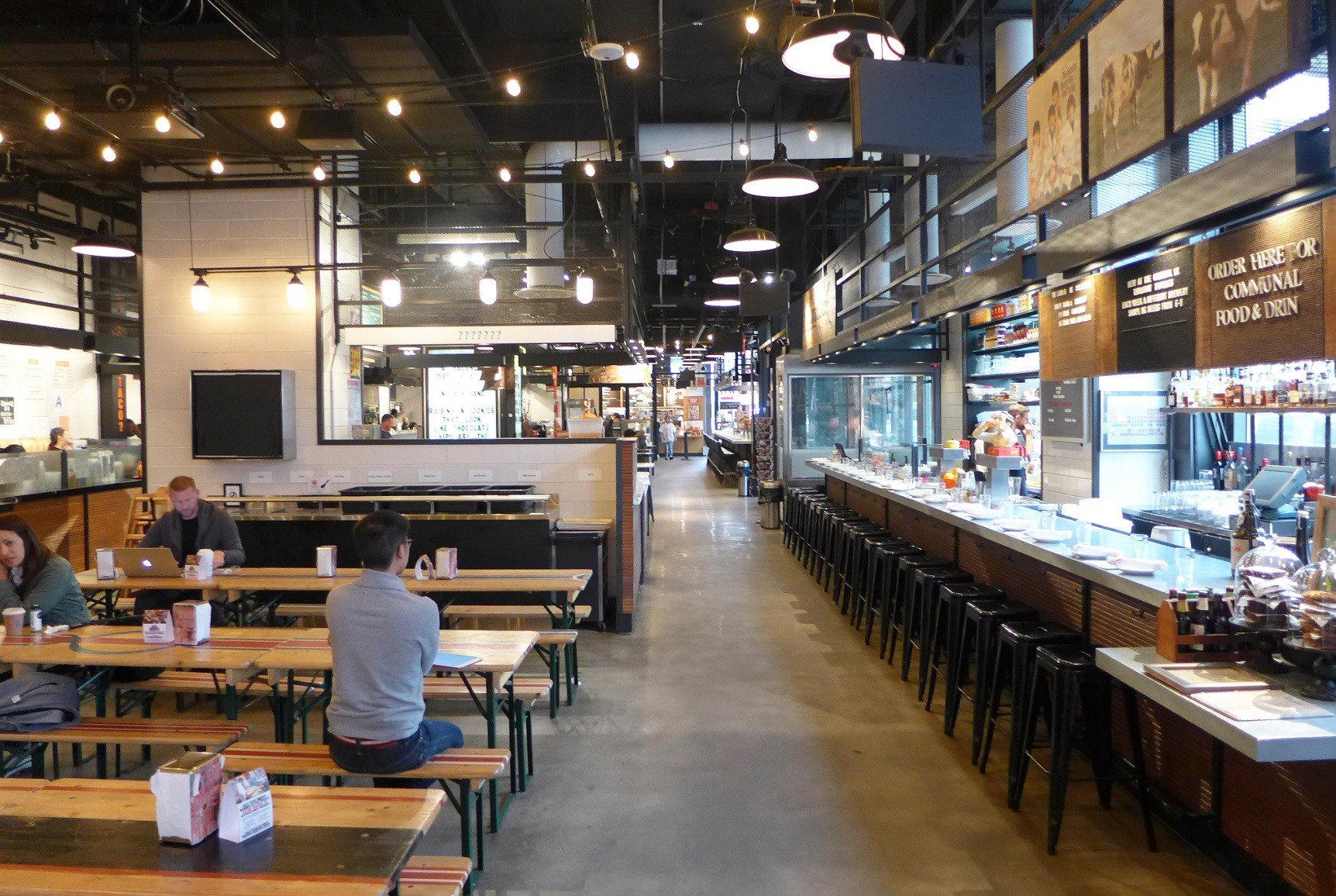
Hell's Kitchen's Food Hall Moment
Gotham West Market is a multi-vendor food hall in Hell's Kitchen, New York City, at 600 11th Ave. Hell's Kitchen, once defined by loading docks and transit infrastructure, now supports a residential density that has created genuine demand for the kind of communal, multi-vendor eating format that Gotham West Market occupies. The food hall model it represents, multiple operators sharing a single physical envelope, is now a settled feature of how certain American cities handle the gap between fast-casual convenience and the considered, single-kitchen experience.
That gap matters more in this part of New York than in, say, the West Village or Midtown proper. The blocks around 600 11th Ave are not naturally served by the concentration of independent restaurants that characterises other Manhattan dining corridors. A food hall in this location is not a lifestyle accessory; it functions more like neighbourhood infrastructure, and the vendors who occupy it tend to be evaluated on that basis rather than against the tasting-menu tier where Le Bernardin, Atomix, and Masa operate.
The Sustainability Argument for the Food Hall Format
Food halls have attracted growing attention from those thinking about the environmental cost of restaurant operations, and not without reason. Shared infrastructure, a single HVAC load, centralised waste handling, consolidated refrigeration, one delivery address for multiple operators, compresses the per-cover environmental footprint in ways a standalone restaurant cannot easily replicate. The model that Gotham West Market represents is worth examining through that lens, because the sustainability case is structural rather than decorative.
Compare this to the farm-integrated approach taken by venues like Blue Hill at Stone Barns in Tarrytown or Single Thread Farm in Healdsburg, where the sustainability story runs through sourcing relationships and agricultural philosophy. Those are single-operator propositions built around a chef's direct control of the supply chain. The food hall equivalent of that story is different: it is about shared physical plant, reduced redundancy, and the aggregation of foot traffic in a way that keeps per-meal transport emissions lower than a scattered set of standalone destinations would produce. Neither model is automatically superior; they are suited to different urban contexts and different price points.
For diners who cross-reference their eating choices against broader values, the multi-vendor format at this price tier represents a practical and accessible entry point, more so than the sourcing-forward tasting menus at Eleven Madison Park or the hyper-local frameworks that define places like Smyth in Chicago or Lazy Bear in San Francisco.
Positioning Within New York's Eating Spectrum
New York's dining options now span a range that is almost impossible to compress into a single hierarchy. At the formal end, per-person spend at venues like Per Se or Masa routinely exceeds $300 before wine. The restaurant operates in a category where the ceiling is considerably lower and the audience is commensurately broader. That breadth is not a weakness; it reflects a different function within the city's food ecology.
Food halls in this position, geographically peripheral to established dining corridors, anchored in a transitional neighbourhood, often become proving grounds for operators who are not yet ready to carry a standalone lease. The format provides a lower-risk environment for culinary concepts to be tested against real foot traffic, which has a knock-on effect on the variety and turnover of what is available. For visitors, that dynamism can work in their favour or against it, depending on what they are looking for. Consistency across visits is harder to guarantee than at a kitchen with a decade of operation behind it, like Emeril's in New Orleans or The French Laundry in Napa.
For a fuller map of New York's dining range, from this price tier to the Michelin-starred end of the spectrum, our full New York City restaurants guide covers the key options by neighbourhood and format.
Planning a Visit: What to Know Before You Go
The practical calculus for a food hall differs from the reservation-led venues that dominate premium dining coverage.
| Venue | Format | Price Tier | Booking Required |
|---|---|---|---|
| The restaurant | Food Hall, Multi-Vendor | $–$$ | No |
| Le Bernardin | Fine Dining, Seafood | $$$$ | Yes, weeks ahead |
| Per Se | Fine Dining, French | $$$$ | Yes, weeks ahead |
| Atomix | Fine Dining, Korean | $$$$ | Yes, months ahead |
| Eleven Madison Park | Fine Dining, Vegan | $$$$ | Yes, weeks ahead |
Transit access to 600 11th Ave requires either the M11 or M12 bus routes, or a short walk from the A/C/E subway lines at 42nd Street Port Authority. The location is not pedestrian-convenient from most Midtown hotels, which should factor into planning, particularly for evening visits. The neighbourhood is better served by rideshare than by subway for those arriving from south of 34th Street.
Broader Context: Ethical Sourcing Across Price Points
The conversation about ethical sourcing and waste reduction in restaurants has largely been conducted at the upper end of the price spectrum, where venues like Frasca Food and Wine in Boulder, Providence in Los Angeles, and internationally, Atelier Moessmer Norbert Niederkofler in Brunico and Dal Pescatore in Runate, have the margin to invest in transparent supply chains. The food hall format opens that conversation to a price point where the structural efficiencies of shared space do some of the work that sourcing philosophy does at the tasting-menu tier. They are different mechanisms toward a partially overlapping goal.
A Minimal comparable set
Comparable venues nearby, for context on price, style, and recognition.
| Venue | Cuisine | Price | Notes |
|---|---|---|---|
| Gotham West MarketThis venue — the venue you are viewing | Not listed | $$ | Not listed |
| Amaze | East Midtown-Turtle Bay, Asian Fusion | $$ | Not listed |
| Mexiterranean Grill | Not listed | $$ | Upper East Side-Lenox Hill-Roosevelt Island, Mexican-Mediterranean Fusion |
| Geisha Asian Fusion | Not listed | $$ | Washington Heights (North), Asian Fusion Sushi |
| Franchia | Not listed | $$$ | Midtown-Times Square, Pan-Asian Vegan Fusion |
| WARUDE | Not listed | $$ | Bedford-Stuyvesant (West), Japanese-Mexican Fusion Bowls and Tacos |
Continue exploring
More in New York City
Restaurants in New York City
Browse all →
Bars in New York City
Browse all →

Hotels in New York City
Browse all →





At a Glance
- Lively
- Casual
- Trendy
- Group Dining
- Family
- Casual Hangout
- After Work
- Open Kitchen
- Standalone
- Beer Program
Spacious, cozy food court atmosphere with community seating; casual and welcoming with a local pulse; described as a nice public market with good energy and not overly crowded.