
Falstaff Restaurant - 85 Falstaff Points
Our verdict
Gerbermühle occupies a historic mill building on the southern bank of the Main in Frankfurt's Sachsenhausen district, positioning it apart from the city's more conventional dining rooms. The address has long drawn guests for its riverside setting, placing it in a category of Frankfurt restaurants where atmosphere and location carry as much weight as what arrives on the plate.

Pearl is the En Primeur Club membership app, where members save venues, book tables and use the concierge.

The menu
What to order
- Schnitzel with green sauce
- Kaiserschmarren
- Tafelspitz
- Himmel und Erde
A Mill on the Main: Frankfurt's Riverside Dining Tradition
Frankfurt's relationship with the River Main is not incidental to its food culture. The southern bank, running through Sachsenhausen, has historically been where the city exhales: cider houses, apple wine taverns, and, at the more formal end of the spectrum, restaurants that trade as much on their physical address as on their kitchens. Gerbermühle, at Gerbermühlstraße 105, sits at the far end of this tradition. The building is a former tanner's mill, and arriving by the riverside path rather than by car gives you the stronger first impression: the structure faces the water directly, and the Main here is wide enough that the Frankfurt skyline sits at a cinematic remove across the surface.
That physical remove from the banking district is more than scenic. It places Gerbermühle in a different register from the hotel dining rooms and finance-district restaurants that define much of Frankfurt's formal eating. Where venues like Allgaiers Restaurant or Ariston operate in denser urban contexts, the Sachsenhausen mill address carries an inherent informality of approach, even when the food tilts toward the serious end of the dial.
The Local-Ingredient Tradition in Hessian Cooking
Hesse is not a region that generates the same international attention as Baden-Württemberg or Bavaria when it comes to fine dining. The broader German scene, which includes destinations like Schwarzwaldstube in Baiersbronn and Waldhotel Sonnora in Dreis, tends to cluster its Michelin-level prestige in the southwest and along the wine rivers. Frankfurt itself is more of a transit and business dining city than a destination cooking one, which creates space for restaurants that build identity around place and product rather than around chef celebrity or tasting-menu architecture.
The Frankfurt dining scene has also broadened considerably in the past decade. Spanish-influenced rooms like ALEJANDRO'S, modern Turkish cooking at Babam, and wine-led concepts such as atm by Deli&Grape all demonstrate that the city's restaurant culture is absorbing international technique at a pace that would have been harder to predict fifteen years ago. In that context, a restaurant anchored to a historic Hessian address occupies a counterpoint position: it can draw on the credibility of the location itself while still applying whatever contemporary approach the kitchen chooses.
That intersection of local material and imported method is precisely where many of Germany's most interesting restaurants currently operate. JAN in Munich and ES:SENZ in Grassau both demonstrate how German regional produce can be worked through techniques that owe as much to French or Scandinavian kitchens as to any local tradition. Whether Gerbermühle's current kitchen pursues that path, or whether it reads as a more traditional address, is something the booking process will clarify: the restaurant's own positioning is the clearest signal of where it sits in that spectrum.
Placing Gerbermühle in Frankfurt's Competitive Set
Frankfurt's restaurant map divides fairly cleanly between the high-formality hotel and finance-adjacent rooms, the neighbourhood bistro tier, and the destination-address category where setting accounts for a significant share of the proposition. Gerbermühle, by virtue of its mill building and Main frontage, belongs to that third category. Peers in the city tend to include other venues where arriving is itself part of the experience, where the reservation is as much about securing a position in space as about a specific tasting menu.
Across Germany more broadly, the addresses that have built lasting reputations in that destination-setting tier include Schanz in Piesport, where the Moselle vineyard context does similar atmospheric work, and Vendôme in Bergisch Gladbach, which uses a schloss setting to reinforce its position in the upper tier. Gerbermühle's riverside mill occupies a different register from those, but the underlying logic is the same: the address is doing substantive work in defining the experience before a single plate arrives.
At the technical extreme, German fine dining has produced destinations like Victor's Fine Dining by Christian Bau in Perl, Aqua in Wolfsburg, and the format experiment of CODA Dessert Dining in Berlin. It belongs to a different but equally legitimate category: restaurants where the building, the river, and the Sachsenhausen neighbourhood form the primary argument for the visit. Internationally comparable addresses might include Le Bernardin in New York City or Lazy Bear in San Francisco, where institutional clarity of concept is the signature, though Gerbermühle's character is closer in spirit to Restaurant Haerlin in Hamburg, another German city-dining room where a historic address frames the formal ambition.
Planning Your Visit
Gerbermühle sits at Gerbermühlstraße 105 in the Sachsenhausen district. Reaching it by foot along the southern Main embankment from the Schweizer Platz area takes roughly fifteen minutes and gives the clearest sense of how the building relates to the river. The Sachsenhausen apple wine quarter is within walking range, which makes a pre- or post-dinner circuit through that neighbourhood a practical option. As with most Frankfurt restaurants that carry a settled address reputation, contacting the venue directly for current hours, reservation availability, and any seasonal programming is the most reliable approach, given that operational details shift with the calendar.
For a broader orientation to where Gerbermühle fits within Frankfurt's eating options across every price point and neighbourhood, the full Frankfurt restaurants guide maps the city's dining character in more detail.
Frequently asked questions
What do people recommend at Gerbermühle?
Gerbermühle's address in a historic mill on the Main riverbank is consistently cited as the defining element of the experience. The restaurant occupies a position in Frankfurt's dining scene where the setting and the Sachsenhausen neighbourhood context contribute as materially to the visit as any specific dish. Comparable Frankfurt addresses such as Allgaiers Restaurant offer a useful comparison for how the city's mid-to-upper dining tier presents its food.
Do I need a reservation for Gerbermühle?
For a Frankfurt restaurant with an established address reputation and riverside setting, advance booking is the more reliable approach, particularly on weekends and during the warmer months when outdoor or waterside seating at Sachsenhausen venues sees heavier demand. Frankfurt's dining calendar is also shaped by trade fair periods, when the city's restaurant occupancy rises sharply across all tiers. Contacting the venue directly is the most current method, as booking systems and availability windows vary between individual restaurants rather than conforming to a city-wide standard.
What is the historical significance of the Gerbermühle building in Frankfurt?
The Gerbermühle has roots as a working mill in Frankfurt's Sachsenhausen district, and the building carries particular literary resonance: it was associated with Johann Wolfgang von Goethe, who visited the property in the early nineteenth century, giving it a cultural context that extends well beyond its restaurant history. That heritage situates the address in a small category of Frankfurt dining venues where the building itself predates the restaurant by centuries. For visitors interested in Frankfurt's literary and architectural history, the location sits in a part of Sachsenhausen where the Main embankment still reads as one of the older edges of the city.
The Minimal Set
Comparable venues nearby, for context on price, style, and recognition.
| Venue | Cuisine | Price | Awards | Notes |
|---|---|---|---|---|
| GerbermühleThis venue (the venue you are viewing) | Modern German with International Influences | $30–50 | Falstaff Restaurant - 85 Falstaff Points | Not listed |
| Allgaiers Restaurant | French-inspired German | Not listed | Falstaff Restaurant - Listed | Goethehaus, French-inspired German |
| Stanley Diamond | Modern German Comfort Food | Not listed | Not listed | Goethehaus, Modern German Comfort Food |
| Iroha | Authentic Japanese Sushi | $30–50 | Not listed | Roemerberg, Authentic Japanese Sushi |
| Brasserie du Sud | Classic French Brasserie | $50–100 | Not listed | Sachsenhausen, Classic French Brasserie |
| Mutter Ernst | Traditional German Hausmannskost | $20–30 | Not listed | Roemerberg, Traditional German Hausmannskost |
Recognition history
Dated appearances from independent guides and award organizations, with the underlying list record or original source where available.
Falstaff Restaurant - 85 Falstaff Points
Falstaff
Continue exploring
More in Frankfurt
Restaurants in Frankfurt
All restaurants in Frankfurt →
Bars in Frankfurt
All bars in Frankfurt →
Hotels in Frankfurt
All hotels in Frankfurt →

Gerbermühle
The wine
- Extensive wine list
- Craft cocktails
- Beer program
Details
- Romantic
- Classic
- Scenic
- Elegant
- Well Known
- Cozy
- Date Night
- Group Dining
- Family
- Casual Hangout
- Special Occasion
- Waterfront
- Garden
- Terrace
- Historic Building
- Standalone
- Extensive Wine List
- Craft Cocktails
- Beer Program
- Local Sourcing
- Waterfront
- Skyline
- A La Carte
- Family Style
- Wine
- Craft Cocktails
- Beer
- Vegetarian Friendly
- Vegan Options
Current opening hours
- Monday
- Closed
- Tuesday
- 11:30 AM–10:30 PM
- Wednesday
- 11:30 AM–10:30 PM
- Thursday
- 11:30 AM–10:30 PM
- Friday
- 11:30 AM–10:30 PM
- Saturday
- 11:30 AM–10 PM
- Sunday
- 11:30 AM–9:30 PM
Hours can change for holidays and private events. Hours as of .
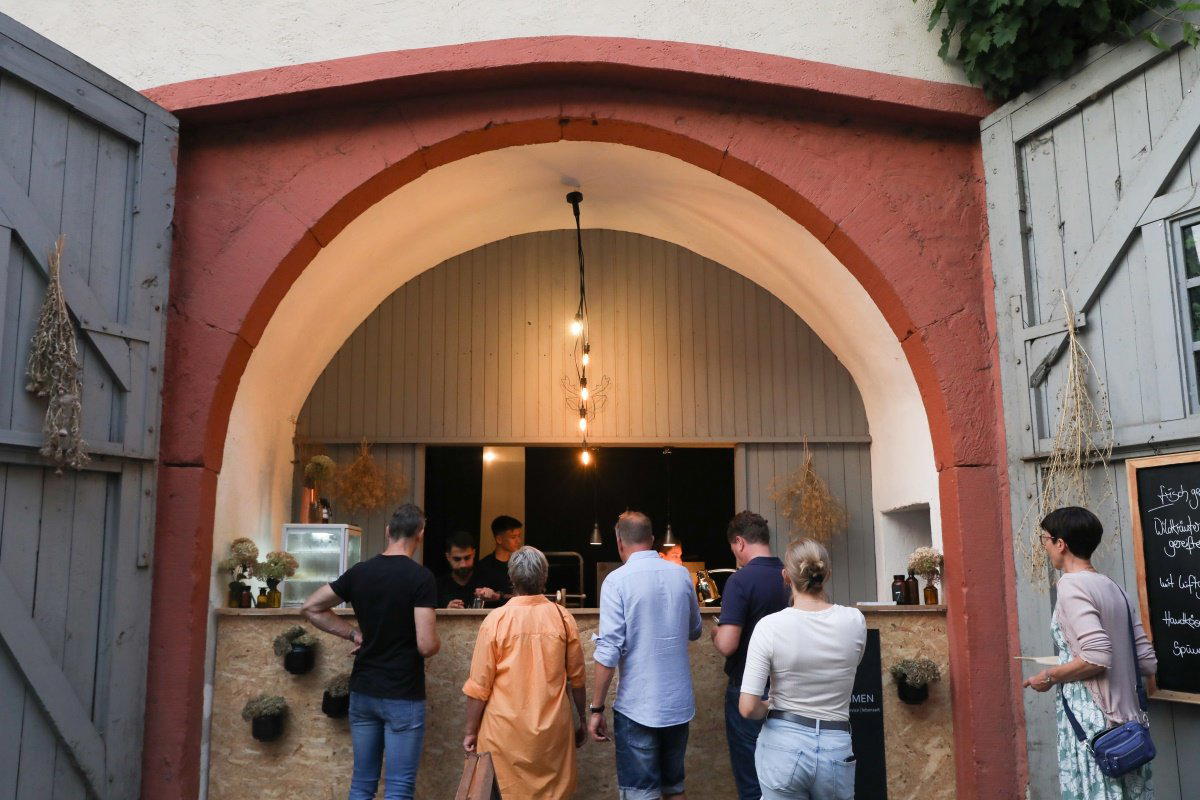
Warm, welcoming, and homey country estate atmosphere with elegant dining rooms and conservatory; chestnut trees and riverside setting create a tranquil escape from urban noise.