
Genki belongs to Tokyo’s smaller, ingredient-led okonomiyaki conversation: wheat batter, cabbage, seafood, meat, sauce, steam, and griddle work treated with the seriousness usually reserved for pricier counters. Its repeated Tabelog Okonomiyaki 100 selections through 2025 place it in a vetted national category, while the Kinshicho setting keeps the experience closer to izakaya culture than formal dining.
Pearl is the En Primeur Club membership app — saves, bookings, and concierge access live there. Same editors, same standards.
- Address
- Japan, 〒130-0013 Tokyo, Sumida City, Kinshi, 4 Chome−14−9 本間ビル
- Phone
- +81 3-3621-4189
- Website
- tabelog.com
 Saves & bookings on Pearl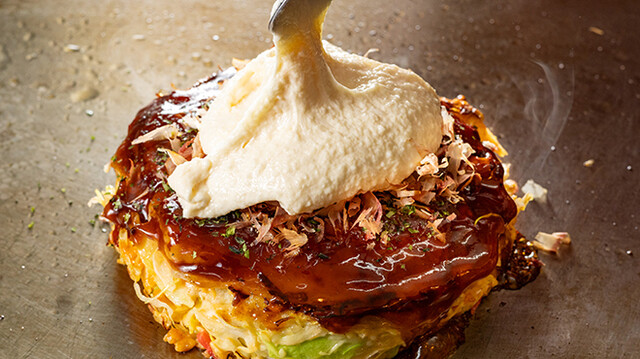
Kinshicho’s north side has a different rhythm from the polished dining corridors of Ginza or Aoyama. The area works late, drinks early, and feeds people who want heat, smoke, and speed without ceremony. In that context, okonomiyaki is not nostalgia food; it is ingredient management in public view. Batter has to carry cabbage without turning heavy, seafood and meat need enough time on the iron to develop depth, and the sauce cannot be allowed to do all the talking. Genki sits inside that grammar of griddle cooking, where a modest room can say more about Tokyo eating habits than another high-budget tasting counter.
Tokyo’s okonomiyaki scene is often misread as casual by default. The category is casual in posture, not in execution. Konamon, the broad family of flour-based Japanese cooking, depends on ratios, timing, and temperature control. A dull version becomes a soft pancake under sweet sauce; a serious version keeps texture, seasoning, and toppings in balance. Recognition in Tabelog’s Okonomiyaki 100 for 2025, with earlier selections in 2024, 2023, 2022, and 2018, matters because the list separates durable specialists from places that merely offer the dish as drinking food.
Okonomiyaki as ingredient discipline, not comfort-food shorthand
The appeal here is the way okonomiyaki bridges two Tokyo dining instincts: the democratic pull of izakaya cooking and the city’s obsession with narrow specialization. In a sushi room, sourcing is discussed through fish markets, aging, and knife work. At a griddle counter, the conversation is less formal but no less dependent on supply. Cabbage quality changes texture. Seafood, pork, and batter ratios decide whether the pancake eats cleanly or collapses into weight. Teppanyaki technique supplies the final test: heat must brown, steam, and bind at once.
That makes Genki useful for travelers who want a Tokyo meal outside the familiar hierarchy of omakase, ramen, and wagyu. The cooking category is built for groups and drinks, but the repeated award recognition places it closer to a specialist address than a fallback pub. The drinks range across sake, shochu, wine, and cocktails, which aligns the room with izakaya behavior rather than restaurant formality. It is a format for conversation, sharing, and repeat ordering, not a chef-narrated sequence.
Kinshicho strengthens that point. Sumida’s dining culture does not trade on international luxury cues; it rewards places that can hold local attention over time. Compared with the broader Tokyo spread, nearby references show the district’s range: Venu's South Indian Dining Kinshichou ten sits in a similar dinner price band, ASIA CURRY HOUSE operates at a lower everyday register, and Tori Ki occupies a higher-ticket yakitori bracket. Genki’s position is different again: griddle-led, drink-compatible, and anchored in a category where texture and timing are the real credentials.
The room belongs to Tokyo's compact, smoke-tolerant izakaya tradition
The format is small, with counter seating and tables rather than a dining-room procession. That matters because okonomiyaki loses part of its logic when treated like plated restaurant food. The griddle is both kitchen and stage, but not in the theatrical sense. It is where the customer can read pacing, heat, and volume. In Tokyo, this kind of compact room has become less common in new openings, especially as central rents push restaurants toward higher-yield formats. A small okonomiyaki specialist in Sumida occupies another lane: lower in cost than tasting-menu dining, higher in craft than a generic drinking stop.
The adult-only smoking policy also places the restaurant firmly in an older izakaya lineage. For some travelers, that will be a reason to choose elsewhere; for others, it explains the social shape of the meal. This is not a family lunch address or a neutral dining room designed for every preference. It is better understood as an evening okonomiyaki and teppanyaki stop for adults who are comfortable with the conventions of a smoking izakaya.
That specificity is the strength. Tokyo has become fluent in exportable dining formats, but okonomiyaki remains stubbornly local in how it is eaten: shared plates, hot iron, drinks on the table, a room that turns on pace rather than polish. Genki’s award history gives the venue a credentialed reason to cross town, while the category itself gives the meal cultural weight. The food comes from ordinary ingredients made accountable by heat. That is the point.
How to place it within a Tokyo itinerary
For a traveler mapping Tokyo by dining type, this is a useful counterweight to higher-ritual meals. Pairing it with yakitori, curry, coffee, or bars in other neighborhoods gives a more accurate read of the city than stacking only prestige counters. For broader planning, see Our full Tokyo restaurants guide, then compare adjacent categories through Our full Tokyo bars guide, Our full Tokyo hotels guide, Our full Tokyo experiences guide, and Our full Tokyo wineries guide.
Useful Tokyo contrasts include seafood-led drinking at. 鮪と炭火焼き うお炭 秋葉原店, Shinjuku dining at 12/10 Shinjuku ten, yakitori focus at 124. KAGURAZAKA (Yakitori), visual cafe culture at 2D Cafe, and curry specialization at 3 Chome no Curry Ya San. Beyond Tokyo, the wider Japanese and Japanese-influenced map runs from -Grilled beef Sukiyaki- KAMAKURA TANUKIAN 鎌倉 たぬき庵 in Kamakura.cafe in Osaka.know in Kumamoto, (Shoku) Vietnam in Kawasaki, [Curry Senmon Ten] Maruyama Kyoju. in Sapporo, and [ki:] in Kyoto to Los Angeles-area references such as Jōdo Saké Bar in Los Angeles and Onigiri Time in Pasadena.
A Quick Peer Check
Comparable venues to place this listing in its category.
| Venue | Cuisine | Price | Notes |
|---|---|---|---|
| GenkiThis venue — the venue you are viewing | Okonomiyaki / Teppanyaki / Izakaya | $$ | Not listed |
| Yamacho (黒うどん 山長) | Black Udon (Kuro Udon) | $$ | Harajuku |
| Yakiniku Uguisudanien | Japanese Yakiniku (Grilled Wagyu) | $$ | Taitō |
| 久丹 | Fine Dining Japanese | Not listed | Chūō |
| TIES | Japanese Kissaten / Cafe | $$ | Bunkyō |
| Tonkatsu Iwai | Tonkatsu | $$ | Minato |
Recognition history
Dated appearances from independent guides and award organizations, with the underlying list record or original source where available.
Tabelog 100 #74 · No. 74
Tabelog · Tabelog 100 - Okonomiyaki - 2025






At a Glance
- Cozy
- Classic
- Lively
- Group Dining
- Casual Hangout
- After Work
- Family
- Standalone
- Sake Program
- Beer Program
- Craft Cocktails
Current opening hours
- Monday
- Closed
- Tuesday
- 5–11 PM
- Wednesday
- 5–11 PM
- Thursday
- 5–11 PM
- Friday
- 5–11 PM
- Saturday
- 5–10:30 PM
- Sunday
- 5–10 PM
Hours can change for holidays and private events. Last verified .
Compact, informal, and bustling, with a casual neighborhood feel and a lively dinner atmosphere centered on counter and table seating.