
Fukutarou Honten sits in Osaka’s Sennichimae konamon belt, where okonomiyaki is treated less as a snack than as civic grammar. Its Tabelog 100 Okonomiyaki 2025 selection, long run of prior selections, and teppanyaki format place it in the serious end of a category built on cabbage, batter, heat, and timing rather than luxury signals.
Pearl is the En Primeur Club membership app — saves, bookings, and concierge access live there. Same editors, same standards.
- Address
- 2 Chome-3-17 Sennichimae, Chuo Ward, Osaka, 542-0074, Japan
- Phone
- +81 6-6634-2951
- Website
- 2951.jp
 Saves & bookings on Pearl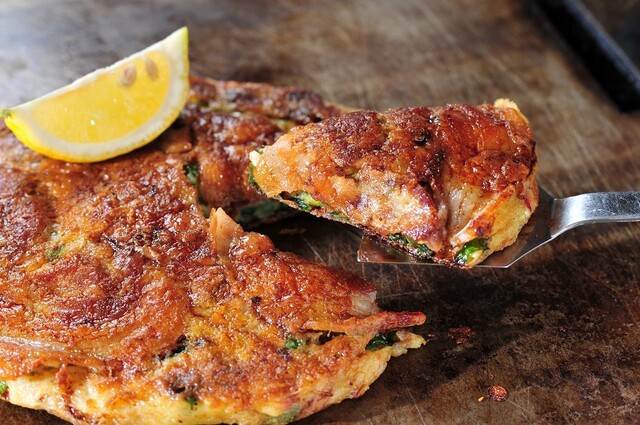
Approaching Sennichimae, Osaka’s appetite announces itself in layers: griddles, noren, station traffic, and the compact theatre of cooks working close enough for diners to read the rhythm of the spatula. This is the city’s konamon territory, where flour-based cooking carries a different weight than it does elsewhere in Japan. Okonomiyaki in Osaka is not a nostalgic side note; it is a working cuisine with neighborhood loyalty, late-night utility, and enough technical variation to reward repeat eating.
Within that setting, Fukutarou Honten belongs to the more serious tier of Osaka okonomiyaki houses. The recognition matters: selection for Tabelog 100 Okonomiyaki 2025, with earlier selections in 2024, 2023, 2022, 2019, and 2018, signals consistency in a category where many restaurants trade on energy alone. The venue’s Tabelog score of 3.72 is less important as a trophy than as a marker of sustained approval in a city that grades this dish with local severity.
Osaka okonomiyaki is ingredient discipline disguised as comfort food
The easy mistake is to treat okonomiyaki as casual because the price band is accessible and the format is social. In Osaka, the better version depends on proportion: cabbage cut to release moisture without collapsing, batter used as binder rather than bulk, seafood or meat folded in with restraint, and sauce applied as punctuation rather than camouflage. Teppanyaki gives the kitchen little cover. Heat management, timing, and surface texture are exposed in real time.
That is where ingredient sourcing becomes more than a procurement note. Konamon cooking is built from everyday materials, so quality shows through small differences: the sweetness of cabbage, the freshness of seafood, the fat and salt balance of pork, the way flour and egg hold without turning heavy. Osaka’s long-standing okonomiyaki culture prizes generosity, but not looseness. A plate can be casual and exacting at once.
Fukutarou Honten’s category listing spans okonomiyaki, teppanyaki, and steak, which places it inside a broader griddle tradition rather than a single-dish shop. That matters for diners comparing Osaka tables. Takada Noageage and Datedachi sit in a similar JPY 2,000 to JPY 2,999 dinner band, while Stand Aida and Ankera So push into JPY 3,000 to JPY 3,999, and Konamon Dokoro Mitsukuni Ura nanba ten reaches JPY 5,000 to JPY 5,999. Fukutarou Honten’s appeal is not luxury pricing; it is category credibility in the city where the form is judged hardest.
The room favors griddle proximity over ceremony
The experience is closer to Osaka vernacular dining than polished kappo. A 76-seat layout split across counter, table, and tatami seating gives the room scale without removing the central drama of the iron plate. The counter count is meaningful: in teppanyaki and okonomiyaki restaurants, proximity changes the meal from plate delivery to process watching. The dish is assembled through sequence, not reveal.
This is also why the absence of a named chef is not a weakness here. Okonomiyaki culture rarely depends on auteur biography in the way Tokyo sushi or Kyoto kaiseki can. The better question is whether the house keeps the form disciplined across service, across years, and across local scrutiny. Repeated Tabelog 100 Okonomiyaki selections provide the stronger signal for this category than a personality-led narrative would.
The Sennichimae location gives the meal its proper urban frame. Namba’s dining area is dense, practical, and competitive, with takoyaki counters, ramen shops, standing bars, department-store food halls, and destination restaurants all pressing into the same evening circuit. For a wider read on the city’s dining range, see Our full Osaka restaurants guide; for planning beyond dinner, the adjacent city guides cover Osaka hotels, Osaka bars, Osaka wineries, and Osaka experiences.
How to read the choice, not just the address
The restaurant makes the strongest case for travelers who want Osaka’s everyday food treated with category seriousness. It is not the move for diners seeking hushed ceremony, a chef-led tasting menu, or a room built around rare ingredients. It is the move when the point is to understand how a city turns batter, cabbage, griddle work, and sauce into a benchmark cuisine.
That distinction matters in Osaka, where casual formats can be harder to judge than luxury restaurants. Awards help separate durable houses from tourist heat, but the reader’s own expectations should do the final filtering. The restaurant suits a group meal, a counter-led introduction to okonomiyaki technique, or a first-night Namba dinner that avoids both overplanning and randomness. Take-out service adds flexibility, while the non-smoking policy makes it easier to fold into a longer evening.
For nearby and broader Osaka comparisons, EP Club’s restaurant index includes casual and specialist addresses such as.cafe, 52CHO-ME BAKERY, 551 Horai (551蓬莱), 99 Pizza Napoletana Gourmet, and a canto (Italian). Wider Japan and international references include -Grilled beef Sukiyaki- KAMAKURA TANUKIAN 鎌倉 たぬき庵 in Kamakura. 鮪と炭火焼き うお炭 秋葉原店 in Tokyo.know in Kumamoto, (Shoku) Vietnam in Kawasaki, [Curry Senmon Ten] Maruyama Kyoju. in Sapporo, [ki:] in Kyoto, Jōdo Saké Bar in Los Angeles, and Onigiri Time in Pasadena.
Cuisine and Awards Snapshot
Comparable venues in the metro at similar price points.
| Venue | Cuisine | Price | Notes |
|---|---|---|---|
| Fukutarou HontenThis venue — the venue you are viewing | Osaka okonomiyaki & teppanyaki | $$ | Not listed |
| Ramen Chonmage Osaka Tenroku | Japanese Ramen | $$ | Tenjinbashi |
| Kakomo Kitahama ten | Japanese Standing Bar | $$ | Chūō |
| Sora Tsuruhashi souhonten | Traditional Osaka yakiniku & horumon | $$ | Tennōji |
| Izumi Burger | Yoshoku European-style curry & hamburger steak | $$ | Nishi |
| Oden Marukome | Osaka oden izakaya | $$ | Nishinari |
Recognition history
Dated appearances from independent guides and award organizations, with the underlying list record or original source where available.
Tabelog 100 #90 · No. 90
Tabelog · Tabelog 100 - Okonomiyaki - 2025
Continue exploring
More in Osaka
Restaurants in Osaka
Browse all →




Bars in Osaka
Browse all →




Hotels in Osaka
Browse all →



Wineries in Osaka
Browse all →
At a Glance
- Lively
- Cozy
- Classic
- Well Known
- Casual Hangout
- Family
- Group Dining
- Solo
- After Work
- Open Kitchen
- Standalone
- Beer Program
- Local Sourcing
- Street Scene
Current opening hours
- Monday
- 5–10:45 PM
- Tuesday
- 5–10:45 PM
- Wednesday
- 5–10:45 PM
- Thursday
- 5–10:45 PM
- Friday
- 5–10:45 PM
- Saturday
- 12–10:45 PM
- Sunday
- 12–10:45 PM
Hours can change for holidays and private events. Last verified .
Bustling and cozy with counter, table, and tatami seating around hot iron griddles, creating a lively, classic Osaka teppanyaki atmosphere focused on watching chefs cook right in front of you.