Fornos of Spain
On Ferry Street in Newark's Ironbound district, Fornos of Spain has anchored the neighbourhood's Iberian dining tradition for decades. The kitchen draws on Spanish culinary conventions in a corridor where Portuguese and Spanish cooking exist side by side, making it a reliable reference point for the area's old-world character. Fornos sits at the heart of one of the most concentrated Iberian dining corridors on the East Coast.
Pearl is the En Primeur Club membership app — saves, bookings, and concierge access live there. Same editors, same standards.
- Address
- 47 Ferry St, Newark, NJ 07105
- Phone
- +19735894767
- Website
- fornosofspain.com
- Directions
- Get directions
 Saves & bookings on Pearl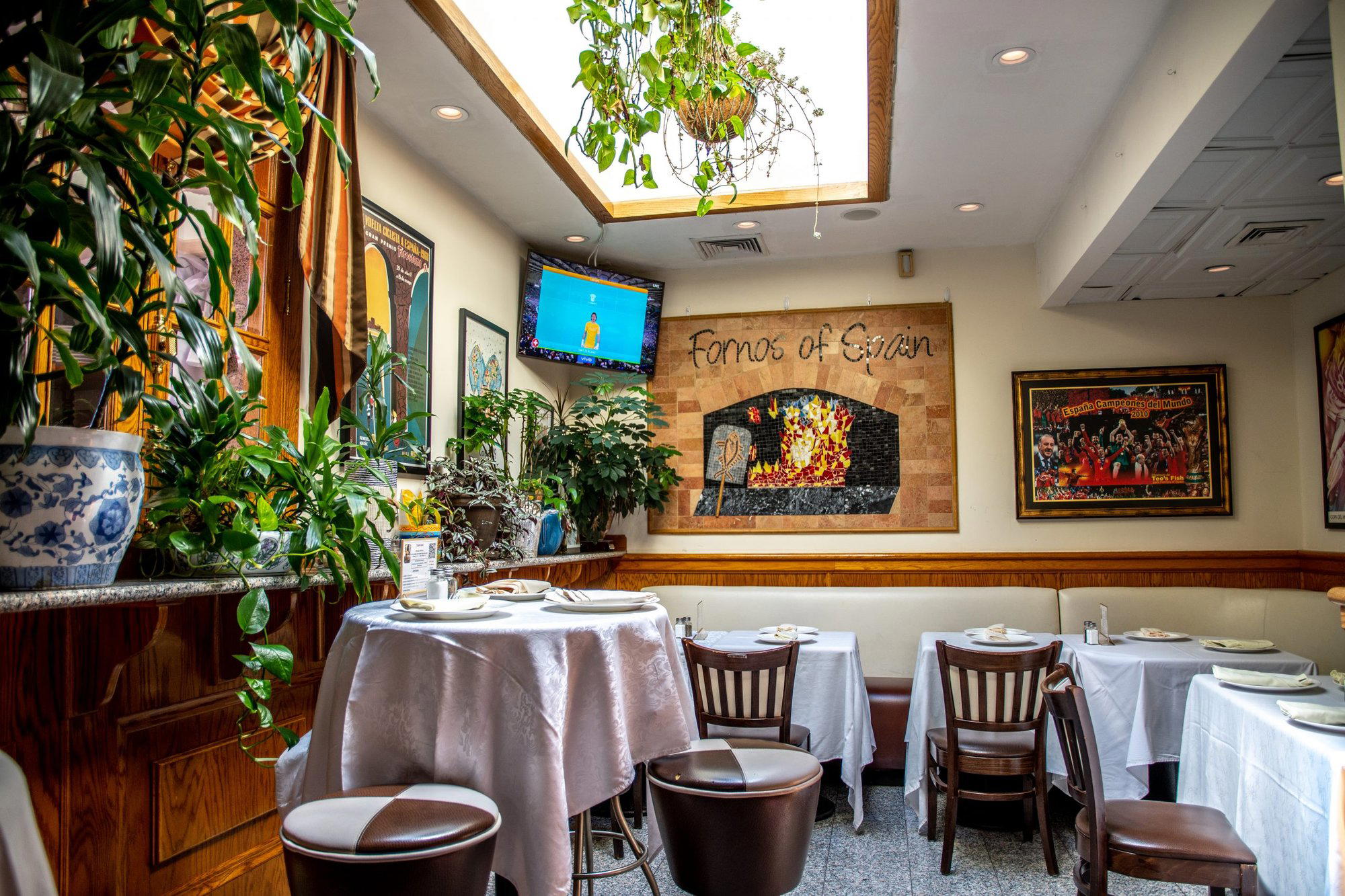
The Ironbound and Its Iberian Table
Ferry Street in Newark's Ironbound neighbourhood operates as one of the most concentrated corridors of Iberian cooking on the eastern seaboard. The blocks between Penn Station Newark and the Passaic River hold Portuguese tascas, Spanish seafood houses, and decades-old dining rooms that have outlasted trends in New York City just ten miles west. Fornos of Spain at 47 Ferry Street sits inside this tradition, a Spanish address in a stretch where Spanish and Portuguese kitchens have competed for the same tables since the mid-twentieth century.
The Ironbound's character comes from immigration patterns that predate the current wave of food-media interest in Newark. Spanish and Portuguese communities settled this neighbourhood in large numbers through the 1950s and 1960s, and the restaurant corridor they built never fully assimilated into the homogenised dining culture that reshaped other American ethnic enclaves. What remains is a dining district that functions more like a southern European neighbourhood than a theme park version of one: practical, consistent, and oriented toward regular custom rather than tourist capture. Fornos occupies that world.
How the Menu Speaks
Spanish restaurant menus in the Ironbound tend to follow a structure that differs sharply from the small-plates format that defines Spanish dining in New York City. Where Manhattan's Iberian rooms have largely adopted the tapas-and-sharing format, Ferry Street's Spanish kitchens have maintained a more traditional full-service architecture: appetisers, soups, mains with sides, and the kind of portion discipline that signals a restaurant built around regular diners eating full meals rather than grazing professionals ordering strategically. This structural choice is itself an editorial statement about who the restaurant serves and how.
Spanish cooking at this tier in the Ironbound tends to anchor around proteins: whole fish preparations, roasted meats, shellfish, and rice dishes that draw on Valencian and Galician traditions rather than the Catalan-inflected menus that dominate more fashion-conscious Spanish rooms. The menu architecture at a restaurant like Fornos reflects a culinary lineage that treats the main course as the centrepiece and the rest of the meal as frame rather than feature. That conservatism is not a weakness in this context. It is the point.
Compared to the broader Newark dining scene, which has diversified considerably in recent years with arrivals like Konoz Restaurant and Seoul Tofu House extending the neighbourhood's culinary range, the Ferry Street Iberian corridor holds a different position: it is the original layer, the founding sediment beneath newer arrivals. Fornos and its peers, including Campino Restaurant and Don Pepe Restaurant, operate within a tradition rather than against one.
Within the Ironbound specifically, Spanish restaurants occupy a narrower competitive band than the Portuguese houses. The Portuguese dining tradition runs deeper numerically on Ferry Street, with more establishments and a stronger claim on the neighbourhood's culinary identity in terms of sheer volume. Spanish rooms like Fornos function as the minority voice within an Iberian chorus, which gives them a slightly different character: they tend to draw a more deliberately chosen clientele, diners who have made a specific choice rather than defaulting to the dominant local option.
Venues like Jack's Restaurant and Bar represent a different register of Newark dining, one oriented toward a broader bar-and-grill format. Fornos operates at a different frequency: specifically Iberian, specifically rooted, and less interested in performing accessibility for a general audience.
For context at the far end of the American fine dining spectrum, rooms like Le Bernardin in New York City, The French Laundry in Napa, or Atomix in New York City represent a completely separate category of dining ambition, one oriented toward tasting menus, critical validation, and international positioning. The Ironbound's Spanish rooms including Smyth in Chicago or Blue Hill at Stone Barns in Tarrytown as reference points would be a category error. Fornos belongs to a tradition of community-anchored dining where consistency over time is the primary credential, not critical acclaim or tasting-menu innovation.
Getting There and Planning Your Visit
The Ironbound is accessible by rail via Newark Penn Station, which sits within walking distance of Ferry Street and connects directly to New York Penn Station via NJ Transit in under twenty minutes. That proximity to Manhattan makes the neighbourhood genuinely practical for a dining excursion, particularly given the price differential between Ironbound dining and equivalent-quality Spanish cooking in New York City. The corridor's restaurants draw a mixed audience of local regulars, New Jersey suburban diners, and cross-river visitors who have made the calculation that the travel is worthwhile.
Timing matters on Ferry Street. Weekend evenings bring the highest volume across the corridor, and the most established rooms fill through regular custom rather than reservation systems built for incoming traffic. Arriving earlier in the evening, or opting for a weekday visit, gives a more settled experience of what these rooms actually are rather than what they become under peak-night pressure. For a fuller picture of Newark's dining options beyond the Ironbound, our full Newark restaurants guide maps the city's broader dining patterns.
Travellers comparing the Ironbound to Spanish dining in other American cities will find that the New Jersey corridor occupies a genuinely different position from Spanish rooms in Los Angeles (see Providence for a sense of the LA fine dining register) or San Francisco (where Lazy Bear represents a distinctly California-inflected approach to serious dining). The Ironbound does not attempt what those cities do. It does something older and less mediated.
For those drawn to the international reference point, European dining rooms with similar community-anchored longevity include addresses like Atelier Moessmer Norbert Niederkofler in Brunico, though the culinary ambition and price tier differ considerably. The comparison is structural, not qualitative: both represent restaurants that have earned their position through duration and local relationship rather than through critical machinery. Additional American reference points with different dining registers include Emeril's in New Orleans, Addison in San Diego, Single Thread Farm in Healdsburg, and The Inn at Little Washington in Washington, all of which operate in a register of critical ambition that Ferry Street's Iberian corridor does not seek.
Continue exploring
More in Newark
Restaurants in Newark
Browse all →
Bars in Newark
Browse all →
Hotels in Newark
Browse all →








At a Glance
- Classic
- Cozy
- Group Dining
- Family
- Celebration
- Date Night
- Private Dining
Current opening hours
- Monday
- 11:30 AM–10:30 PM
- Tuesday
- 11:30 AM–10:30 PM
- Wednesday
- 11:30 AM–10:30 PM
- Thursday
- 11:30 AM–10:30 PM
- Friday
- 12–11 PM
- Saturday
- 12–11 PM
- Sunday
- 12–10:30 PM
Hours can change for holidays and private events. Last verified .
Old world Spanish charm with inviting decorations, busy activity, and warm attentive service.
Know Before You Go
- Getting there
- 47 Ferry St, Newark, NJ 07105