Our verdict
Food Bazar occupies a central address on Dorotheenstraße in Stuttgart's city core, placing it within reach of the wider dining conversation that runs through Baden-Württemberg. With minimal publicly available data, the venue holds a degree of editorial mystery that warrants a closer look from visitors approaching Stuttgart's market-hall and street-food tier. Check directly for current hours, menus, and booking availability before visiting.

Pearl is the En Primeur Club membership app, where members save venues, book tables and use the concierge.
Stuttgart's Market-Hall Tier and Where Food Bazar Sits
Stuttgart's dining scene has long been defined by its upper register: a cluster of Michelin-recognised kitchens concentrated in and around the city, with the broader Baden-Württemberg region supplying some of Germany's most decorated tables. Speisemeisterei and Délice anchor the creative fine-dining end; Hegel Eins and 5 cover the modern-cuisine ground. What sits below that tier, in the city's market-hall, street-food, and informal gathering formats, is considerably less documented in English-language editorial, and that gap matters for travellers whose appetite doesn't track Michelin stars exclusively.
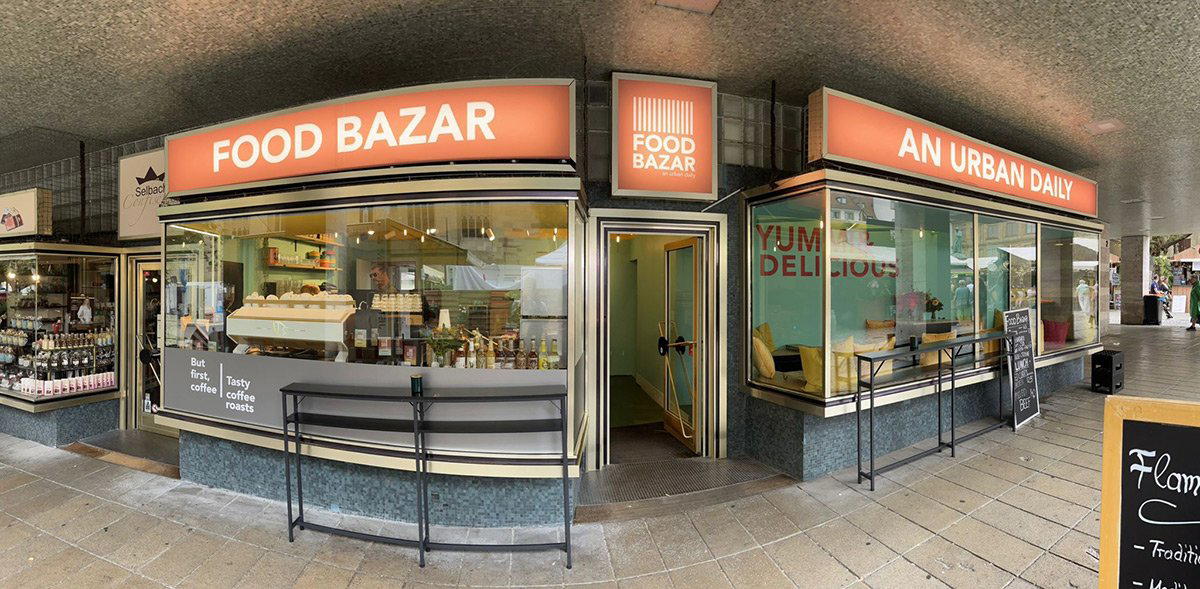
Food Bazar at Dorotheenstraße 3, in Stuttgart's 70173 postal district, sits within the city centre's commercial and pedestrian corridor. The address places it close to the Königstraße retail axis and within walking distance of the Hauptbahnhof, which means it functions as a genuinely accessible urban stop rather than a destination requiring planning. In a city where the highest-profile tables, like Der Zauberlehrling, require forward booking and occasion framing, a central informal venue fills a different but equally necessary role in how visitors actually eat across a multi-day stay.
The Sustainability Lens on German Informal Dining
Across Germany, the informal and market-hall dining format has become one of the more interesting sites for sustainability-led thinking. The logic is structural: a venue that sources from multiple vendors, rotates its offer with seasonal availability, and operates without the overhead of a fixed printed menu is, by design, closer to a low-waste model than a traditional à la carte kitchen. Baden-Württemberg has particular pull here, the region's agricultural diversity, from the Swabian Alb's heritage grains to the Neckar valley's produce, gives sourcing-conscious operators genuine local supply chains to work with.
Germany's broader food-market movement, which has grown steadily since the early 2010s, reflects a consumer shift toward provenance transparency. Markets and bazar-format venues attract operators who are already working with shorter supply chains because the format rewards daily or weekly restocking over fixed inventory. Visitors interested in how German cities are rethinking informal food spaces will find the market-hall tier, of which Food Bazar forms a part, more consequential than it might initially appear.
For comparison at the fine-dining end of the sustainability conversation, venues like ES:SENZ in Grassau and Schanz in Piesport have made regional sourcing central to their editorial identity. The informal tier doesn't operate at that level of documented intention, but it often delivers the outcome more directly through sheer proximity to supply.
The City-Centre Positioning and What It Signals
A Dorotheenstraße address in central Stuttgart is not incidental. The street sits within the city's commercial core, which means the venue is drawing from a mixed catchment: office workers at lunch, transit passengers, tourists working through the city's central sites, and locals who treat this part of the city as a daily route. That kind of location tends to produce a different operational model than a neighbourhood dining room or a destination restaurant on the city's hillside periphery.
Stuttgart's peer cities in southern Germany operate similar central market formats with varying degrees of permanence and vendor rotation. JAN in Munich represents the fine-dining pole of that city's scene; the informal central tier in Munich, as in Stuttgart, is considerably less visible to English-language travel publishing despite carrying a significant share of actual daily eating. Food Bazar occupies a position in Stuttgart's scene that is, in editorial terms, under-reported relative to its likely daily footfall.
Placing Food Bazar Against the Wider German Table
Germany's fine-dining conversation at the national level runs through venues with significant Michelin presence: Schwarzwaldstube in Baiersbronn, Aqua in Wolfsburg, Vendôme in Bergisch Gladbach, and Waldhotel Sonnora in Dreis hold the upper bracket. Victor's Fine Dining by Christian Bau in Perl and Restaurant Haerlin in Hamburg extend that map geographically. Food Bazar sits in an entirely different category from these, not because it is lesser, but because it is playing a different game: accessible, central, informal, and structurally closer to how most people eat most of the time.
For international reference, the bazar and food-hall format as a serious dining category has been validated at cities globally. Le Bernardin in New York City and Lazy Bear in San Francisco represent the formal American fine-dining pole, points of contrast that clarify why the informal European market format occupies its own distinct value proposition. CODA Dessert Dining in Berlin shows how German cities can take unconventional formats seriously at a recognised level; the informal market tier is the other end of that experimental spectrum.
Practical Notes for the Stuttgart Visitor
Food Bazar's Dorotheenstraße address puts it within a short walk of Stuttgart Hauptbahnhof, making it a practical stop before or after rail travel across Baden-Württemberg or into Bavaria. The city centre is compact enough that the venue is reachable on foot from most central accommodation.
Visitors planning a broader Stuttgart dining programme should treat Food Bazar as part of a layered approach: informal grazing through the city centre alongside a more structured dinner at one of the city's recognised tables. The full Stuttgart restaurants guide covers that wider range. For a single city stay across two or three nights, the combination of market-tier informality and fine-dining ambition gives Stuttgart more range than its English-language press coverage typically suggests.
Frequently asked questions
What's the address for Food Bazar?
Food Bazar is located at Dorotheenstraße 3, 70173 Stuttgart, Germany, Stuttgart.
Is Food Bazar in Stuttgart suitable for a quick stop between trains?
The Dorotheenstraße address sits within a short walk of Stuttgart Hauptbahnhof, making it a practical option for travellers with time between rail connections. Market-hall formats at this city-centre tier in Germany are generally structured for faster turnaround than a full tasting-menu sitting. Confirming current hours with the venue before arrival is advisable.
What's the must-try dish at Food Bazar?
Given its market-hall positioning on Dorotheenstraße in central Stuttgart, the format typically centres on rotating, market-driven selections rather than a fixed signature dish.
Should I book Food Bazar in advance?
Its Dorotheenstraße address in Stuttgart's commercial core places it in a high-footfall area, which tends to mean peak lunch and early-evening slots fill quickly on weekdays. Contacting the venue directly before a planned visit is the most reliable approach.
Cuisine and Credentials
| Venue | Cuisine | Price | Awards | Notes |
|---|---|---|---|---|
| Food BazarThis venue (the venue you are viewing) | Urban Café & Deli | $10–20 | Not listed | Not listed |
| Speisemeisterei | Modern Creative Fine Dining | $200–300 | 2 Michelin Stars · La Liste Top Restaurants | Creative |
| Der Zauberlehrling | Modern Fusion Fine Dining | $150–200 | 1 Michelin Star | Creative |
| Hegel Eins | Modern Fusion Fine Dining | $150–200 | Michelin Plate | Modern Cuisine |
| Hupperts | Modern German Fine Dining | $100–150 | 1 Michelin Star | Classic Cuisine |
| Wielandshöhe | Classic French Fine Dining with Swabian Influences | Not listed | 1 Michelin Star · Falstaff Restaurant - 94 Falstaff Points | Classic French |