Dukagjini Burek

Our verdict
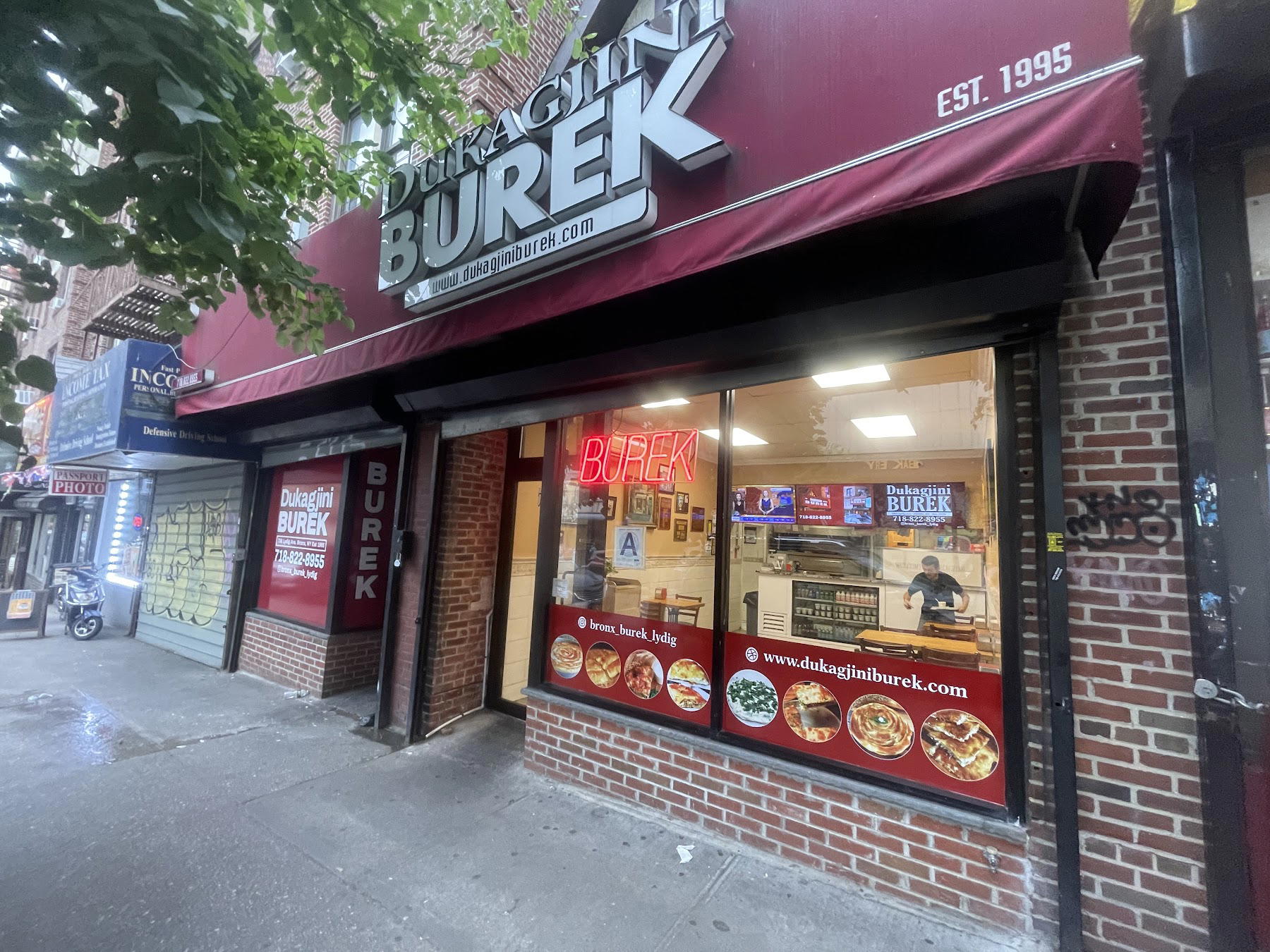
Dukagjini Burek is a low-price Albanian counter in New York City built around phyllo-layered burek filled with beef, feta, or spinach. Its appeal sits in the city’s immigrant bakery tradition: fast, filling, regional, and far more specific than the generic slice-shop shorthand that often defines casual eating in New York.

Pearl is the En Primeur Club membership app, where members save venues, book tables and use the concierge.
The menu
What to order
- Burek w/ Meat
- Burek w/ Cheese
- Burek w/ Spinach
In New York City, the signal is not design theater but the promise of hot pastry built for appetite rather than ceremony. Dukagjini Burek belongs to a New York category that rarely needs chandeliers or tasting-menu choreography: focused, immigrant-rooted rooms where one dish can carry a region, a memory, and a workday lunch crowd. In this case, the dish is Albanian burek, a Balkan staple whose authority comes from layered pastry, generous filling, and the precise moment when crisp edges give way.
Albanian burek in a city trained on slices
New York has long treated handheld food as civic infrastructure: pizza, bagels, dumplings, patties, tacos, falafel. Burek fits that grammar but does not copy it. The form is older and broader than any single storefront, moving through Albanian and wider Balkan kitchens with regional variations in shape, dough, and filling. At Dukagjini Burek, the point is the layered pie, built for warmth, texture, and appetite. The pastry crackles and flakes before softening under the bite, which gives the dish its particular pleasure: structure first, then comfort and density.
That matters in New York because casual dining often gets flattened into speed and price. Here, the low price tier does not mean generic. It means a narrow format with cultural specificity. Albanian cooking has a visible place in New York, and burek is one of its most accessible entry points: filling enough for a meal, portable enough for the street, familiar enough to pizza eaters, and distinct enough to reset expectations. The line “Pizza, you’ve been put on notice” works because the comparison is not decorative. It names the city’s dominant pastry-and-cheese reflex, then offers a flakier, more Balkan answer.
For readers mapping New York through food rather than reservation trophies, this is the same city that can hold many forms of casual specialization, from focused counters to exacting small-format dining rooms. The useful through-line is not luxury; it is specialization. A city’s food culture is often clearer at the narrow counter than in the grand dining room, and Dukagjini Burek makes that argument through pastry, heat, and repetition.
What the format says about value
The price signal is simple: this is a $ address, and that places it outside the anxiety economy of New York dining. No long tasting menu, no chef mythology, no forced occasion. The trade is more direct. The kitchen is judged on whether the pastry has lift, whether the filling is generous, and whether the final piece eats as a meal rather than a snack. The appeal comes from a compact idea executed with enough focus to make the format feel complete.
That kind of focus is why single-format specialists deserve attention in a city crowded with concepts. A menu built around burek does not need breadth to make its case. It needs repetition, heat, and a pastry structure that survives filling without turning slack. In editorial terms, Dukagjini Burek is less a “find” than a reminder that New York’s casual canon is still being argued over by immigrant bakeries, neighborhood counters, and regional kitchens that never asked permission from Manhattan dining fashion.
Visitors building a broader eating itinerary should treat this as a counterweight to higher-ceremony meals. Pairing it mentally with other casual New York City dining makes sense not because the cuisines overlap, but because such places show how diaspora food becomes part of the city’s daily rhythm. For the wider map, use Our full New York City restaurants guide alongside the city’s parallel hospitality layers: Our full New York City hotels guide, Our full New York City bars guide, Our full New York City wineries guide, and Our full New York City experiences guide.
How to place it in a wider American food trip
Dukagjini Burek also belongs to a larger American pattern: small-format restaurants that make one regional idea legible without sanding it down. That can mean many kinds of specialist counters, bakeries, casual rooms, and regional kitchens across major food cities. The common value is clarity: a diner understands the premise quickly, then judges execution.
Other regional stops sharpen the same point, from highly focused casual cooking to compact rooms built around a single staple, technique, or tradition. Against that wider field, the New York Albanian burek counter reads as a lesson in scale. A serious meal does not require a long bill; it requires a form, a tradition, and enough discipline to let both speak plainly.
Frequently asked questions
What part of town is Dukagjini Burek in?
Dukagjini Burek is located in New York City.
Has Dukagjini Burek won any awards?
Dukagjini Burek was recognized by The New York Times on its 2026 Best Restaurants in New York City list, where it was ranked No. 55.
What should I expect cuisine-wise at Dukagjini Burek?
Dukagjini Burek serves Albanian cuisine.
How much does it cost to eat at Dukagjini Burek?
Pricing at Dukagjini Burek is listed as $.
What's the best way to book Dukagjini Burek?
Plan an in-person visit in New York City. At a $ price point, Dukagjini Burek fits the kind of stop where the meal matters more than a formal reservation script.
What is Dukagjini Burek known for?
Dukagjini Burek is known for Albanian burek in New York City, with a focused format that puts the pastry at the center of the meal.
How It Compares
Comparable venues nearby, for context on price, style, and recognition.
| Venue | Cuisine | Price | Notes |
|---|---|---|---|
| Dukagjini BurekThis venue (the venue you are viewing) | Traditional Albanian/Kosovar burek bakery | $10–20 | Not listed |
| Nanoosh | Mediterranean Hummus Bar | Not listed | Midtown South-Flatiron-Union Square |
| Alta | Mediterranean Tapas | Not listed | Greenwich Village |
| Glasserie | Mediterranean with Middle Eastern influences | Not listed | Greenpoint |
| The Hummus & Pita Co. | Mediterranean Fast-Casual | $10–20 | Chelsea-Hudson Yards |
| Essex | Mediterranean Steakhouse | $50–100 | Lower East Side |
Recognition history
Dated appearances from independent guides and award organizations, with the underlying list record or original source where available.
New York Times Best Restaurants in New York City #55
New York Times
Continue exploring
More in New York City
Restaurants in New York City
All restaurants in New York City →
Bars in New York City
All bars in New York City →

Details
- Cozy
- Solo
- Family
- Casual Hangout
- Late Night
- Standalone
- A La Carte
- Counter Dining
Current opening hours
- Monday
- 8:30 am–9 pm
- Tuesday
- 8:30 am–9 pm
- Wednesday
- 8:30 am–9 pm
- Thursday
- 8:30 am–9 pm
- Friday
- 8:30 am–9 pm
- Saturday
- 8:30 am–9 pm
- Sunday
- 8:30 am–9 pm
Hours can change for holidays and private events. Hours as of .