Dindigul Thalappakatti
Our verdict
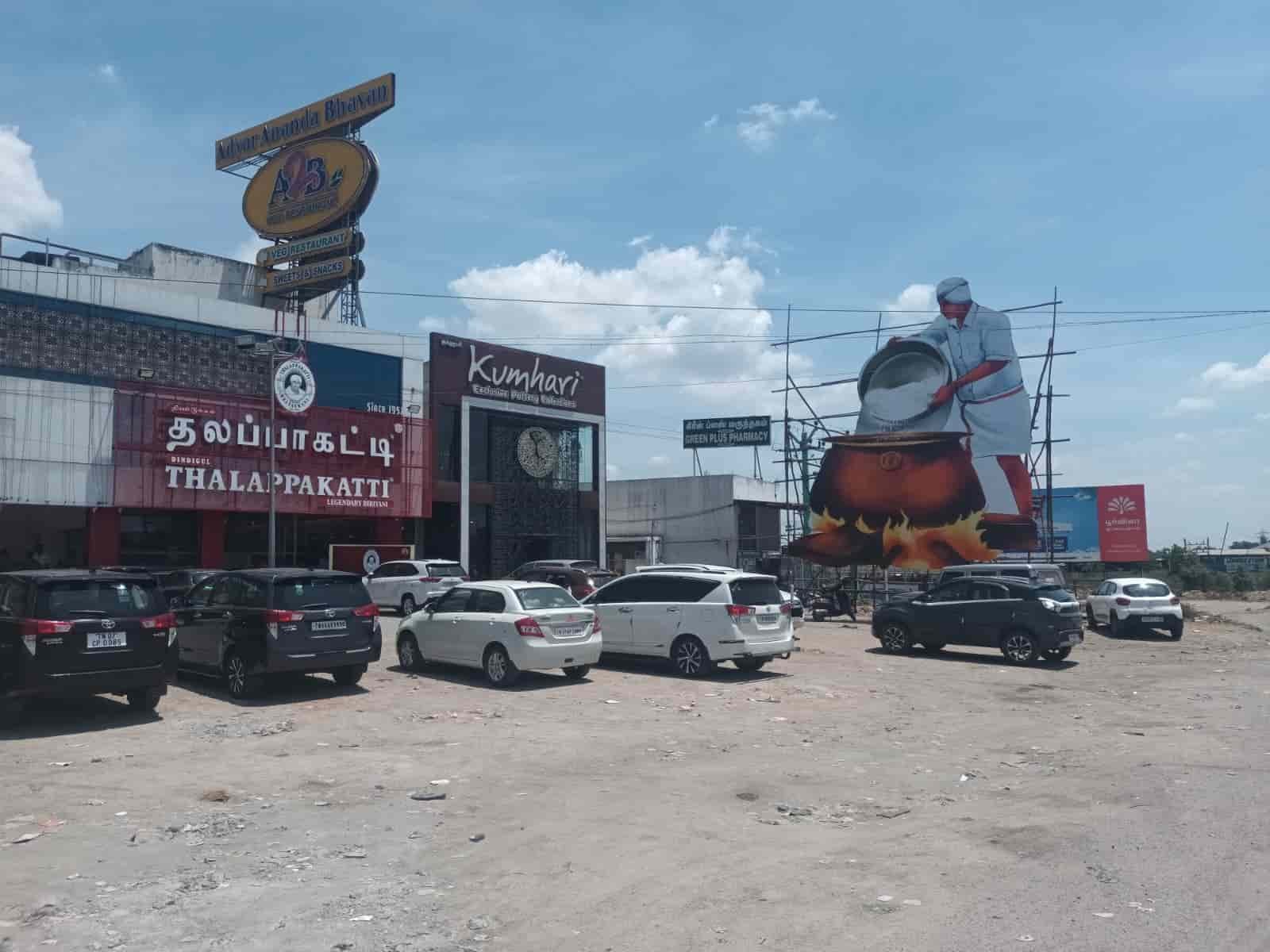
Dindigul Thalappakatti on NH45 near Vikravandi Toll Plaza is a stop on one of Tamil Nadu's most recognisable biryani trails. The chain's Dindigul-style biryani, built on seeraga samba rice and Kannivadi mutton, represents a distinct regional tradition that separates it sharply from the Hyderabadi and Lucknow formats that dominate national conversation about Indian rice dishes.

Pearl is the En Primeur Club membership app, where members save venues, book tables and use the concierge.
The menu
What to order
- Thalappakatti Biryani
- Chettinad Chicken
- Mutton Chops
A Highway Halt With Regional Conviction
The stretch of NH45 running through Vikravandi is functional Tamil Nadu: toll plazas, lorry traffic, roadside fuel stops. Against that backdrop, the Dindigul Thalappakatti outlet near the Vikravandi Toll Plaza operates less as a destination restaurant and more as a station on a well-worn route, the kind of place where families on long drives between Chennai and Madurai pull off not because an app suggested it, but because the name carries its own accumulated weight across Tamil Nadu. The physical environment reflects that purpose: the space is designed for throughput, not lingering. Yet what arrives at the table belongs to a culinary tradition specific enough to reward attention from anyone serious about South Indian food. For a broader look at what Vikravandi's dining scene offers, see our full Vikravandi restaurants guide.
The Sourcing Logic Behind Dindigul Biryani
Dindigul biryani earns its regional identity from two sourcing decisions that predate the chain and define the style category. The first is seeraga samba rice, a short-grain variety cultivated in the Cauvery delta region of Tamil Nadu. Smaller and more aromatic than basmati, it absorbs fat and spice differently, producing a denser, more cohesive biryani rather than the long-grained, separated-grain presentations associated with Hyderabadi dum cooking. The second sourcing anchor is Kannivadi mutton, from goats raised around the Kannivadi area of Dindigul district. Leaner than standard commercial mutton, it holds its texture under the pressure cooking method the style employs, and contributes a flavour profile that biryani cooks in Chennai or Madurai have historically found difficult to replicate without the same animal and feed conditions.
These two ingredients are not interchangeable marketing claims. They represent a geographic specificity comparable, in structural terms, to the appellation logic that defines European food traditions, not in scale or legal framework, but in the way the sourcing shapes the final product in ways that cannot simply be reproduced with substitutions. This is the same sourcing-first argument made, in very different registers, by farm-to-table restaurants like Farmlore in Bangalore or ingredient-led approaches at Inja in New Delhi, the claim that what the food is made from matters as much as how it is prepared.
Where Dindigul Style Sits in the Broader Biryani Map
Indian biryani divides into regional traditions with genuinely distinct cooking methods, not just flavour preferences. The Lucknowi dum style layers raw meat and parcooked rice in a sealed vessel, finishing them together over low heat; Hyderabadi kacchi biryani does something similar but with raw rather than marinated meat. Calcutta biryani adds potato and leans on a sweeter spice profile with a Mughal lineage through the Nawabs of Awadh. Dindigul biryani sits outside all of these. It uses a pressure cooker method, which produces a faster cook and a more integrated result: the rice and meat finish at closer to the same moment, and the fat from the meat distributes through the grain differently than in dum preparations.
Restaurants like Kappa Chakka Kandhari in Chennai have built audiences around the argument that South Indian culinary traditions deserve the same careful documentation and presentation that northern Indian formats receive. Dindigul Thalappakatti makes a similar implicit argument through sheer consistency: by keeping the sourcing and method stable across locations, the chain functions as a kind of living record of a regional style that might otherwise blur into generic biryani production as it scaled. Compare this to the Kerala-rooted sourcing philosophy at Leela Kerala Terrace in Trivandrum or the ingredient provenance emphasis at Naar in Kasauli, where local and regional sourcing frames the entire menu proposition.
The NH45 Context: Reading a Highway Restaurant Correctly
A highway location on NH45 invites a particular kind of reading. This is not a city-centre restaurant competing on ambience or tasting menu architecture. It is, instead, a point on a highway corridor where the question is not whether you are getting a refined dining experience, but whether you are getting an accurate and consistent version of a specific regional tradition. On that measure, the Thalappakatti name carries a track record built over decades and across multiple Tamil Nadu locations.
Highway restaurants in Tamil Nadu occupy a specific social function. They serve the logistics of a state where road travel connects cities, pilgrimage sites, and agricultural districts across significant distances. The NH45 corridor between Chennai and Dindigul passes through Vikravandi, and the volume of traffic on that route, commercial, private, and pilgrimage-bound, sustains a category of restaurant that operates at scale without pretension. This is a different mode of operation from the intimate sourcing-led formats found at Bomras in Anjuna or the destination-dining logic of Dining Tent in Jaisalmer, but it is no less embedded in a regional food culture.
How It Compares to the Wider South Indian Table
The restaurant sits within a broader South Indian dining conversation that has grown considerably more visible internationally over the past decade. Tamil, Kerala, and Andhra cooking traditions are receiving the kind of critical attention previously reserved for Mughal-derived northern Indian formats. Venues like View in Madurai, Royal Vega in Chennai, and The Malabar House in Fort Cochin each represent different points in the spectrum of how South Indian food is now being presented and interpreted. Thalappakatti's position in that conversation is not about refinement or reinterpretation. It is about preservation of a specific format at volume, a different kind of contribution, but a real one.
For readers accustomed to the benchmark-setting rigour of places like Le Bernardin in New York City or the fermentation-and-sourcing depth of Lazy Bear in San Francisco, the framing here shifts entirely. Thalappakatti is not operating in that register. What it shares with those restaurants is an underlying sourcing logic, the conviction that the starting material defines the result, expressed through a completely different institutional form. That parallel is worth noting, even if the contexts are miles apart.
Planning Your Visit
The Vikravandi outlet sits at SF No- 1/1, NH45, near the Vikravandi Toll Plaza, Tamil Nadu 605652. No booking infrastructure exists for this format; it operates on a walk-in basis aligned with road traffic patterns. Comparable highway-format operations across Tamil Nadu tend to peak at lunch, roughly 12:00 to 14:30, and again in the early evening. If you are planning a longer Tamil Nadu food itinerary, cross-reference with Palaash in Yavatmal, Neel in Patiala, and Ran Baas The Palace in Qila Mubarak for a sense of how regional restaurant traditions operate across India at different price points and formats.
Frequently asked questions
Would Dindigul Thalappakatti be comfortable with kids?
A highway outlet on NH45 near the Vikravandi Toll Plaza is set up for practical, high-volume dining, which generally means tolerant, unfussy seating arrangements that work well for families. Biryani formats served in portions make sharing and ordering for mixed groups straightforward. There is no fine-dining formality to navigate here.
Is Dindigul Thalappakatti better for a quiet night or a lively one?
The NH45 location draws a steady flow of travellers, lorry drivers, and local regulars rather than an evening crowd gathered for atmosphere. Expect activity driven by road traffic patterns, which means midday and early evening tend to be the busiest windows. This is a working restaurant, not a destination for a slow dinner.
How does the Vikravandi Thalappakatti outlet differ from city-centre locations of the same chain?
Positioned at SF No- 1/1, NH45, near the Vikravandi Toll Plaza, this outlet serves a transit audience rather than an urban dining crowd, which shapes everything from pace of service to seating capacity. Highway outlets in Tamil Nadu typically run on volume and speed rather than extended table time. The Dindigul biryani itself follows the same regional sourcing tradition as other Thalappakatti locations, making the food consistent regardless of the highway context.
What do regulars order at Dindigul Thalappakatti?
The Dindigul biryani, built on seeraga samba rice and its distinctive sourcing logic, is the reason most people stop at any Thalappakatti outlet. The short-grain seeraga samba variety carries more flavour per mouthful than basmati and defines the style category across the chain. That dish is the point of the visit.
What's Dindigul Thalappakatti's location?
Dindigul Thalappakatti is located at SF No- 1/1, NH45, near Vikravandi Toll Plaza, Vikravandi, Tamil Nadu 605652, India, Vikravandi.
How far ahead should I plan for Dindigul Thalappakatti?
This is a walk-in highway restaurant at SF No- 1/1, NH45, Vikravandi, advance booking is not part of the format. Timing around peak road-traffic hours is the main consideration.
What's the signature at Dindigul Thalappakatti?
Dindigul biryani made with seeraga samba rice is the defining dish, and the chain takes its name from the Thalappakatti biryani tradition originating in Dindigul, Tamil Nadu. The style is distinguished by the use of short-grain rice and a cooking method that sets it apart from both Lucknowi dum and Hyderabadi kacchi traditions. Every other item on the menu exists in relation to that central dish.
A Quick Peer Check
Comparable venues nearby, for context on price, style, and recognition.
| Venue | Cuisine | Price | Notes |
|---|---|---|---|
| Dindigul ThalappakattiThis venue (the venue you are viewing) | South Indian Biryani Specialists | $1–10 | Not listed |
| Swirl | Indian Pure Vegetarian | Not listed | Vrindavan |
| Kailash Parbat- Pure Vegetarian Restaurant | Pure Vegetarian North Indian & Chaat | $1–10 | Nungambakkam |
| The Pavillion | Indian, Chinese & Continental | Not listed | Rajpur Road |
| Plantain Leaf Restaurant, Tirupati | Pure Vegetarian South Indian & Multi-Cuisine | $1–10 | Tata Nagar |
| Zing | World of Flavors Buffet - Asian, Italian, Indian & Maharashtrian | Not listed | Chikalthana MIDC |
Continue exploring
More in Vikravandi
Restaurants in Vikravandi
All restaurants in Vikravandi →
Hotels in Vikravandi
Browse all →
Details
- Lively
- Rustic
- Family
- Group Dining
- Casual Hangout
- Standalone
- A La Carte
- Vegetarian Friendly
Current opening hours
- Monday
- 11 AM–11 PM
- Tuesday
- 11 AM–11 PM
- Wednesday
- 11 AM–11 PM
- Thursday
- 11 AM–11 PM
- Friday
- 11 AM–11 PM
- Saturday
- 11 AM–11 PM
- Sunday
- 11 AM–11 PM
Hours can change for holidays and private events. Hours as of .
Casual and bustling family restaurant with bright lighting and a welcoming South Indian vibe.