Our verdict
Datsha occupies a corner of the 3rd arrondissement's Rue des Gravilliers, a street that has tracked the Marais's shift from artisan trades to a more design-conscious dining circuit.

Pearl is the En Primeur Club membership app — saves, bookings, and concierge access live there. Same editors, same standards.
- Address
- 57 Rue des Gravilliers, 75003 Paris, France
- Phone
- +33143569509
- Hours
- Mon ClosedTue–Sat 7–11 PMSun Closed
- Website
- datshaunderground.com
- Directions
- Get directions
- Booking
- Book on the venue's website
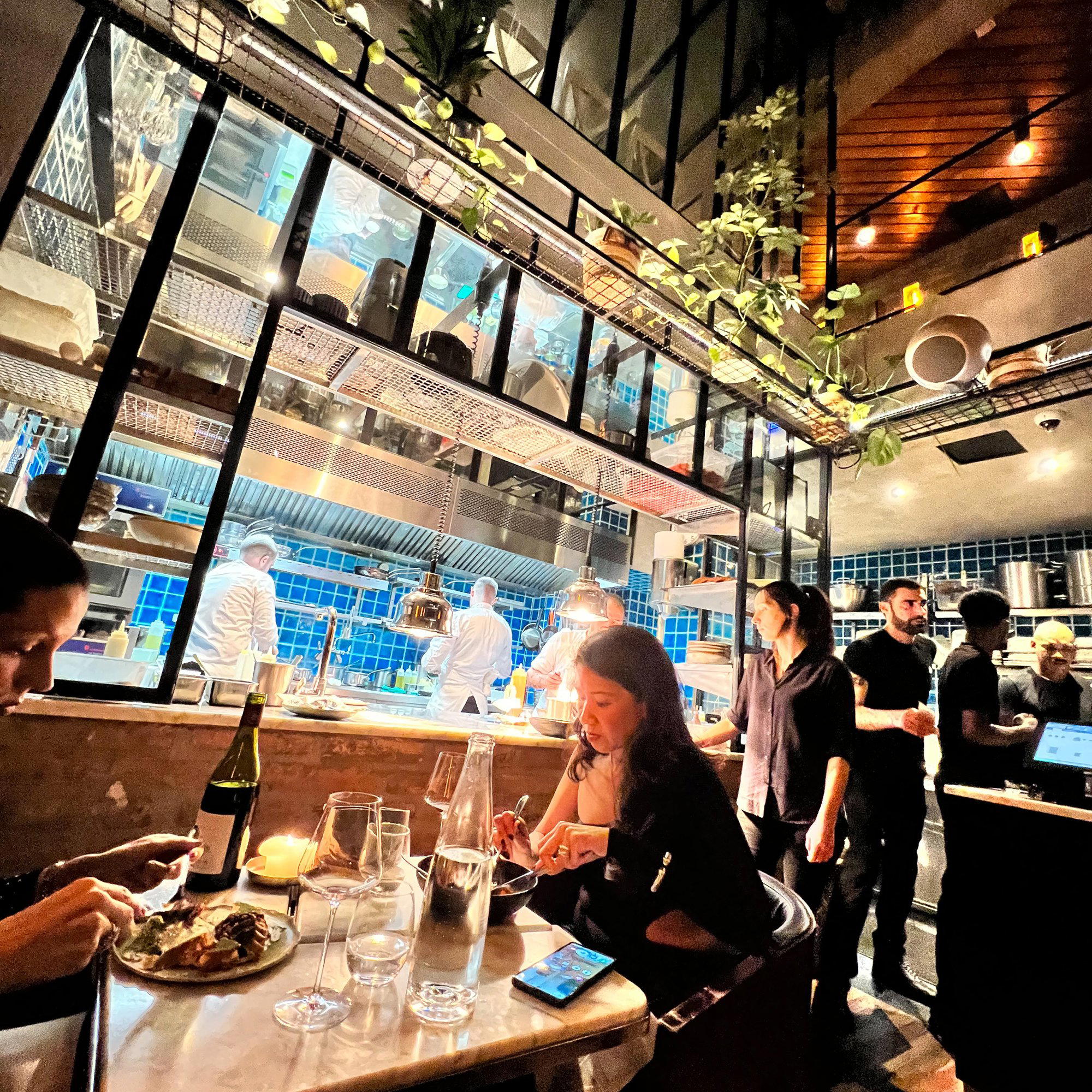
Rue des Gravilliers and the Marais's Slower Arc
The northern Marais has moved at a different pace from the rest of central Paris's dining scene. Where the 1st and 8th arrondissements built their reputations on grand rooms and formal ceremony — venues like L'Ambroisie or Le Cinq at the Four Seasons George V anchoring a particular idea of French institutional dining — the streets around Rue des Gravilliers developed a more provisional identity. The area's old wholesale textile trade shaped a neighbourhood of narrow facades and ground-floor spaces repurposed over decades into galleries, studios, and eventually restaurants. Datsha sits at number 57 on that street, within a part of the 3rd arrondissement that still carries more neighbourhood texture than destination-restaurant noise.
That address is worth noting before anything else, because it tells you something about the kind of dining circuit this venue entered. Paris's full restaurant scene operates across a wide register, from the €€€€ tasting-menu tier occupied by Alléno Paris au Pavillon Ledoyen down through bistros and neighbourhood tables that rarely attract international coverage. Rue des Gravilliers belongs to neither extreme. It is a street of considered mid-register decisions, where the competitive pressure comes not from Michelin-starred neighbours but from a local audience that knows what the area used to be and watches what it is becoming.
A Name That Signals Eastern European Reference
The name Datsha, a transliteration of dacha, the Russian term for a country house, points to an Eastern European register that has a distinct, if modest, presence in Parisian dining. This is not the Franco-Russian tradition of grand brasserie cooking, which has its own genealogy in Paris's 19th-century café culture. It is something closer to the more recent wave of restaurants in European capitals that take Central and Eastern European home cooking as a point of reference, then situate it in a contemporary urban setting.
That framing places Datsha in a particular niche within Paris's evolving dining plurality. The city has spent the past decade absorbing influences that sit outside its classical French identity: Japanese-trained French chefs, as at Kei; coastal and regional French voices with their own distinct traditions, as at venues connected to chefs from Mirazur in Menton or the deep regional roots of Bras in Laguiole. An Eastern European-inflected address contributes to that diversification, though it operates at a different scale and with different cultural weight than the starred rooms.
The Evolution Question: What Rue des Gravilliers Does to a Restaurant
Understanding how a venue in this part of the Marais changes over time requires understanding what the neighbourhood itself does to businesses. Rue des Gravilliers has not gentrified in the manner of, say, the southern Marais around the Place des Vosges, where property prices and tourist volume have pushed many independent operators out over twenty years. The northern stretch retains a working character, printing suppliers, clothing wholesalers, small fabricators still occupy ground floors nearby, which creates a particular kind of pressure on restaurants: the local clientele is present and opinionated, the tourist overlay is lighter, and the room for reinvention is constrained by the neighbourhood's own pace.
Restaurants that survive in this context tend to do so by becoming more specifically themselves over time rather than chasing format trends. The evolution pattern visible across the 3rd arrondissement's longer-standing tables is one of consolidation: tightening the offer, deepening the sourcing, and building repeat-visit loyalty rather than first-visit spectacle. France's most enduring regional addresses, Auberge de l'Ill in Illhaeusern, Les Prés d'Eugénie in Eugénie-les-Bains, or Georges Blanc in Vonnas, demonstrate that longevity in French dining is rarely about spectacle. Urban venues in dense neighbourhoods apply the same principle at a smaller scale.
Placing Datsha in the Parisian Data Gap
The publicly available record on Datsha is thin. That absence is itself informative. In Paris's restaurant ecosystem, venues without major award recognition or widespread international coverage tend to function primarily as neighbourhood addresses: they serve a local audience, they are discovered through word of mouth or neighbourhood press rather than aggregator algorithms, and their longevity depends on consistency rather than attention cycles.
This contrasts sharply with the award-tracked tier, where venues like Arpège operate with global visibility and booking windows that extend months ahead. It also contrasts with the regional French tradition of the destination restaurant, places like Troisgros in Ouches, Flocons de Sel in Megève, or Paul Bocuse in Collonges-au-Mont-d'Or, where the address is itself the draw and diners travel specifically for the room. Datsha at 57 Rue des Gravilliers operates in a different register entirely: it is, on current evidence, a neighbourhood proposition in a neighbourhood that has historically resisted the kind of transformation that would make it a destination circuit.
For context, the gap between neighbourhood-level venues and internationally tracked rooms also appears in cities like New York, where Le Bernardin anchors a formal tier while local operators work at a completely different frequency, and San Francisco, where Lazy Bear has built a distinct model around communal format rather than traditional restaurant structure. Auberge du Vieux Puits in Fontjoncouse and La Table du Castellet show how France's own regional tier operates with similar independence from Paris's award apparatus.
Planning a Visit
Datsha's address, 57 Rue des Gravilliers, 75003 Paris, places it within walking distance of Arts et Métiers station (lines 3 and 11), which makes arrival direct from most central Paris arrondissements. The street is pedestrian-friendly and the surrounding blocks reward time spent on foot before or after a meal. Given the neighbourhood's independent-operator character, walk-in availability may be more realistic than at venues requiring advance reservations weeks out, though that cannot be confirmed without current operational data.
Frequently asked questions
Would Datsha be comfortable with kids?
The address at 57 Rue des Gravilliers in the 3rd arrondissement places Datsha in the northern Marais, a neighbourhood that trends toward relaxed, resident-facing dining rather than formal service.
How would you describe the vibe at Datsha?
The name Datsha references the Russian dacha — an informal country house — which in Paris has historically translated into convivial, unhurried rooms rather than high-concept service theatre. Rue des Gravilliers in the 3rd reinforces that register: this is a street of long-standing workshops and neighbourhood addresses, not tourist-facing dining. Expect something closer to a seated gathering than a performance.
Is Datsha one of the few Paris restaurants working from a Russian dacha reference point?
The dacha tradition as a direct restaurant concept is rare in Paris, which has a broader Eastern European presence but far fewer venues that name that specific register so explicitly. Datsha's address in the 3rd arrondissement — a district with documented roots in Central and Eastern European immigrant communities — makes the positioning legible rather than arbitrary. No comparable Paris venue with the same named concept appears in the verified awards or recognition data.
What's the best thing to order at Datsha?
The venue's Eastern European reference point is its clearest signal: the dacha tradition gravitates toward hearty, preservation-rooted cooking — fermented, cured, and slow-cooked dishes with a domestic rather than chefly scale. In the Paris context, that typically means the house speciality will anchor the menu rather than a rotating seasonal tasting format.
Where exactly is Datsha?
Datsha is located at 57 Rue des Gravilliers, 75003 Paris, France, Paris.
How hard is it to get a table at Datsha?
At neighbourhood addresses in the 3rd arrondissement, walk-ins are often possible mid-week, while weekend evenings at popular local spots can fill several days in advance. A call or same-day check is the practical approach given the absence of a confirmed online booking channel.
What's the defining dish or idea at Datsha?
The defining idea is domestically-scaled hospitality rooted in the Eastern European dacha tradition — informal, generous, and grounded in a specific cultural register rather than pan-European fusion. In Paris, that positions Datsha within a small cohort of restaurants that treat a non-French culinary heritage as a serious primary reference rather than an accent. The 3rd arrondissement, with its history of artisan and immigrant food culture, is a coherent setting for that kind of address.
Budget Reality Check
Comparable venues nearby, for context on price, style, and recognition.
| Venue | Cuisine | Price | Awards | Notes |
|---|---|---|---|---|
| DatshaThis venue — the venue you are viewing | Modern Fusion Small Plates | Not listed | Not listed | Not listed |
| Au 41 penthièvre | Refined French Bistro | $50–100 | Not listed | Faubourg Saint-Honoré, Refined French Bistro |
| D'Chez Eux | Traditional French Bistro | $50–100 | Not listed | 7th Arrondissement, Traditional French Bistro |
| Bel Canto | French Bistronomic with Opera | $100–150 | Not listed | Hôtel de Ville, French Bistronomic with Opera |
| La Condesa | Modern Fusion: French-Mexican-Asian | $150–200 | Michelin Plate | 9th arrondissement, Modern Fusion: French-Mexican-Asian |
| Le Calife | Classic French Fine Dining | $100–150 | Not listed | Saint-Germain-des-Prés, Classic French Fine Dining |
Continue exploring
More in Paris
Restaurants in Paris
Browse all →
Bars in Paris
Browse all →
Hotels in Paris
Browse all →



Details
- Modern
- Trendy
- Sophisticated
- Intimate
- Date Night
- Special Occasion
- Open Kitchen
- A La Carte
- Small Plates
- Vegetarian Friendly
Current opening hours
- Monday
- Closed
- Tuesday
- 7–11 PM
- Wednesday
- 7–11 PM
- Thursday
- 7–11 PM
- Friday
- 7–11 PM
- Saturday
- 7–11 PM
- Sunday
- Closed
Hours can change for holidays and private events. Last verified .
Sophisticated bunker-like atmosphere with comforting decor and modern sensory design.