
Datedachi puts Osaka’s tachinomi culture into a compact Sennichimae format: stand-up drinking, yakitori, izakaya cooking, and sake rather than a long seated meal. Its selection for Tabelog 100 Tachinomi 2025 gives it a useful signal in a category where atmosphere and turnover matter as much as formal service.
Pearl is the En Primeur Club membership app — saves, bookings, and concierge access live there. Same editors, same standards.
- Address
- 2 Chome-4-12 Sennichimae, Chuo Ward, Osaka, 542-0074, Japan
- Website
- kuramaproject.com
 Saves & bookings on Pearl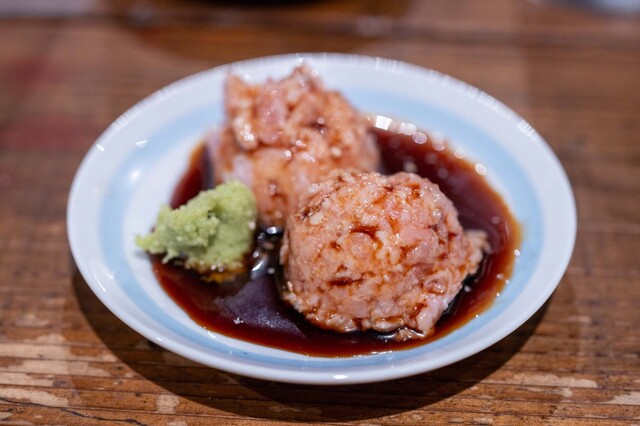
Approach Osaka’s stand-up drinking scene and the first cue is physical: counters replace dining rooms, movement replaces ceremony, and the meal is built in short, repeatable decisions rather than a fixed procession. Datedachi belongs to that grammar. It is not trying to behave like a tasting-menu restaurant in miniature; it sits inside the tachinomi tradition, where sake, skewers, small izakaya plates, and counter proximity define the evening.
That distinction matters in Sennichimae, an area where Osaka’s eating culture compresses into a few blocks of casual intensity. The district rewards formats that can handle quick appetites without flattening the meal into convenience food. Tachinomi works because it gives structure to spontaneity: order a drink, add something grilled, pause, repeat. In that rhythm, menu architecture becomes the real story.
A tachinomi menu built around standing, drinking, and short orders
Osaka is often reduced to takoyaki and okonomiyaki in travel shorthand, but the city’s more revealing meals are frequently modular. Datedachi’s listed categories, stand-up bar, yakitori, and izakaya, point to a menu designed for pacing rather than ceremony. Yakitori gives the kitchen a grilled backbone; izakaya cooking widens the order into shared or solo plates; sake provides the through-line. The result is a format in which the first order does not have to decide the entire meal.
That is the appeal of tachinomi at its sharper end. The standing format limits sprawl. It discourages the long, upholstered evening and favors a tighter, more alert kind of drinking food. A counter seat, when present, changes the meal’s social physics: solo diners are not made to feel like an exception, and small groups do not need the choreography of a full table. The category has its own discipline, even when the room feels casual.
Tabelog’s 2025 Tachinomi 100 selection gives Datedachi a meaningful external marker in a field that can be hard for visitors to read from the street. The score attached to its listing, 3.61, is not the same kind of signal as a fine-dining star, but for a stand-up bar it helps separate a serious local drinking-food address from generic nightlife. Tachinomi recognition is less about polished luxury and more about whether the format holds up under repeat use.
Compared with Osaka dining at higher spend levels, the value of this category is not breadth of service. Hon Sekiguchi operates in a much higher bracket, while Ankera So and Stand Aida sit closer to the casual-drinking lane at a different spend tier. Fukutarou Honten and Gyokusei Ya show how Osaka’s everyday dining can remain compelling without formal dining-room cues. Datedachi’s place in that spread is clear: it is for a short, focused stand-up session rather than a seated evening built around courses.
Sennichimae rewards restaurants that move with the neighborhood
Sennichimae’s strength is density. The area does not ask every restaurant to become a destination in the grand sense; it asks each format to know its role. A tachinomi counter has to handle irregular arrivals, solo drinking, second stops, and pre- or post-dinner decisions. The menu therefore needs recognizable anchors, fast ordering logic, and enough range to keep a drink from feeling stranded.
In that context, sake is not a decorative detail. Nihonshu changes the center of gravity from beer-and-snack speed to something more deliberate, while yakitori keeps the food legible for guests who may not want a heavy meal. The combination explains why this kind of bar can function as dinner for one person and as a short stop for another. Osaka’s casual dining intelligence lives in those flexible uses.
Visitors building a broader Osaka food map should treat Datedachi as one part of a neighborhood sequence rather than the whole plan. For a wider view of the city’s restaurant range, start with Our full Osaka restaurants guide. Nearby or citywide contrasts can be useful: 551 Horai (551蓬莱) represents a different kind of Osaka queue logic, while 52CHO-ME BAKERY, .cafe, 99 Pizza Napoletana Gourmet, and a canto (Italian) show how the city’s casual and specialist formats sit side by side.
The wider EP Club map also helps place Osaka in a national and international context. Japanese dining does not travel as a single category: [ki:] in Kyoto. 鮪と炭火焼き うお炭 秋葉原店 in Tokyo.know in Kumamoto, (Shoku) Vietnam in Kawasaki, [Curry Senmon Ten] Maruyama Kyoju. in Sapporo, and -Grilled beef Sukiyaki- KAMAKURA TANUKIAN 鎌倉 たぬき庵 in Kamakura each point to different local habits. Abroad, Jōdo Saké Bar in Los Angeles and Onigiri Time in Pasadena underline how sake bars and compact Japanese formats change when removed from their home-city pressures.
How to read the room before deciding what kind of night this is
The correct expectation is a compact Osaka drinking-food experience, not a quiet private dinner. Stand-up bars trade comfort for tempo. That is not a defect; it is the operating system. The format suits diners who want to eat and drink with precision, keep the evening mobile, and leave room for another stop if the night calls for it.
Practical decision is therefore less about cuisine preference than rhythm. If the plan is a slow meal with private conversation, a seated restaurant will make more sense. If the plan is sake, grilled food, and a close reading of Osaka’s casual counter culture, this is the category to study. For planning beyond restaurants, use Our full Osaka hotels guide, Our full Osaka bars guide, Our full Osaka wineries guide, and Our full Osaka experiences guide.
Same-City Peers
Comparable venues by cuisine and category.
| Venue | Cuisine | Price | Notes |
|---|---|---|---|
| DatedachiThis venue — the venue you are viewing | Stand-up Yakitori & Izakaya | $$ | Not listed |
| Menya JouRoku (麺屋 丈六) | Takaida-Style Tamari Shoyu Ramen | $$ | Namba |
| Itamae Yakiniku Itto Tengachaya honten | Japanese Yakiniku | $$ | Nishinari |
| Naniwa Menjiro Zen | Japanese Ramen | $$ | Kita |
| curry restaurant BRUNO HEP NAVIO ten | Japanese Curry House | $$ | Kita |
| Yasuda | Traditional Shabu-shabu & Beef Hotpot | $$ | Miyakojima |
Recognition history
Dated appearances from independent guides and award organizations, with the underlying list record or original source where available.
Tabelog 100 #85 · No. 85
Tabelog · Tabelog 100 - Tachinomi - 2025
Continue exploring
More in Osaka
Restaurants in Osaka
Browse all →


Bars in Osaka
Browse all →
Hotels in Osaka
Browse all →


Wineries in Osaka
Browse all →
At a Glance
- Lively
- Energetic
- Cozy
- After Work
- Casual Hangout
- Solo
- Late Night
- Standalone
- Sake Program
- Beer Program
Current opening hours
- Monday
- 3–10:30 PM
- Tuesday
- 3–10:30 PM
- Wednesday
- 3–10:30 PM
- Thursday
- 3–10:30 PM
- Friday
- 3–10:30 PM
- Saturday
- 3–10:30 PM
- Sunday
- 3–10:30 PM
Hours can change for holidays and private events. Last verified .