





Dal Pescatore has held three Michelin stars continuously since 1996, an Italian record, and sits in the upper tier of classical European dining as ranked by both La Liste (98 points in 2026) and Opinionated About Dining. Located in the hamlet of Runate in the Mantuan countryside, this multi-generational family restaurant draws a destination-dining clientele willing to travel for cuisine rooted in the Po Valley's distinct culinary traditions.
 Discover on Pearl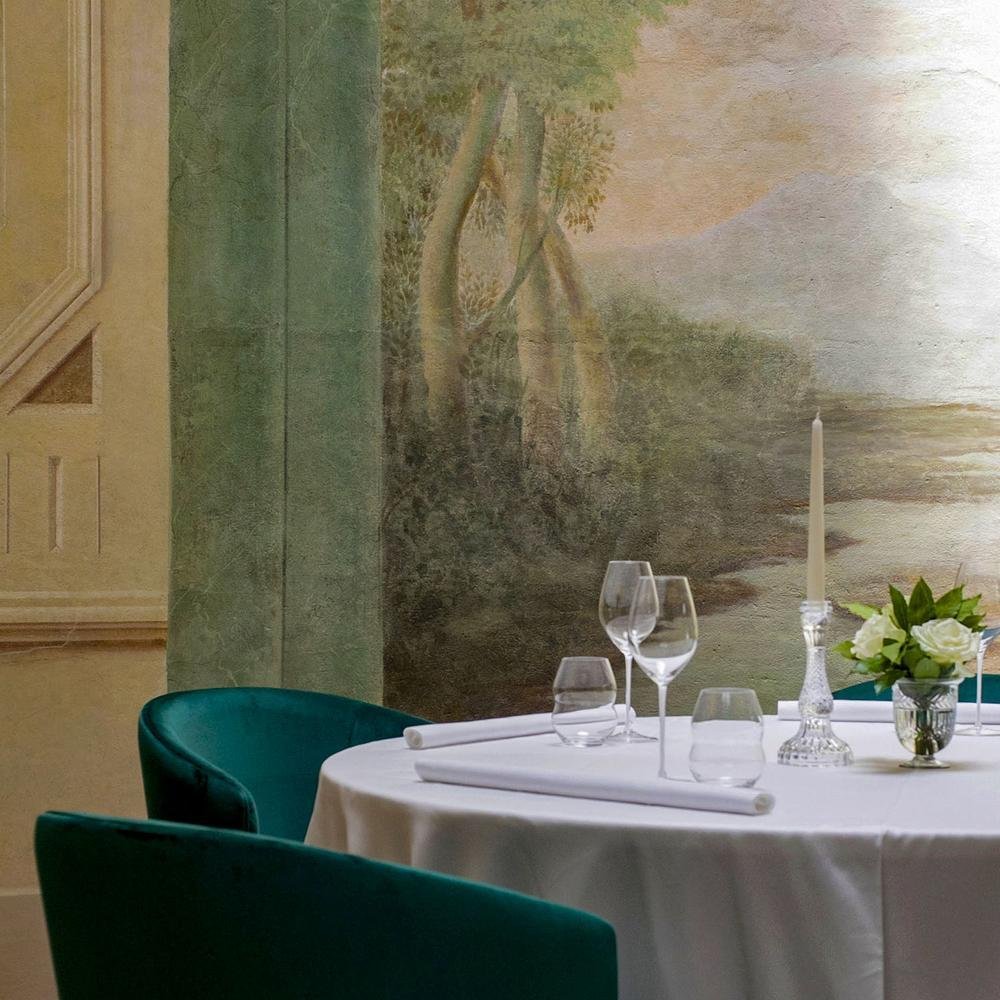
Where the Mantuan Countryside Sets the Standard
The road to Runate passes through flatlands that feel, in the leading possible way, like the margins of the map. The village has a few dozen inhabitants, no visible commercial strip, and no particular reason to exist on a traveller's itinerary except one: Dal Pescatore, which has sat at this address for the better part of a century and has, in that time, become one of the most decorated restaurants in Italy. Approaching the converted farmhouse through the countryside between Cremona and Mantova, the question of whether fine dining belongs in a major city dissolves. Northern Italy's most serious tables are often rural, and Dal Pescatore is the clearest argument for why.
A Lombardian Kitchen, Not a Generic Italian One
The regional identity question matters at a restaurant operating at this level. Italy's three-star tier spans wildly different culinary traditions: the Adriatic restraint of Uliassi in Senigallia, the creative mountain cooking of Atelier Moessmer Norbert Niederkofler in Brunico, the progressive Modenese vision at Osteria Francescana. Dal Pescatore belongs to a different lineage entirely: the agricultural heartland of Lombardia, specifically the Mantuan zone where the Po and Oglio rivers shape both the landscape and the larder.
The shortlist, unlocked.
Hard-to-book tables, cellar releases, and concierge-planned trips.
Get Exclusive Access →Mantuan cooking is among Italy's most particular regional traditions. The city's Renaissance-court history produced a cuisine that sits between the austerity of the Veneto and the richness of Emilia, leaning toward sweet-and-savoury combinations, freshwater fish, game, and slow-cooked meats that reward patience over technique. The risotto here is padano in character: short-grained rice grown in the surrounding flats, finished with local aged cheese, without the saffron that would signal a Milanese kitchen or the seafood base that defines Venetian variants. This is not fusion or revision; it is a cuisine that has been practised in this corridor for centuries, and Dal Pescatore's significance lies partly in how seriously that tradition is maintained.
The kitchen reflects that specificity. Meat for the roasts and braised dishes comes from Cascina Runate, the farm immediately adjacent to the property. Local petit gris snails, prepared with aromatic herbs and sweet garlic, appear as a dish that would read as incongruous elsewhere but functions here as a statement of place. These are not heritage gestures retrofitted to a fine-dining menu; they are what this land produces, cooked the way this land has always cooked it.
The Record and What It Means
Dal Pescatore has held three Michelin stars without interruption since 1996, which constitutes an Italian record for continuous three-star retention. The weight of that statistic becomes clearer when mapped against the broader Italian three-star cohort: Le Calandre in Rubano, Enoteca Pinchiorri in Florence, Enrico Bartolini in Milan, and Piazza Duomo in Alba all hold the same three stars, but none has maintained them for as long from the same address under the same family. Consistency at this level, over nearly three decades, requires something beyond cooking ability. It requires institutional commitment to a style of hospitality that does not chase trend cycles.
The external validation continues to accumulate. La Liste, which aggregates global critic scores into a single ranking, placed Dal Pescatore at 98 points in 2026, up from 97 points the year before, and ranked 16th globally in the Classical Europe category by Opinionated About Dining in 2025. The restaurant held a World's 50 Best position for eight consecutive years between 2003 and 2011, peaking at 23rd in both 2004 and 2008. It also holds a Michelin Green Star for sustainability and is a member of both Relais and Châteaux and Les Grandes Tables du Monde, two hospitality designations that signal as much about service philosophy as they do about cuisine. The EP Club rating for the property stands at 4.6 out of 5.
Family Structure as Culinary Model
In Italian fine dining, the family-run restaurant is a model that appears frequently but rarely at this altitude. The division of labour at Dal Pescatore follows a structure that has proved durable: Antonio Santini manages the front of house, a role that in this context encompasses everything from wine service to the orchestration of a room that draws international visitors alongside local regulars. Nadia Santini leads the kitchen, with sons Giovanni and Alberto working alongside her. The succession question that haunts many multi-generational restaurants has been answered here by maintaining continuity of vision rather than dramatic reinvention.
This model contrasts with the urban three-star kitchens at restaurants like Reale in Castel di Sangro or Da Vittorio in Brusaporto, where chef-led creative programs define the identity. At Dal Pescatore, the family is the institution, and the cooking reflects that stability. Dishes evolve across years and decades rather than across menu cycles, which means returning visitors over a decade can track genuine development rather than seasonal repositioning.
The Room and the Experience
The interior occupies a register that Italian country houses have historically done well: formal enough to signal serious dining, grounded enough in the building's age and setting that it never tips into corporate luxury. The combination of light, space, and colour in the dining room works as a frame for an extended lunch or dinner rather than a backdrop for social media documentation. The service tempo is calibrated to the format: this is a destination where the expectation is a long meal, and the pacing reflects that. Hours run Thursday through Saturday from 7:30 to 9:30 in the evening, with Friday, Saturday, and Sunday also offering lunch from midday to 1:30 pm. The kitchen is closed Monday and Tuesday.
Practically, the village location requires a car or organised transfer. The nearest substantial towns are Mantova to the east and Cremona to the west, both roughly 30 to 40 minutes' drive, and both worth visiting as part of a regional itinerary. Accommodation in the immediate area is limited; most visitors either stay in one of the nearby cities or treat this as a day journey from Milan, which lies around 90 minutes away by road. Reservations at this level of recognition require advance planning; the combination of limited covers and a destination-dining profile means weekend tables in particular book well ahead. Contact for reservations is available through the Relais and Châteaux network via pescatore@relaischateaux.com, or directly by telephone at +39 0376 72 30 01. The website is dalpescatore.com.
Where Dal Pescatore Sits in the Northern Italian Context
Northern Italy's three-star tier clusters in a corridor from Milan eastward through Veneto and southward into Emilia-Romagna. The geography produces distinct culinary identities that are easy to conflate from the outside. The comparison set for Dal Pescatore is not the modernist creative cooking at Osteria Francescana or the progressive technique-driven menus at Le Calandre; it is a smaller group of classical Italian houses that treat continuity and regional integrity as the primary value. Within that group, Dal Pescatore's record is unmatched in Italy.
The Italian three-star category contains several properties oriented toward a different peer set. Casa Perbellini 12 Apostoli in Verona and Antica Osteria del Ponte in Cassinetta di Lugagnano offer useful reference points in the classical northern Italian register, while Quattro Passi in Marina del Cantone illustrates how different the southern Italian approach to this tier can feel. Dal Pescatore's specific claim, the one that explains why it draws visitors from outside Italy, is the combination of genuine regional rootedness with a level of execution that has been externally verified for close to three decades without a break. That is a narrow space to occupy, and it has done so without repositioning.
For broader context on the area's dining and hospitality, see our full Runate restaurants guide, our full Runate hotels guide, our full Runate bars guide, our full Runate wineries guide, and our full Runate experiences guide.
The shortlist, unlocked.
Hard-to-book tables, cellar releases, and concierge-planned trips.
Get Exclusive Access →Frequently Asked Questions
Comparable Spots, Quickly
These are the closest comparables we have in our database for quick context.
| Venue | Cuisine | Price | Awards | Notes |
|---|---|---|---|---|
| Dal Pescatore | Italian, Italian Contemporary | €€€€ | Michelin 3 Stars, Les Grandes Tables Du Monde Award (2025), GREEN STAR | This venue |
| Atelier Moessmer Norbert Niederkofler | Italian, Creative | €€€€ | Michelin 3 Star | Italian, Creative, €€€€ |
| Enoteca Pinchiorri | Italian - French, Italian Contemporary | €€€€ | Michelin 3 Star | Italian - French, Italian Contemporary, €€€€ |
| Enrico Bartolini | Creative | €€€€ | Michelin 3 Star | Creative, €€€€ |
| Osteria Francescana | Progressive Italian, Creative | €€€€ | Michelin 3 Star | Progressive Italian, Creative, €€€€ |
| Quattro Passi | Italian, Mediterranean Cuisine | €€€€ | Michelin 3 Star | Italian, Mediterranean Cuisine, €€€€ |
Need a table?
Our members enjoy priority alerts and concierge-led booking support for the world's most difficult tables.
Get Exclusive AccessThe shortlist, unlocked.
Hard-to-book tables, cellar releases, and concierge-planned trips.
Get Exclusive Access →