Our verdict
Da Laura occupies a quiet address on Rue du Vingt-Quatre Août, away from the festival-season noise that defines central Cannes. The room positions itself in the mid-tier of the city's dining scene, where neighbourhood reliability and personal service carry more weight than spectacle. For visitors working through Cannes beyond the Croisette, it functions as a practical reference point.

Pearl is the En Primeur Club membership app — saves, bookings, and concierge access live there. Same editors, same standards.
- Address
- 9 Rue Du Vingt-Quatre Août, 06400 Cannes, France
- Phone
- +33493384051
- Hours
- Mon–Sat 7:30 AM–11 PMSun Closed
- Directions
- Get directions
The menu
What to order
- Truffle ravioli
- Carbonara
A Street Removed from the Croisette Circuit
Cannes sustains two distinct dining economies. The first runs along the Croisette and its immediate catchment: hotel dining rooms, high-margin brasseries, and a handful of formally ambitious tables where the price of a meal reflects the address as much as the cooking. The second operates a few blocks inland, on streets like Rue du Vingt-Quatre Août, where the rooms are smaller, the rhythms slower, and the logic of a neighbourhood restaurant reasserts itself. Da Laura sits on that second circuit, at number 9, in a part of the city that most festival-season visitors pass through rather than stop in.
That positioning matters editorially. Cannes' strongest formal reference points — Mirazur in Menton along the coast, or the structured ambition of Flocons de Sel in Megève further north — operate in a different tier and with a different purpose. Within Cannes itself, tables like La Palme d'Or occupy the €€€€ bracket with a full formal apparatus. Da Laura does not compete in that register.
The Cannes Neighbourhood Restaurant and What It Requires
The category of neighbourhood restaurant in a city like Cannes carries specific demands. The town's population swells dramatically during the film festival in May and across the summer season, then contracts to something closer to its working residential character in autumn and winter. Restaurants that survive both modes, festival-season volume and off-season loyalty, tend to rely on a coherent service culture rather than a concept that wears thin on repeat visits.
In that context, the relationship between the floor, the kitchen, and whoever manages the wine list becomes the real differentiator. Across French dining at this tier, from Provence into the broader Riviera, the tables that sustain a local following are those where the front-of-house team reads the room with accuracy: knowing when a table wants to move quickly and when it wants to linger, adjusting the pace of service accordingly. This is less visible than a signed chef or a rating, but it accumulates into what gives a place its character. Bistro Les Canailles and Bobo bistro operate in overlapping territory in Cannes, each with its own calibration of that relationship between service pace and kitchen output.
The broader French tradition at this level, informed in part by the lineage of houses like Auberge de l'Ill in Illhaeusern and the long-standing service culture at Georges Blanc in Vonnas, holds that the dining room functions as a collaborative unit. The sommelier, if present, is not an upseller but a filter, steering guests toward bottles that match both the food and the occasion. That model has spread well beyond the grand maisons. Even at the brasserie and bistro level along the Côte d'Azur, wine service with some specificity to the region is a reasonable expectation.
What the Address Signals for the Experience
Rue du Vingt-Quatre Août runs through a part of Cannes that is genuinely residential in texture. Arriving on foot from the Palais des Festivals takes around ten minutes; arriving from the train station at Cannes is closer to five. The street itself is neither a tourist corridor nor a purely local backwater, it sits in the mixed zone that characterises much of the city's working fabric. In atmospheric terms, that means an approach that is unhurried, without the performance of arrival that accompanies addresses closer to the water.
Inside a room of this type on the Riviera, the physical environment typically reflects the constraints and choices of a small independent operator: tables close enough to overhear neighbouring conversations, a room that relies on the energy of its guests as much as any designed atmosphere. The Côte d'Azur has a long tradition of this format, running from Nice's cours Saleya neighbourhood tables through to the cluttered intimacy of places in the Cannes backstreets. The model favours a certain kind of diner: one who is not seeking the full formal apparatus of a destination restaurant, but who wants cooking with a clear point of view and service that treats regulars and newcomers with equal seriousness.
Placing Da Laura in the Regional Frame
The southern French dining scene at the neighbourhood tier has become more coherent over the past decade, partly because the larger formal houses, in France and internationally, have set expectations around sourcing, seasonal alignment, and wine list depth that have filtered down into how smaller operators present themselves. Tables with Michelin recognition along this coastline, including those in the orbit of La Table du Castellet in Le Castellet, have raised the reference point for what regional cooking can deliver at various price levels.
Internationally, the conversation around collaborative kitchen-and-floor models has sharpened too. Formats like Lazy Bear in San Francisco and the sustained service culture at Le Bernardin in New York City have made the team dynamic a subject in its own right, rather than a background assumption. That shift in how diners read a room, attending to how well the floor and kitchen communicate, has reached even the neighbourhood tier in cities with a developed food culture. Cannes, for all its festival-season noise, has that development.
For a fuller map of where Da Laura sits within the city's options across price tiers and styles, our full Cannes restaurants guide covers the range from Croisette-adjacent formal dining through to the bistro and brasserie register that characterises streets like this one.
Planning a Visit
Da Laura is located at 9 Rue du Vingt-Quatre Août, 06400 Cannes. The address is walkable from both the train station and the old port, making it accessible without a car in a city where parking along the waterfront can be difficult. Given the absence of published booking information at this time, arriving in person to check availability or enquiring through local hotel concierge services is the practical approach, particularly during the film festival in May or the peak weeks of July and August when the city's mid-range tables fill quickly. Off-season, October through March, the room is likely to be more accessible, and the city itself operates at a pace that suits a slower lunch. Comparable neighbourhood options in the same part of Cannes include Astoux et Brun, which has a longer public record and published hours for easier advance planning.
Frequently asked questions
What part of town is Da Laura in?
Da Laura is located at 9 Rue Du Vingt-Quatre Août, 06400 Cannes, France, Cannes.
Is Da Laura a good option for visitors staying near Cannes train station?
The address at 9 Rue du Vingt-Quatre Août places Da Laura within walking distance of both Cannes train station and the old port, making it one of the more accessible neighbourhood restaurants in the city for visitors not staying on the Croisette. This part of Cannes has a residential texture that the seafront hotel district lacks, which changes the pace of a meal considerably. For travellers passing through or staying centrally without a car, the location is practical.
What do people recommend at Da Laura?
Published menu data for Da Laura is limited, so confirmed dish recommendations are not available at this time. That said, neighbourhood restaurants on Rue du Vingt-Quatre Août in Cannes tend to anchor their offer in the Provençal and Ligurian traditions that define the broader Côte d'Azur at this tier — seasonal vegetables, olive oil-led preparations, and fish sourced from the nearby port. Checking directly with the restaurant before visiting will give the clearest picture of what is currently on.
Do they take walk-ins at Da Laura?
No published booking policy exists for Da Laura. At the neighbourhood restaurant tier on streets like Rue du Vingt-Quatre Août in Cannes, walk-ins are often possible outside peak periods, though during the film festival and summer high season the calculus changes significantly. Arriving early for lunch or dinner service, or contacting the restaurant directly ahead of a visit, is the sensible approach.
What makes Da Laura worth seeking out?
Da Laura sits on Rue du Vingt-Quatre Août, a residential stretch of Cannes that operates at a remove from the hotel dining rooms and high-margin brasseries that dominate the Croisette circuit. For visitors who want to eat among locals rather than alongside other tourists, the address alone is a differentiator. The southern French neighbourhood restaurant category at this tier has grown more coherent over the past decade, making places like this a more reliable choice than they might have been previously.
Is Da Laura good for vegetarians?
No menu data is currently available to confirm specific vegetarian coverage at Da Laura. The regional cooking tradition across Provence and the Côte d'Azur does include a strong vegetable component — ratatouille, socca, and market-driven preparations appear regularly at this tier — but whether Da Laura specifically builds this into its offer requires confirming with the restaurant directly before visiting.
Cost Snapshot
Comparable venues nearby, for context on price, style, and recognition.
| Venue | Cuisine | Price | Notes |
|---|---|---|---|
| Da LauraThis venue — the venue you are viewing | Authentic Italian Pasta | $30–50 | Not listed |
| Le Bistrot Marceau | Nouvelle-Aquitaine French Bistro | $30–50 | ['Gare'], Nouvelle-Aquitaine French Bistro |
| CHEZ FRANCO | Italian | $20–30 | ['La Californie'], Italian |
| L'éponyme | Seasonal Mediterranean & French Bistro | $50–100 | ['La Californie'], Seasonal Mediterranean & French Bistro |
| Le Roof | French Bistronomic Rooftop | $50–100 | ['Gare'], Modern French Bistronomic |
| MEAT | French Steakhouse | $30–50 | ['Stanislas'], French Steakhouse |
Continue exploring
More in Cannes
Restaurants in Cannes
Browse all →
Bars in Cannes
Browse all →
Hotels in Cannes
Browse all →

Details
- Cozy
- Lively
- Intimate
- Date Night
- Casual Hangout
- Terrace
- A La Carte
- Vegetarian Friendly
- Vegan Options
Current opening hours
- Monday
- 7:30 AM–11 PM
- Tuesday
- 7:30 AM–11 PM
- Wednesday
- 7:30 AM–11 PM
- Thursday
- 7:30 AM–11 PM
- Friday
- 7:30 AM–11 PM
- Saturday
- 7:30 AM–11 PM
- Sunday
- Closed
Hours can change for holidays and private events. Last verified .
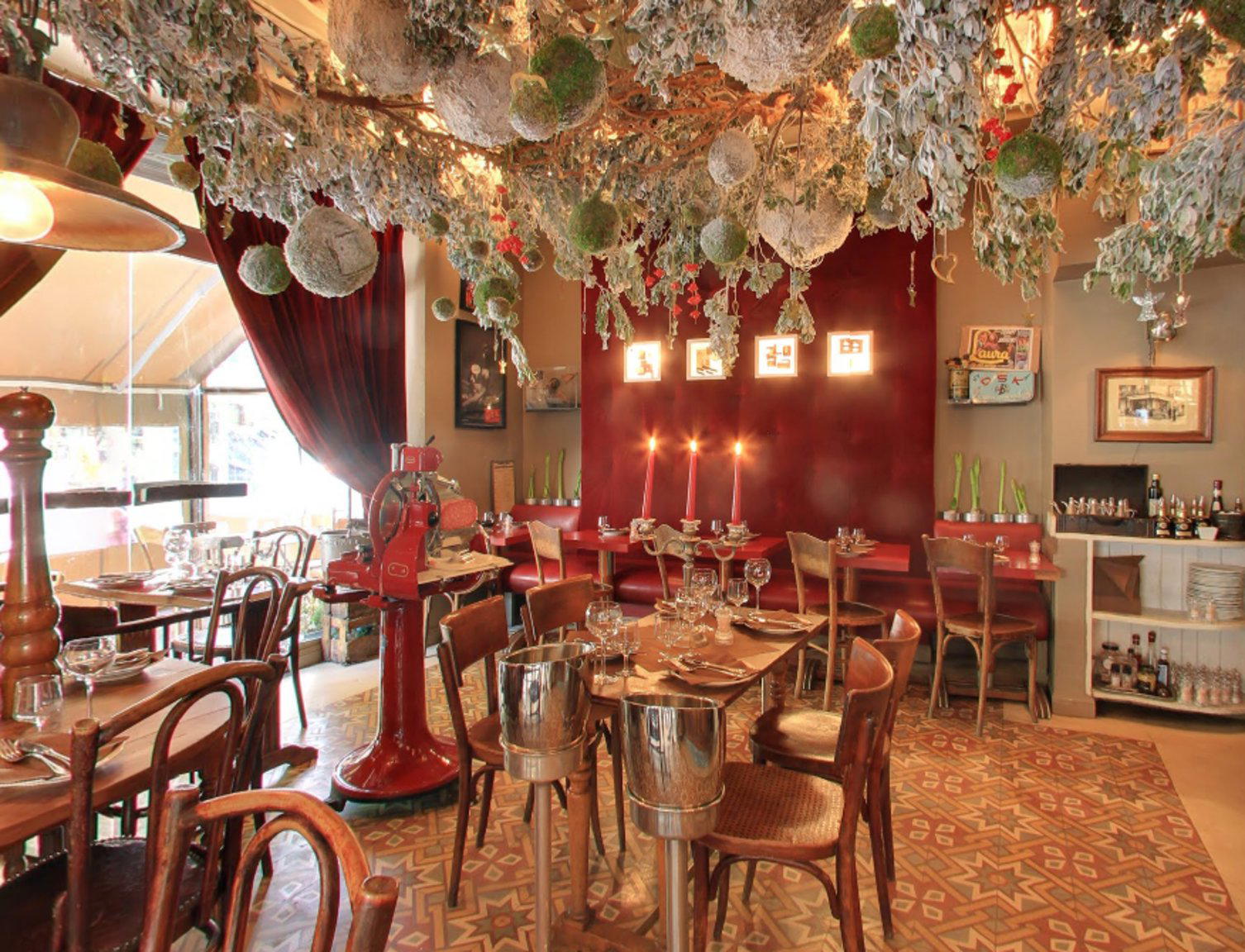
Colorful decor with floral decorations creating a warm, lively, and intimate atmosphere.