Sicily's Larder as the Editorial Thread
Contemporary Italian fine dining, at its most considered, treats the regional larder as both constraint and creative engine. The constraint is productive: a kitchen working within the boundaries of what the surrounding territory produces tends toward greater specificity than one sourcing globally. In southeastern Sicily, that territory includes some of the country's most characterful ingredients. The Val di Noto's almond groves, the fishing grounds off the Ionian and Mediterranean coasts, the island's particular varieties of artichoke, the concentrated capers from Pantelleria to the west, these form the backbone of a cuisine that has enough raw material to sustain serious ambition.
At Crocifisso, the menu is built on this foundation. The artichoke cooked two ways on brioche with anchovy sauce, noted in the Michelin documentation, shows the approach clearly: a single Sicilian vegetable given two treatments, then anchored by anchovy, the salted, fermented flavour that runs through the island's cooking from antiquity. Nothing in that dish needs to travel far. The cod with leek foam and cuttlefish ink, finished with black truffle and basil oil, works the same logic from a marine angle. Cuttlefish ink is a constant presence in Sicilian fish cookery; the black truffle and basil oil refine the technique into fine-dining register without abandoning the ingredient logic of the coast.
This is the productive middle ground that makes serious provincial restaurants worth the detour. The Italian fine-dining canon contains its share of kitchens working at an abstract distance from their geography, three-Michelin-star houses like Le Calandre in Rubano, Enrico Bartolini in Milan, or Osteria Francescana in Modena operate at a level of technical and conceptual elaboration that inevitably pulls away from place. A one-star kitchen in a city like Noto is under different pressures and makes different choices. The local ingredient is not a gesture; it is the whole argument.
Chef Marco Baglieri and the Baroque Reference
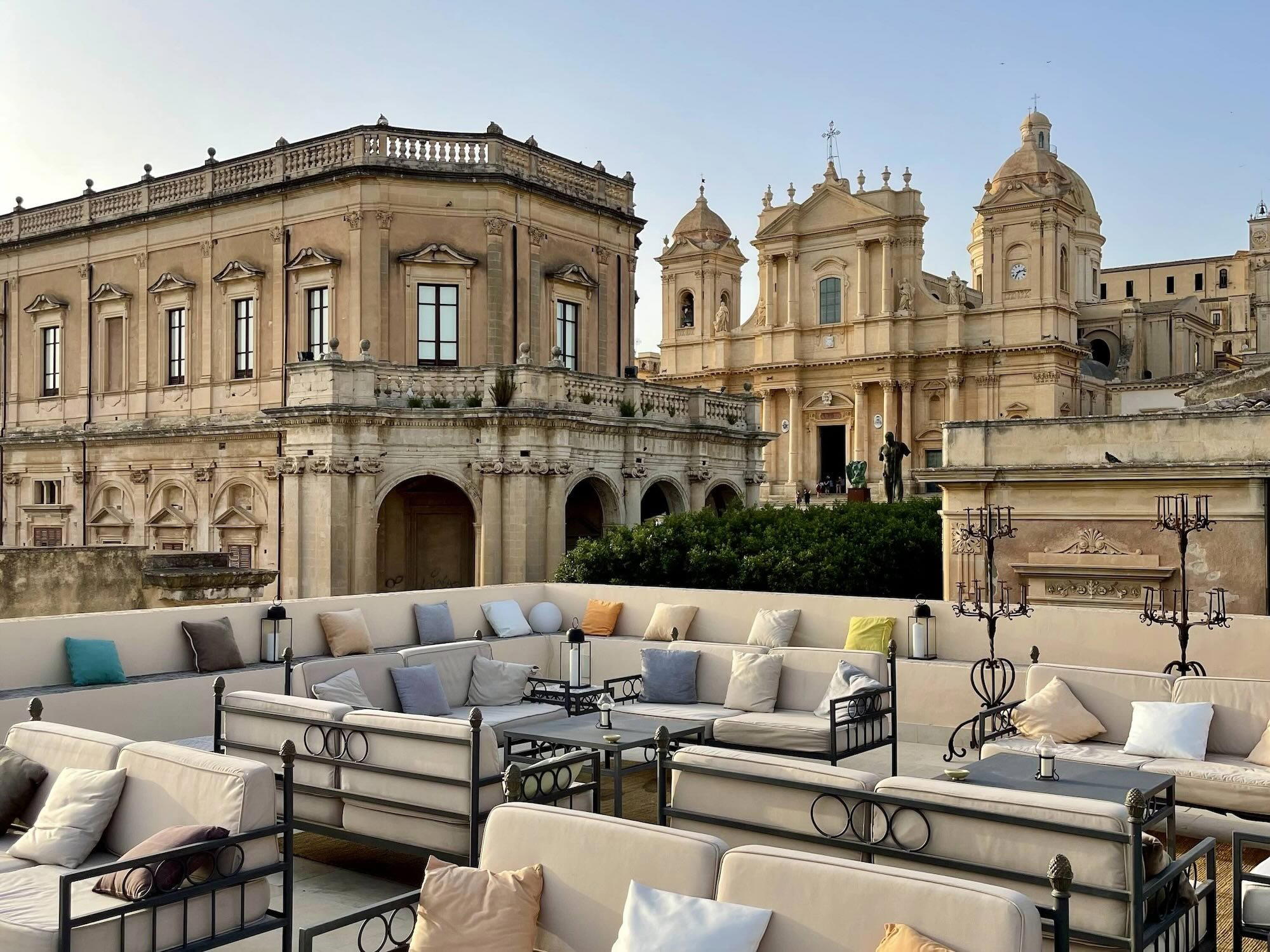
Michelin's assessment describes chef Marco Baglieri's cuisine as becoming "sophisticated and almost baroque", the modifier matters. Noto is arguably the most complete baroque city in Sicily, a UNESCO-listed ensemble rebuilt with theatrical grandeur after the 1693 Val di Noto earthquake. The culinary reference to that aesthetic is a form of local positioning: the dishes reach for complexity and richness without collapsing into excess. The brioche base under the artichoke, the foam on the cod, the truffle and basil oil finish, these are the layering techniques of a kitchen that understands contrast and accumulation while keeping the underlying ingredient legible.
The menu's scope extends beyond fish and shellfish. Both meat and vegetarian dishes feature, which matters in a corner of Sicily where the tourist assumption defaults to seafood. A kitchen that builds serious vegetarian courses in this context is generally one that understands the local agriculture as well as the fishing grounds, the two faces of a territory that produces year-round.
The Wine Program
The glass cellar on the exterior is the restaurant's most public credential before you sit down. Sicily's wine production has shifted substantially over the past two decades. The island now generates serious Nerello Mascalese from Etna, Nero d'Avola of genuine depth from the southeast, and a range of indigenous whites, Carricante, Grillo, Catarratto, that have found serious producers. A cellar at this level is expected to hold the island's own leading alongside the Italian and broader European context. The arrangement and depth of the selection, visible from the street, is part of the restaurant's argument about what kind of kitchen this is.
For comparison, Enoteca Pinchiorri in Florence holds arguably Italy's most celebrated cellar, with a wine program that effectively defines the three-star tier on its own terms. Crocifisso operates at a different scale and price point, but the instinct to make the cellar a visible and primary feature of the offer is a recognisable signal: this kitchen expects wine to carry equal weight to food.
Noto's Contemporary Dining Scene
Noto punches well above its population for serious dining, a function of its position as one of Sicily's most visited baroque towns and the agricultural richness of the Val di Noto surrounding it. The city draws visitors who are already oriented toward culture and quality, which creates the conditions for kitchens that take their cooking seriously. Orti di Villadorata approaches the territory through country cooking, while Principe di Belludia works a creative register. Crocifisso's Michelin star places it at the top of that local tier, part of a broader Italian contemporary movement that includes destination kitchens like Reale in Castel di Sangro, Piazza Duomo in Alba, Atelier Moessmer Norbert Niederkofler in Brunico, and Quattro Passi in Marina del Cantone, as well as contemporary Italian-influenced rooms further afield like César in New York and Jungsik in Seoul.
Within the city itself, the restaurant's location in the historic upper section means it sits among the fabric of Noto's civic heritage rather than at the tourist-facing end of the corso. That positioning is consistent with the cooking: rooted in the place, oriented toward the serious diner rather than the passing visitor. For a fuller picture of what the city offers across categories, EP Club maintains guides to Noto restaurants, hotels, bars, wineries, and experiences.
At price point €€€, Crocifisso sits in a middle tier for Italian fine dining, below the €€€€ bracket occupied by the country's three-star houses but priced for a kitchen that has earned its Michelin recognition. Dinner runs from 7:30 PM through 9:30 PM most evenings, with Wednesday service beginning slightly earlier at 7:00 PM. Given its standing in the city and the size typical of fine-dining rooms in this part of Sicily, booking in advance is advisable, particularly during the high summer months when Noto draws significant visitor numbers. The restaurant's address at via Principe Umberto 46 is in the upper historic quarter, reachable on foot from most of the city's main hotels.
Planning Your Visit
That breadth of opinion adds context to the Michelin assessment: this is a kitchen whose consistency reads across a wide diner base, not just the critic's table. The combination of the 2024 star and sustained high public rating signals a kitchen operating with genuine reliability at its price point.
What Should I Order at Crocifisso?
The Michelin documentation points directly to two dishes that illustrate the kitchen's method: the artichoke cooked two ways on brioche with anchovy sauce, and the cod with leek foam and cuttlefish ink, finished with black truffle and basil oil. Both anchor a specifically Sicilian ingredient, the artichoke, the cuttlefish ink, the anchovy, inside a technically accomplished contemporary format. Chef Marco Baglieri's menu extends to meat and vegetarian courses as well, which means the kitchen's range is broader than a seafood-only read. If the cellar is the other main event, ask what is currently pouring from Etna or the southeast of the island; the glass-fronted exterior display is the restaurant's own argument for taking the wine list seriously.