Carcasse



Carcasse in Sint-Idesbald holds a Michelin Plate and ranked #59 in Opinionated About Dining's 2025 Casual Europe list, placing it among Belgium's most recognised meat-focused restaurants. Under head chef Timon Michiels, the kitchen centres on self dry-aged beef (minimum 28 days) and charcoal-grill cookery, drawing from sourcing across Belgium, the Netherlands, Germany, the UK, and Spain. Open Thursday through Monday for lunch and dinner, priced at €€€€.
 Discover on Pearl
Pearl is the En Primeur Club membership app — saves, bookings, and concierge access live there. Same editors, same standards.
- Address
- H. Christiaenlaan 5, 8670 Koksijde, Belgium
- Phone
- +32 58 51 72 49
- Website
- carcasse.be
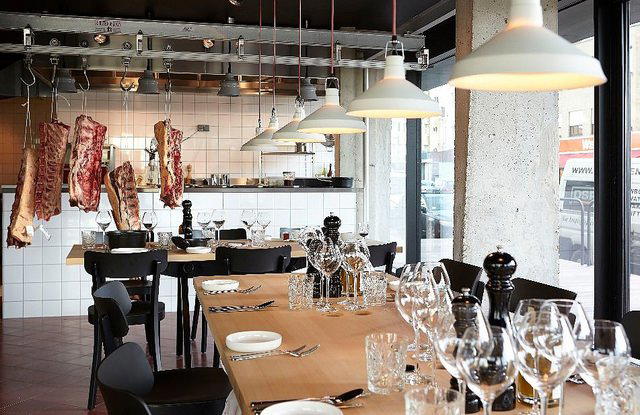
Fire, Age, and the Belgian Coast's Serious Meat Counter
The West Flemish coast is better known for grey-sky seafood institutions than for serious meat cookery, which makes the presence of Carcasse in Sint-Idesbald all the more pointed. Belgium's premium restaurant tier runs heavily toward creative French-Flemish formats, but Carcasse in Sint-Idesbald follows a different path. Boury in Roeselare or the two-star modern European work at Castor in Beveren and Cuchara in Lommel. Carcasse occupies a different lane: a charcoal-grill, dry-age-forward house that has built its reputation around the material itself rather than technique-as-spectacle. That positioning has earned it a Michelin Plate (2025) and a ranking of #59 on Opinionated About Dining's 2025 Casual Europe list, down from #41 in 2024 but still placing it comfortably inside a small peer group of European restaurants where sourcing and aging are the primary arguments.
The Aging Programme: Minimum 28 Days, Self-Managed
Dry-aging in European restaurants occupies a spectrum from decorative display fridges to genuine programme-led operations. Carcasse sits at the operational end. The restaurant ages its beef in-house, with a stated minimum of 28 days, and sources from a deliberately wide geographic spread: Belgium and the Netherlands, Germany, the United Kingdom, and Spain. That sourcing breadth is worth pausing on. Different beef traditions produce structurally different raw material, British grass-fed cattle carry different fat architecture than Iberian breeds or the grain-influenced animals common in Belgian specialist butchery. Running a multi-origin aging programme requires calibrating time and conditions per provenance, not applying a single protocol across unlike product.
The connection to master butcher Hendrik Dierendonck, who founded the concept, remains central. Butchery-led restaurants in Europe have generally outperformed chef-led equivalents on product consistency, precisely because the sourcing relationship predates the cooking. The open kitchen at Carcasse keeps the grill work visible, and the charcoal format is the appropriate instrument for aged beef: it applies intense, direct heat without the moisture interference of a closed environment, allowing the dry-aged crust to develop properly rather than steam off. For comparable approaches at European scale, Damini Macelleria & Affini in Arzignano and AuGust in Zurich represent the Italian and Swiss iterations of this butcher-to-restaurant model.
Head Chef Timon Michiels and the Current Moment
Chef Timon Michiels operates a concept that carries significant institutional weight. The nose-to-tail philosophy, the in-house aging, the sourcing network, these were established before him, and part of his task is to work within a framework with high expectation rather than build from open ground. The kitchen is operating within a framework that already has high expectations. The craft level remains consistent; the question is whether the cooking develops the kind of singular edge that pushes a charcoal-grill house from respected to reference. At roughly $95 per person, that question matters to the experienced diner deciding between this and the broader Belgian fine dining field, which includes two-Michelin-star coastal work at Bartholomeus in Heist and the Flemish creative cooking at Willem Hiele in Oudenburg.
The Room and the Coastal Context
Sint-Idesbald sits within the municipality of Koksijde, a stretch of the Belgian coast that draws a different visitor profile from Knokke to the north, less conspicuously wealthy, more family resort, with a summer-heavy calendar. Carcasse's interior aesthetic, described consistently as a contemporary butcher's atelier, does deliberate work against that coastal-casual backdrop. The open kitchen anchors the space functionally and visually, making the grill operation part of the dining environment rather than something happening behind a wall. The second Carcasse location in Knokke signals that the format scales. That Sint-Idesbald remains the original site gives it the more established kitchen hierarchy and aging infrastructure.
For a broader look at what Sint-Idesbald offers across categories, the full Sint-Idesbald restaurants guide covers the range. Diners coming specifically for Carcasse who want contrast on the same trip will find adjacent territory at Julia Fish & Oysterbar, which handles the seafood register, and Boîte for world cuisine.
Where Carcasse Sits in Belgium's Wider Restaurant Picture
Belgian restaurants at the €€€€ tier increasingly compete on specificity of concept rather than breadth of ambition. The high-technique creative field is well-served, Zilte in Antwerp, Hof van Cleve in Kruishoutem, Bozar Restaurant in Brussels, and d'Eugénie à Emilie in Baudour each occupy defined positions within it. Carcasse's argument is structural: it competes not on the same axis as those kitchens but on product depth and aging specificity. The OAD Casual Europe list is a meaningful placement for a meat restaurant because OAD's casual category tends to reward exactly this, strong product, honest execution, and format clarity over tasting-menu theatrics.
The nose-to-tail commitment also has competitive logic at this price tier. Serving the whole animal, including house charcuterie, slow-cooked secondary cuts alongside the primary grill work, differentiates Carcasse from steakhouses that simply buy in premium product and apply heat. It places the restaurant in a smaller European cohort where the butchery knowledge informs every plate, not just the centrepiece cuts.
Planning a Visit
Carcasse opens Thursday through Monday, with lunch service running 12 to 2 pm and dinner from 7 to 9 pm on each of those days; Tuesday and Wednesday are closed. The address is H. Christiaenlaan 5, 8670 Koksijde, with Sint-Idesbald as the immediately local area. At roughly $95 per person, this is dinner-occasion territory rather than a casual drop-in. The room's format and the aging programme both reflect that positioning. Google reviews sit at 4.5 from 726 ratings.
Cost and Credentials
Comparable venues nearby, for context on price, style, and recognition.
| Venue | Cuisine | Price | Awards |
|---|---|---|---|
| CarcasseThis venue — the venue you are viewing | Meats and Grills | €€€€ | Michelin 1 Star |
| Boury | Modern Frlemish, Creative French | €€€€ | Michelin 3 Star |
| Comme chez Soi | French - Belgian, Classic Cuisine | €€€€ | Michelin 1 Star |
| Hertog Jan at Botanic | Modern Flemish, Creative | €€€€ | Michelin 2 Star |
| L'Eau Vive | French, Modern French | €€€€ | Michelin 2 Star |
| La Durée | French-Belgian, Creative | €€€€ | Michelin 2 Star |
Continue exploring
More in Sint-Idesbald
Restaurants in Sint-Idesbald
Browse all →
Bars in Sint-Idesbald
Browse all →
At a Glance
- Rustic
- Industrial
- Modern
- Elegant
- Date Night
- Celebration
- Special Occasion
- Group Dining
- Family
- Open Kitchen
- Private Dining
- Sommelier Led
- Farm To Table
- Local Sourcing
- Organic
Hip, raw industrial aesthetic with exposed meat aging cabinet and vintage overhead runners; warm and welcoming atmosphere with guitar soundtrack; communal long table encourages shared dining experience.