Caín
.png)
Inside an industrial warehouse on the edge of Nava del Rey, Caín runs on fire. Chef Anaí Meléndez built her menu around open-grill cooking and a commitment to small Castilian producers, with spit-roasted lamb requiring advance notice and several hours of preparation. It is one of the more considered addresses in Valladolid's wider dining orbit, and one that rewards planning.
 Discover on Pearl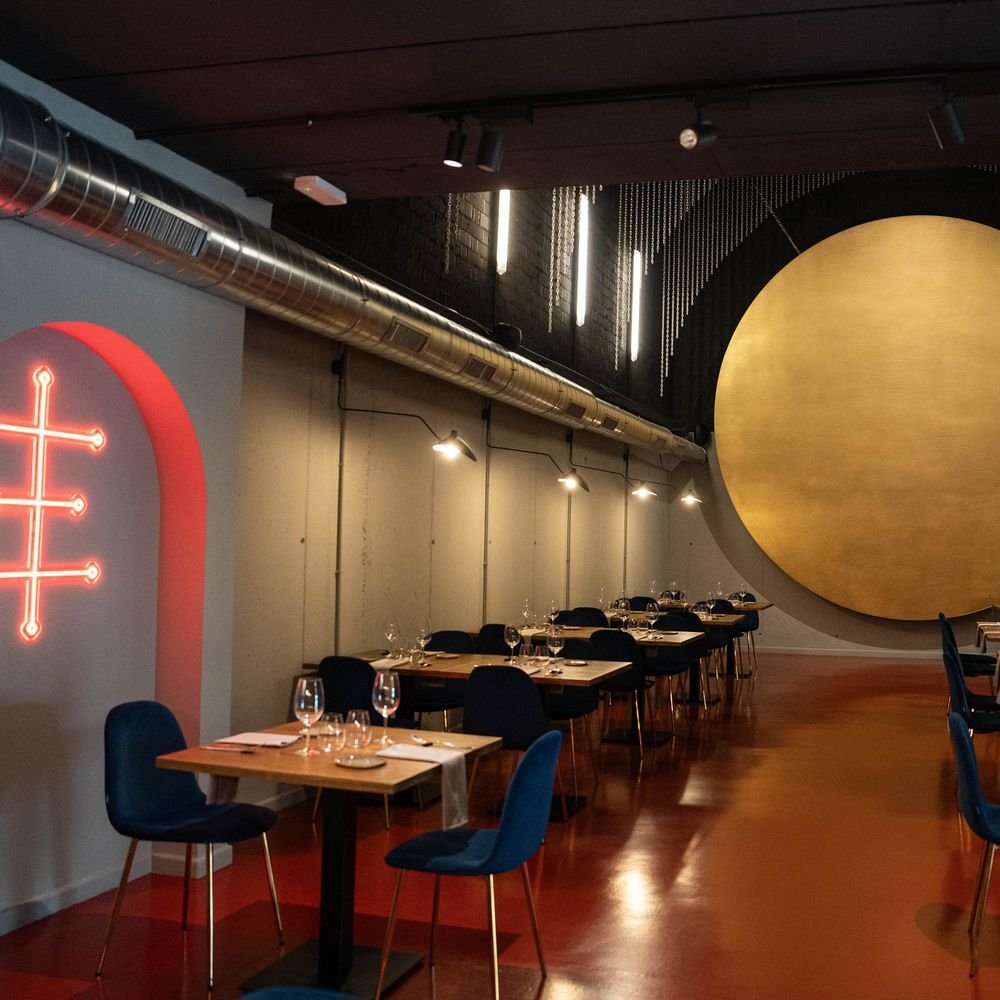
A Warehouse, an Open Grill, and the Logic of Fire
The approach to Caín tells you nothing obvious. An industrial-looking warehouse on the outskirts of Nava del Rey, a small town in the Valladolid province of Castile and León, does not signal fine dining by conventional cues. But that mismatch is precisely the point. Where Castilian restaurants have historically leaned into rustic stone, dark wood, and the visual grammar of the mesón, Caín works in the opposite direction: raw industrial materials, a punk aesthetic filtered through what the kitchen describes as a religious dedication to embers, and a design language that sets it apart from the regional baseline without borrowing from urban minimalism either.
The open kitchen is the room's anchor. The incandescent grills sit at the centre, and the heat and light they throw are structural, not decorative. Everything about the dining experience radiates outward from that fire, which is both a cooking method and a kind of editorial statement about what Castilian cuisine can look like when it is reimagined rather than preserved.
The shortlist, unlocked.
Hard-to-book tables, cellar releases, and concierge-planned trips.
Get Exclusive Access →Where the Food Comes From, and Why the Supply Chain Matters
Caín sits inside a broader movement in Spanish regional cooking that has, over the past decade, shifted the conversation from technique to provenance. The most closely watched kitchens in the country, from Azurmendi in Larrabetzu to El Celler de Can Roca in Girona, have all formalised their relationships with local suppliers as part of their identity. At the three-Michelin-star tier, that sourcing is often documented and audited. At Caín's level, in a small Castilian town rather than a major culinary city, the commitment to small local producers carries a different weight: it is not a marketing position but a practical act of regional loyalty, and one that shapes the menu's constraints as much as its ambitions.
Castile and León is Spain's largest autonomous community by area and one of its most agricultural. The livestock traditions here, particularly around lamb and veal, are among the oldest and most regulated in the country. Lechazo, milk-fed lamb, is the region's culinary reference point, protected under its own designation of origin and tied to specific breeds and slaughter weights. When a kitchen in this territory insists on sourcing from small local producers, it is working within, and signalling allegiance to, a supply chain that is already highly defined. The sourcing decision and the cooking method are inseparable: embers slow enough to allow real connective tissue to relax, cuts that reward patience over speed, producers who raise animals at the scale where quality is still controllable.
The Menu: Fire as Method and Philosophy
Almost everything on the menu at Caín passes through or near the grill. Beef and veal chops represent the everyday register of the open-fire cooking, available across service. The set-piece is the young lamb on the spit, which is only offered at lunchtime and only by prior reservation, given that it requires between four and five hours of roasting. That structural constraint is worth understanding before you plan a visit: this is not a dish that can be ordered on arrival or added mid-service. It must be requested in advance, and it commits the kitchen to a morning of preparation for each table that orders it. The format places Caín in a tradition of destination cooking, where the meal is planned rather than spontaneous, and where the kitchen's timetable shapes the guest's itinerary rather than the reverse.
This approach connects, at a different scale and price tier, to the logic of Spain's most deliberate restaurant experiences. Aponiente in El Puerto de Santa María and Mugaritz in Errenteria both require advance commitment and build menus around ingredients that have their own preparation timelines. Caín's spit-roasted lamb operates on the same principle, adapted to a Castilian context and a very different price bracket.
The Broader Spanish Fire-Cooking Revival
Live-fire cooking has consolidated into one of the more coherent movements in contemporary Spanish gastronomy. It draws simultaneously on deep regional tradition, particularly in Castile, the Basque Country, and Extremadura, and on a newer critical interest in wood and ember as primary flavour tools rather than finishing techniques. The kitchens receiving the most attention in this space have moved away from gas and induction not as a nostalgic gesture but as a technical choice: embers introduce variables that require skill to manage, and that skill is now being recognised as a distinct competency. Atrio in Cáceres and Ricard Camarena in València represent different registers of Spanish regional cooking that have also engaged seriously with their respective landscapes' produce. Caín sits within this broader shift, operating at the point where tradition and a more confrontational aesthetic sensibility intersect.
Nava del Rey and Why Location Is Relevant
Nava del Rey is not a culinary destination in the way that San Sebastián or Madrid commands attention. It is a small agricultural town in the Valladolid province, known primarily for its wines, particularly its white Verdejo and Viura-based bottles, and for its position within the Rueda Designation of Origin. If you are building a trip around the broader Castile and León wine and food circuit, the town offers a logical stop, and Caín represents the most considered restaurant option in its immediate orbit. For those who have been working through our full Nava del Rey restaurants guide, it stands as the kitchen with the most defined culinary identity in the area.
The surrounding region also warrants attention beyond the meal itself. Our full Nava del Rey wineries guide covers the Rueda producers worth visiting, and given that the town's identity is as much about its white wines as its food, pairing a Caín lunch with a winery visit in the afternoon is a logical structure for a day trip from Valladolid. Those staying longer in the area can also consult our full Nava del Rey hotels guide and our full Nava del Rey bars guide to extend the itinerary, as well as our full Nava del Rey experiences guide for context on what the region offers beyond the table.
Planning Your Visit
Given that Caín sits outside the main town centre, and that phone and website details are not currently listed through standard directories, the most reliable approach is to contact the restaurant directly through its address at Camino del Río, 13, Nava del Rey, Valladolid. If the spit-roasted lamb is the reason for your visit, that communication needs to happen before arrival, and ideally several days ahead. Lunch is the primary service for the more time-intensive dishes, and the format of the restaurant rewards arriving with time to spare rather than treating it as a quick stop.
For those comparing this against the higher-profile end of the Spanish dining circuit, the reference points are useful but not directly transferable. DiverXO in Madrid, Arzak in San Sebastián, Martin Berasategui in Lasarte - Oria, Cocina Hermanos Torres in Barcelona, and Quique Dacosta in Dénia all operate at the Michelin three-star tier with corresponding booking lead times, price points, and operational structures. Caín occupies a different tier entirely, which is not a criticism: it is the kind of address that works because it is rooted in a specific place, a specific agricultural supply chain, and a specific set of cooking convictions, none of which require a city-scale infrastructure to be worth the detour.
The shortlist, unlocked.
Hard-to-book tables, cellar releases, and concierge-planned trips.
Get Exclusive Access →Frequently Asked Questions
Peer Set Snapshot
These are the closest comparables we have in our database for quick context.
| Venue | Cuisine | Price | Awards | Notes |
|---|---|---|---|---|
| Caín | On the outskirts of this small town, inside an industrial-looking warehouse, the… | This venue | ||
| Aponiente | Progressive - Seafood, Creative | €€€€ | Michelin 3 Star | Progressive - Seafood, Creative, €€€€ |
| Arzak | Modern Basque, Creative | €€€€ | Michelin 3 Star | Modern Basque, Creative, €€€€ |
| DiverXO | Progressive - Asian, Creative | €€€€ | Michelin 3 Star | Progressive - Asian, Creative, €€€€ |
| El Celler de Can Roca | Progressive Spanish, Creative | €€€€ | Michelin 3 Star | Progressive Spanish, Creative, €€€€ |
| Quique Dacosta | Creative | €€€€ | Michelin 3 Star | Creative, €€€€ |
Need a table?
Our members enjoy priority alerts and concierge-led booking support for the world's most difficult tables.
Get Exclusive AccessThe shortlist, unlocked.
Hard-to-book tables, cellar releases, and concierge-planned trips.
Get Exclusive Access →