Our verdict
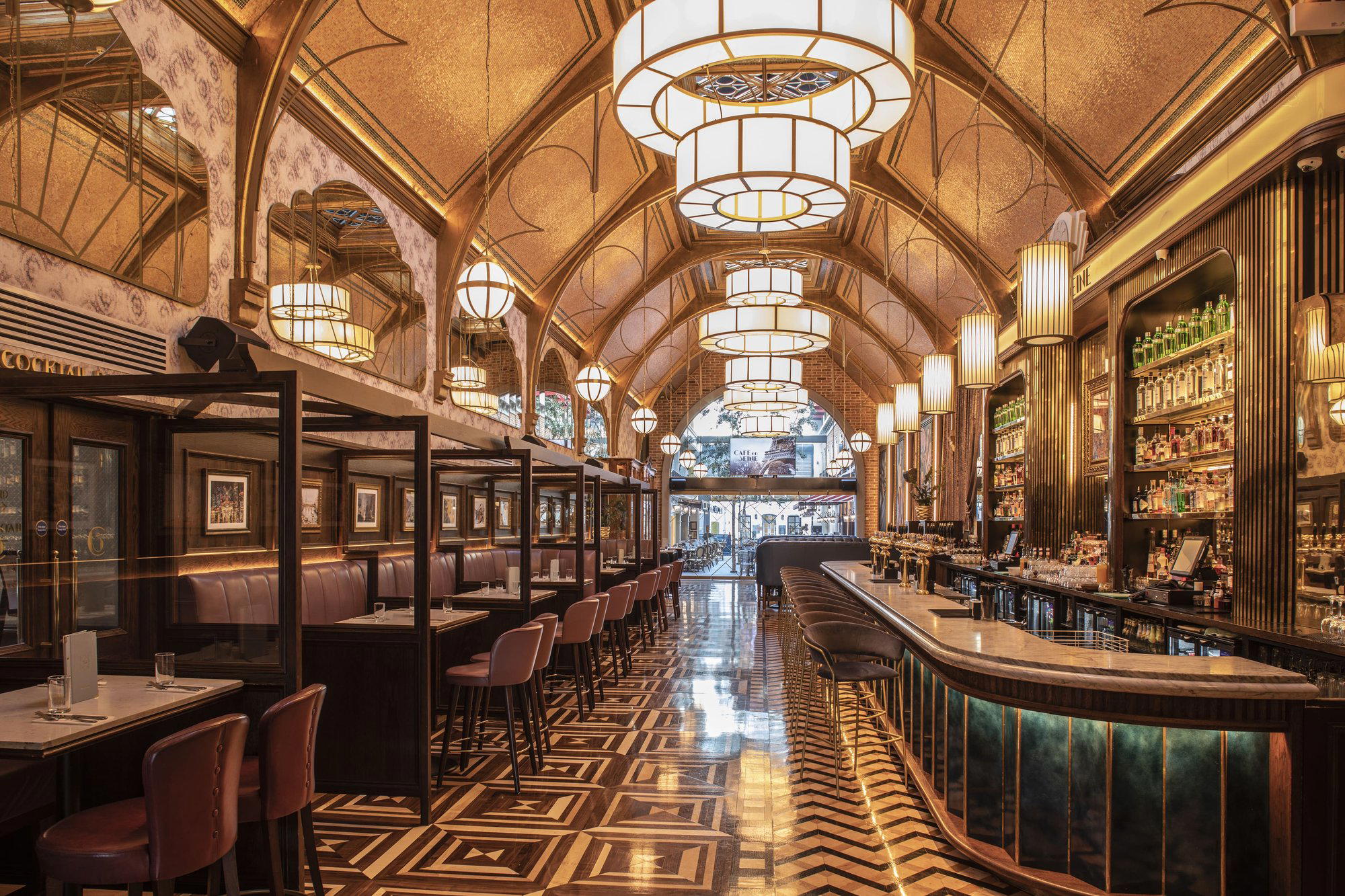
On Dawson Street in Dublin city centre, Café en Seine is one of the capital's most architecturally arresting bar and dining spaces, drawing a broad crowd to its multi-level interior of wrought iron, soaring ceilings, and glass canopies. Compared to Dublin's intimate gastropub circuit, it occupies a different register entirely: grand in scale, central in location, and built for long evenings.

Pearl is the En Primeur Club membership app — saves, bookings, and concierge access live there. Same editors, same standards.
- Address
- 40 Dawson St, Dublin, Ireland
- Phone
- +35316774567
- Hours
- Mon–Wed 11:30 AM–11:30 PMThu–Sat 11:30 AM–2:30 AMSun 11:30 AM–11 PM
- Website
- cafeenseine.ie
- Directions
- Get directions
- Booking
- Book on OpenTable
The menu
What to order
- Double Mash Burger
- Fish and Chips
- Beer Battered Fish & Chips
- Sea Bream
Dawson Street's Grand Interior in Context
Dublin's bar scene has long split between the intimate snug-and-timber model of the Victorian pub and a newer wave of European-style grand café formats that arrived in the 1990s and gathered momentum through the Celtic Tiger years. Café en Seine, at 40 Dawson Street, belongs firmly to the second category. The address sits on one of the city centre's most commercially dense stretches, running south from Nassau Street toward St Stephen's Green, and the building itself announces its intentions before you push through the door: a facade that signals occasion rather than neighbourhood ease.
Inside, the proportions are the point. Multi-level galleries, wrought-iron balustrades, and a glass canopy overhead place this space in a European café-brasserie tradition that references Paris and Vienna more directly than anything on the Liffey quays. Dublin has relatively few interiors that operate at this scale, which is why Café en Seine has retained a consistent draw across different dining and drinking generations since opening. For visitors orienting themselves in the city, the space sits within walking distance of Grafton Street and a short walk from the Merrion Square cultural belt, making it a natural anchor point on a central Dublin itinerary.
The Broader Dublin Dining Frame
Understanding where Café en Seine fits requires a quick map of Dublin's current restaurant geography. The capital's most ambitious cooking is concentrated in a handful of rooms: Chapter One by Mickael Viljanen has set the pace for modern European fine dining at the Parnell Square end, while Patrick Guilbaud on Merrion Street holds the city's longest-standing Michelin recognition in the French-Irish tradition. Bastible on Camden Street represents the modern Irish register at a more accessible price point, and Glovers Alley and D'Olier Street have both added serious culinary weight to the city centre in recent years.
Café en Seine occupies a different tier from all of these. Where those rooms compete on the quality of their kitchen output, Café en Seine competes on atmosphere, footprint, and accessibility of format. That is not a lesser ambition in a city whose hospitality economy depends heavily on large-group bookings, after-work trade, and the kind of space that can hold a crowd at 6pm and still be the right choice at 10pm. The grand-café model, when executed at this scale, requires a different kind of operational discipline than a thirty-cover tasting menu room, and Dublin has few places that attempt it.
Irish Ingredients in a European Frame
The editorial angle most relevant to a venue like Café en Seine is the one that runs through much of Ireland's current hospitality conversation: what happens when a broadly European format meets the raw material abundance that Irish agriculture and coastline produce. Ireland's food supply credentials are well-documented beyond marketing. The grass-fed beef from the midland counties, the shellfish from the west coast, the dairy from Cork and Tipperary, and the lamb from Connemara and Kerry all represent a larder that more technically ambitious rooms, from Liath in Blackrock to Aniar in Galway, have built entire philosophies around.
For a large-format brasserie-style space, the challenge is different: sourcing at volume while maintaining regional integrity, and building a menu broad enough to serve a mixed crowd without defaulting entirely to generic European templates. Venues at this scale across Ireland, from Terre in Castlemartyr to The Oak Room in Adare, have shown that the country-house and hotel-restaurant format can hold serious ambition at scale. The question for a city-centre grand café is whether the same sourcing logic applies when the primary offer is drinks-led and the food functions partly as support for longer sessions rather than as the main event.
Internationally, the intersection of local ingredients and imported technique has been handled most credibly in rooms where the kitchen has a clear point of view: Le Bernardin in New York City built its reputation on French technique applied to American seafood with near-absolute discipline, while Lazy Bear in San Francisco has used a communal format to deliver technically serious California-sourced cooking. The lesson from those rooms is that format and ingredient philosophy need to be aligned rather than in tension.
The Café en Seine Visit: What to Know Before You Go
For visitors planning a Dublin itinerary, Café en Seine works well understood as a drinks and atmosphere destination that also serves food, rather than a restaurant that happens to have a bar. The Dawson Street location is central enough that it fits naturally into a city-centre evening without requiring a detour. Those looking for focused modern Irish cooking in the same geographical cluster would do better starting at the restaurants referenced above, or consulting our full Dublin restaurants guide for the complete picture across price tiers and cooking styles.
Beyond Dublin, the broader Irish dining scene extends through a network of serious rooms that reward travel: dede in Baltimore, Bastion in Kinsale, Chestnut in Ballydehob, Homestead Cottage in Doolin, Campagne in Kilkenny, and The Morrison Room in Maynooth all represent the country's regional dining ambition at a level that merits specific planning.
For Café en Seine itself, the practical calculus is direct: the space is large enough that walk-in access is generally more realistic here than at the tighter-capacity rooms on the Dublin fine-dining circuit. Weekend evenings, particularly Friday and Saturday from early evening onward, attract the largest crowds. If your primary aim is the interior and the atmosphere, arriving before 7pm gives you the leading chance of settling in without pressure. If food is the priority, the city's more focused kitchens nearby will serve that need more precisely.
Frequently asked questions
What should I order at Café en Seine?
Do I need a reservation for Café en Seine?
What is Café en Seine known for?
Can Café en Seine handle vegetarian requests?
Is Café en Seine a good choice for a large group evening out in Dublin city centre?
Just the Basics
Comparable venues nearby, for context on price, style, and recognition.
| Venue | Cuisine | Price | Notes |
|---|---|---|---|
| Café en SeineThis venue — the venue you are viewing | Modern Irish-European Gastropub | $20–30 | Not listed |
| Beanhive | Irish Cafe with Healthy Options | $10–20 | Mansion House B, Irish Cafe with Healthy Options |
| Kittyhawks | Irish Gastropub | Not listed | Airport, Irish Gastropub |
| The Little Kitchen | Modern Irish | $30–50 | Pembroke West C, Modern Irish |
| MV Cill Airne | Irish Steakhouse on a Historic Boat | $30–50 | North Dock B, Irish Steakhouse on a Historic Boat |
| The Washerwoman | Modern Irish Gastropub | $30–50 | Botanic A, Modern Irish Gastropub |
Continue exploring
More in Dublin
Restaurants in Dublin
Browse all →
Bars in Dublin
Browse all →
Hotels in Dublin
Browse all →
Wineries in Dublin
Browse all →
Details
- Lively
- Well Known
- Elegant
- Trendy
- Brunch
- Group Dining
- Casual Hangout
- Special Occasion
- Historic Building
- Private Dining
- Craft Cocktails
- Extensive Wine List
- Local Sourcing
- Small Plates
- A La Carte
- Craft Cocktails
- Wine
- Beer Program
- Vegetarian Friendly
- Vegan Options
- Gluten Free Options
Current opening hours
- Monday
- 11:30 AM–11:30 PM
- Tuesday
- 11:30 AM–11:30 PM
- Wednesday
- 11:30 AM–11:30 PM
- Thursday
- 11:30 AM–2:30 AM
- Friday
- 11:30 AM–2:30 AM
- Saturday
- 11:30 AM–2:30 AM
- Sunday
- 11:30 AM–11 PM
Hours can change for holidays and private events. Last verified .
Lively and sophisticated atmosphere with beautiful Art Nouveau design, chandeliers, and lively energy blending historic elegance with modern casual vibe.