Google: 4.1 · 331 reviews
.png)
Brasserie RÉGINE occupies the ground floor of the St. Regis Hotel Osaka, bringing seasonal prix fixe menus and classical French technique to Chuo Ward's business district. The kitchen operates under the supervising chef from Ryuzu, one of Tokyo's most respected French addresses. The mosaic floors, spacious interior, and outdoor terrace frame a dining room that reads as genuinely Parisian rather than hotel-adjacent pastiche.
 Discover on Pearl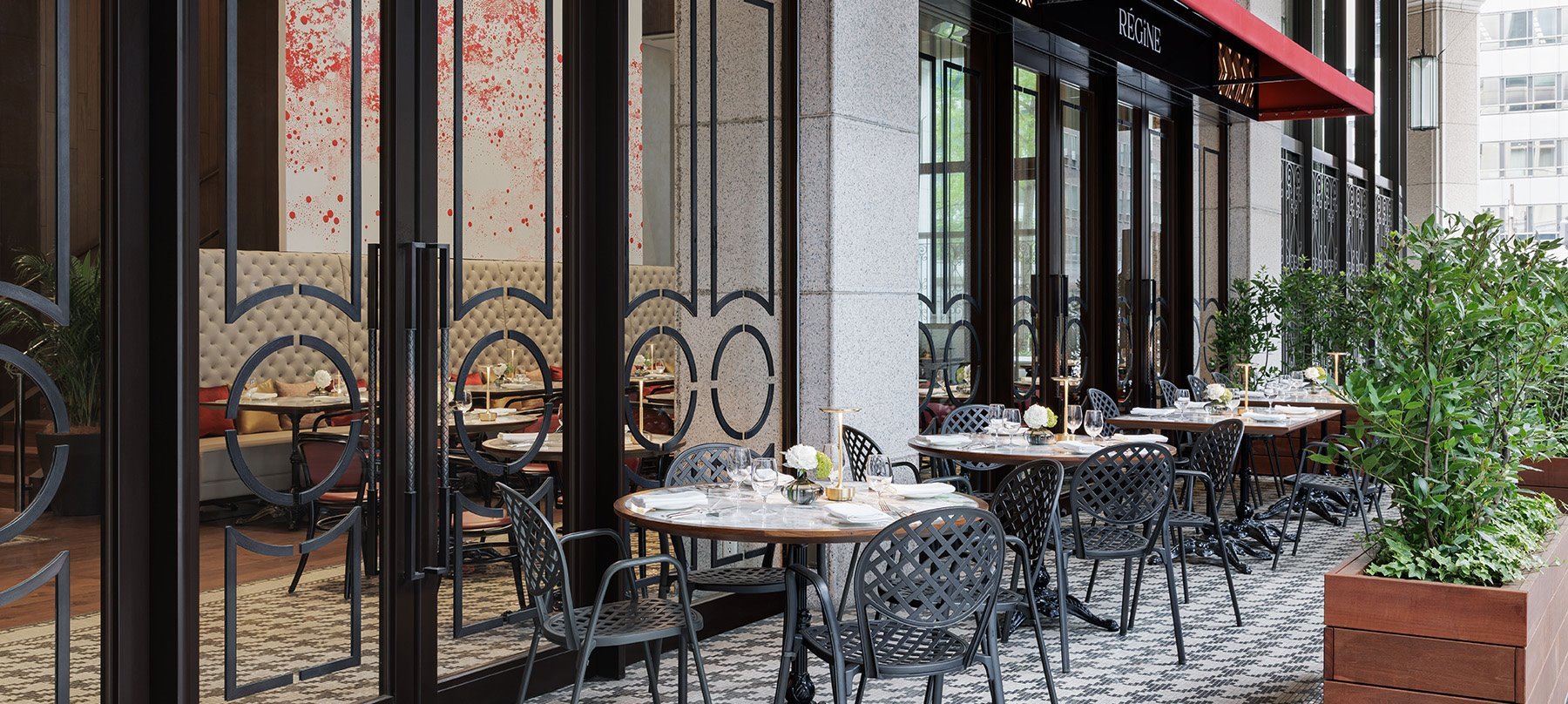
Where the Brasserie Format Lands in Osaka
The brasserie, as a dining format, carries specific expectations: a generous room, a menu that changes with the seasons, and a kitchen anchored in classical French technique rather than innovation for its own sake. Osaka's French dining scene has historically skewed toward the haute end — HAJIME holds three Michelin stars for its conceptual French-Japanese work, and La Cime operates at two stars with a tasting-menu format that demands full commitment from the diner. Against that backdrop, a properly executed brasserie represents something the city's French offer genuinely lacks at the upper tier: the combination of serious culinary supervision and a format that allows for shorter, more flexible visits.
Brasserie RÉGINE sits on the ground floor of the St. Regis Hotel Osaka in Honmachi, Chuo Ward. Hotel brasseries in Japan often default to competent-but-anonymous international cooking, present more for the property's profile than for the city's dining conversation. RÉGINE positions itself differently, placing a supervising chef with a direct connection to Ryuzu — a Tokyo restaurant that has held consistent Michelin recognition , at the head of the kitchen program. That lineage matters when assessing where this restaurant sits in Osaka's French tier: it is not attempting to compete with the tasting-menu houses, but it carries credentials that place it well above the average hotel dining room.
The Room and What It Signals
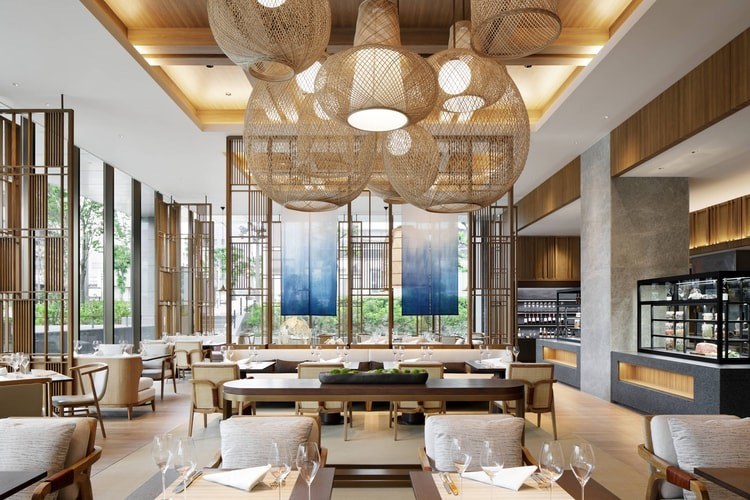
Walking into Brasserie RÉGINE, the reference points are clear. Mosaic floors, a spacious interior volume, and an outdoor terrace are the structural elements of a brasserie format drawn from the French original rather than a japonified approximation. The design reads as deliberate rather than decorative , in a city where French restaurants frequently compress into intimate counter or booth configurations, this is a room that breathes. The terrace element is particularly notable in an urban Osaka context, where outdoor dining space at this tier is scarce. In the warmer months, it shifts the experience considerably, pushing the room toward something closer to a Parisian café-brasserie than a hotel restaurant.
The décor is described as simple and modern, which in practice means the architecture carries the weight rather than the furnishings. This is a different calculation than the maximalist approaches found at international luxury hotel restaurants elsewhere in Asia, and it aligns with the French brasserie tradition where the room is a backdrop, not a statement.
Seasonal Prix Fixe and the Ryuzu Connection
Brasserie RÉGINE's menus change seasonally, structured around prix fixe formats. Seasonal prix fixe is the correct vehicle for classical French cooking in Japan, where ingredient quality peaks are as culturally significant as technique. Japan's seasonal rhythms , the arrival of specific fish, the brief window for mountain vegetables, the autumn progression through mushroom varieties , map naturally onto the French brigade system's respect for produce calendars. A kitchen supervised by a chef from Ryuzu's lineage understands both sides of that equation.
Ryuzu, in Tokyo's Roppongi district, built its reputation on classical French foundations applied with precision and restraint. The supervising relationship at RÉGINE is not a vanity attachment; it functions as a quality framework that connects this Osaka kitchen to a proven culinary standard. Comparable arrangements exist across Japan's hotel French dining rooms, but the credibility of the anchor address varies considerably. Ryuzu's Michelin-recognized standing gives the supervisory role here more weight than a more generic consulting arrangement would carry.
For context on the broader Osaka French-dining conversation, Fujiya 1935 operates at two Michelin stars with an innovative format, while the Japanese fine-dining category at a comparable price tier includes Kashiwaya Osaka Senriyama and Taian, both holding three Michelin stars. RÉGINE is not competing for that critical tier, but the Ryuzu lineage ensures it is a serious address rather than a convenient one.
Osaka's French Dining and Where RÉGINE Fits
Osaka's dining identity is often framed through its Japanese cooking traditions , kaiseki, teppanyaki, the city's obsessive street food culture. But the French restaurant population here is substantial and long-established. In cities like Osaka and Tokyo, French cooking took hold in the postwar decades and developed into a genuine local tradition, with Japanese chefs training in France and returning to build restaurants that interpret classical technique through a Japanese ingredient sensibility. That tradition now spans everything from three-star conceptual cooking to neighborhood bistros.
RÉGINE occupies a mid-to-upper position in this spectrum: formal enough to carry the St. Regis address, accessible enough to function as a business lunch destination or a relaxed dinner for guests who want French cooking without a multi-hour tasting commitment. In Tokyo, comparable brasserie-format addresses with serious culinary supervision include venues attached to the city's established luxury hotel circuit. In Osaka, the category is thinner, which gives RÉGINE a clearer position.
For those moving through the Kansai region, French dining with comparable attention to classical standards appears at akordu in Nara. Japan-wide, the French fine-dining conversation extends to Harutaka in Tokyo and Gion Sasaki in Kyoto, both of which represent the intersection of French-inflected technique and Japanese ingredient philosophy at a high level. Internationally, the standard against which classical French technique is often measured can be seen at addresses like Le Bernardin in New York City, where classical rigor and ingredient primacy define the critical benchmark. Further afield, Goh in Fukuoka, 1000 in Yokohama, and 6 in Okinawa illustrate how contemporary Japanese cooking in French-influenced formats spreads across the country's dining cities. The cross-cultural tension at venues like Atomix in New York City offers a useful parallel: when a non-French culinary tradition meets classical French structure, the result depends entirely on the precision of the execution.
Planning a Visit
Brasserie RÉGINE is located at 3 Chome-6-12 Honmachi, Chuo Ward, within the St. Regis Hotel Osaka. The Honmachi subway station places it in the central business corridor, accessible from most of Osaka's key districts without significant transit effort. Given the St. Regis address and the Ryuzu supervisory connection, bookings during peak dinner service , Friday and Saturday evenings, and weekday lunch periods tied to the business district , are likely to fill ahead. Seasonal menu changes mean that the experience shifts meaningfully across the year, and visitors with flexibility should consider timing around Japan's seasonal ingredient transitions in spring and autumn.
For a broader picture of where Brasserie RÉGINE fits within Osaka's dining, drinking, and hospitality scene, see our full Osaka restaurants guide, our full Osaka hotels guide, our full Osaka bars guide, our full Osaka wineries guide, and our full Osaka experiences guide.
In Context: Similar Options
A fast peer set for context, pulled from similar venues in our database.
| Venue | Cuisine | Price | Awards | Notes |
|---|---|---|---|---|
| Brasserie RÉGINE | Casual French dining in St. Regis Hotel Osaka, where prix fixe menus change with… | This venue | ||
| HAJIME | French, Innovative | ¥¥¥¥ | Michelin 3 Star | French, Innovative, ¥¥¥¥ |
| La Cime | French | ¥¥¥¥ | Michelin 2 Star | French, ¥¥¥¥ |
| Kashiwaya Osaka Senriyama | Japanese | ¥¥¥ | Michelin 3 Star | Japanese, ¥¥¥ |
| Taian | Kaiseki, Japanese | ¥¥¥ | Michelin 3 Star | Kaiseki, Japanese, ¥¥¥ |
| Fujiya 1935 | Innovative | ¥¥¥¥ | Michelin 2 Star | Innovative, ¥¥¥¥ |
Continue exploring
More in Osaka
Restaurants in Osaka
Browse all →
Bars in Osaka
Browse all →
Hotels in Osaka
Browse all →

Wineries in Osaka
Browse all →
At a Glance
- Elegant
- Sophisticated
- Classic
- Date Night
- Business Dinner
- Special Occasion
- Hotel Restaurant
- Sake Program
- Local Sourcing
- Street Scene
Timeless elegance with lively ambiance, gentle glow, and Parisian brasserie charm.