Our verdict
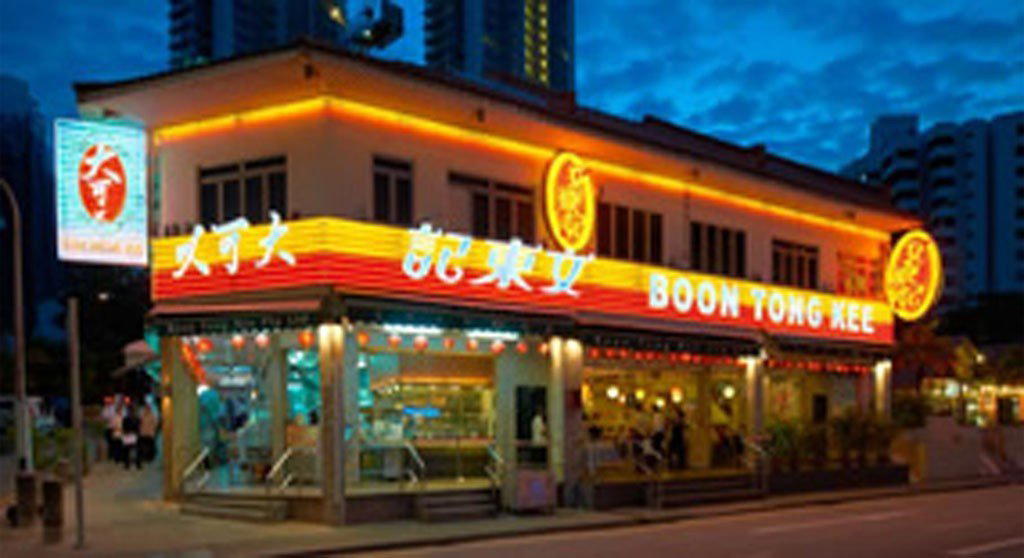
Boon Tong Kee 文東記 on River Valley Road is one of Singapore's most recognisable names in Hainanese chicken rice, operating across multiple decades and several locations citywide. The River Valley branch sits at the edge of the Robertson Quay corridor, drawing a mix of local regulars and visitors working through Singapore's canonical hawker repertoire. The meal here is structured around a single technique refined over generations.

Pearl is the En Primeur Club membership app, where members save venues, book tables and use the concierge.
The menu
What to order
- Signature Boiled Chicken
- Chicken Rice
- Crispy Tofu
River Valley and the Chicken Rice Continuum
Singapore's relationship with Hainanese chicken rice is not a trend or a phase. It is a civic institution, one that stretches from airport food courts to dedicated multi-branch operations that have outlasted entire generations of fine dining openings. The River Valley Road branch of Boon Tong Kee 文東記 sits at address 425, a short walk from the Robertson Quay stretch that now contains everything from wine bars to Michelin-starred counters. That proximity is telling. In a corridor where Les Amis and Odette define one end of Singapore's dining register, Boon Tong Kee anchors the other: a format with no tasting menu, no wine programme, and no ambiguity about what you are there to eat.
That lack of ambiguity is a feature, not a limitation. Chicken rice operations in Singapore succeed or fail on execution consistency across time and across branches. Boon Tong Kee has grown from a single Chinatown stall founded in 1979 into a multi-outlet institution, and the River Valley location carries that institutional weight. The question for any serious visitor is not whether to engage with chicken rice in Singapore, but where in the city's hierarchy of practitioners to place their meal. For those exploring the broader Singapore dining scene, our full Singapore restaurants guide maps the spectrum from hawker to haute.
The Architecture of a Chicken Rice Meal
Hainanese chicken rice follows a structure that is deceptively simple and technically demanding in equal measure. The progression of a table order at a place like Boon Tong Kee is not multi-course in the Western sense, but it has its own sequencing logic that rewards attention.
The centrepiece is poached chicken, cooked to a temperature that leaves the flesh just set, the skin silkened, and the bone-adjacent meat carrying a faint pink that alarms first-timers and reassures regulars. This is not undercooking; it is the hallmark of a technique that prioritises texture and retained juices over the grey uniformity of overcooction. The rice, cooked in chicken stock and rendered fat, arrives fragrant and slightly glossy, each grain separate. These two elements are the axis around which everything else orbits.
The condiment set matters as much as the bird itself. A dark soy sauce, a ginger-scallion paste, and a chilli sauce form the standard trio, and the quality of these preparations is where practitioners diverge most clearly. At the better-regarded operations, the chilli carries heat, acidity, and garlic in proportion rather than leaning on any single element. The soup, often a clear broth with light garnish, arrives as a palate reset rather than a course in its own right.
Beyond the core, a full table order at a chicken rice restaurant typically expands into shared plates: steamed or stir-fried vegetables, tofu preparations, and occasionally offal for those inclined. The meal builds laterally across the table rather than vertically through courses, and the pacing is driven by the kitchen's output rather than a choreographed sequence. This communal, simultaneous structure is characteristic of the Cantonese-influenced Singapore dining mode, distinct from the individual progression expected at places like Zén or Jaan by Kirk Westaway.
Where Boon Tong Kee Sits in the Chicken Rice Field
Singapore's chicken rice practitioners span a wide range. At one end are hawker stalls operating from single woks with minimal overhead, some of which carry Michelin recognition, notably Tian Tian at Maxwell Food Centre. At the other end are restaurant-format operations with air-conditioning, tablecloths, and prices that reflect the overhead. Boon Tong Kee sits in the latter tier: a seated, service-led environment that prices above hawker-stall equivalents but remains well below the cost of a meal at Singapore's fine dining tier.
The brand's reputation rests on a specific claim: that it popularised a silkier, more precisely poached preparation compared to older-style operations that ran hotter and longer. Whether that differentiation holds across branches and across decades is a question each visitor answers for themselves, but the institutional consistency of a multi-decade, multi-location operation is itself a data point. Chains fail when quality drifts; Boon Tong Kee's longevity suggests some degree of process discipline. For a different register of Singapore's hawker heritage, Ah Ter Teochew Fishball Noodles in Downtown Core represents the noodle tradition on the opposite end of the spectrum, while Bugis Street Ah Huat Hainanese Chicken Rice at Changi Airport shows how the format travels into transit contexts.
For those mapping Singapore's broader casual dining options around the Robertson Quay area, Cicheti in Rochor, Etna Restaurant in Outram, and Béni in Orchard offer adjacent options across Italian and French registers. Further afield, Meta represents the innovative contemporary end of Singapore's dining continuum. The contrast between a meal at Boon Tong Kee and one at Lazy Bear in San Francisco or Le Bernardin in New York City illustrates how far the format spectrum runs in any serious food city.
Planning the Visit
The River Valley Road location occupies a shophouse-format space that is accessible from the Robertson Quay area on foot. As with most restaurant-format chicken rice operations in Singapore, the meal is structured around sharing, so a table of two to four is better positioned to sample the full range of supporting dishes than a solo diner. Lunch service tends to draw local office workers and residents; dinner attracts a broader mix. No booking data is publicly confirmed for this location, but walk-in capacity at operations of this type generally accommodates groups more readily at off-peak hours, typically before noon or after 2pm for lunch, and before 7pm for dinner. For context on the wider neighbourhood and what other dining formats operate nearby, venues like Asian Twist by 365 Food in Queenstown and Du Du Shou Shi in Jurong West illustrate the range of casual formats across Singapore's residential districts.
Frequently asked questions
What part of town is Boon Tong Kee 文東記 in?
Boon Tong Kee 文東記 is located at 425 River Valley Rd, Singapore 248324, Singapore.
How does Boon Tong Kee 文東記 compare to single-stall hawker chicken rice operations in Singapore?
Boon Tong Kee sits in a distinct tier from single-wok hawker stalls: it is a restaurant-format operation with multiple branches across Singapore, including River Valley and Balestier, built around consistent replication rather than the artisanal idiosyncrasy of a one-person hawker setup. What you gain is reliability and comfort; what differs is the character of the cooking environment, which at a hawker stall is often inseparable from the dish itself. Both formats are legitimate expressions of Singaporean chicken rice, serving different visitor priorities.
What should I order at Boon Tong Kee 文東記?
Poached chicken rice is the structural centre of any order here, and everything else should orbit it. The shared-plate format at the River Valley Road location supports a table-wide spread of vegetables, tofu, and supporting dishes, but the chicken and its accompanying rice, broth, and chilli sauce are the non-negotiable core. Order for the table rather than individually.
How far ahead should I plan for Boon Tong Kee 文東記?
Boon Tong Kee at 425 River Valley Road operates on a walk-in basis rather than through advance reservations. Peak meal times and weekends will see queues, so arriving early in the lunch or dinner window is the practical approach. No confirmed booking system is in place for this location.
What's the standout thing about Boon Tong Kee 文東記?
Operating since 1979 in a city where chicken rice is a fiercely competitive category, Boon Tong Kee's consistency across multiple branches is the real credential. Longevity in Singapore's food scene is earned, not assumed, and more than four decades of continuous operation in a single format carries more weight than any single accolade.
Can Boon Tong Kee 文東記 handle vegetarian requests?
Chicken rice is a meat-centred format by definition, and the rice itself is cooked in chicken stock and fat, which makes it unsuitable for vegetarians. The River Valley Road location offers vegetable and tofu dishes as side orders, but these function as accompaniments within a chicken-centric meal structure, not as standalone vegetarian alternatives.
Is Boon Tong Kee 文東記 overpriced or worth every penny?
Boon Tong Kee prices above street-level hawker stalls, which is the relevant comparison for this format. What the premium covers is air-conditioning, table service, and the reliability of a multi-branch operation that has maintained consistent standards since 1979. For visitors who want a composed sit-down meal rather than a tray and a plastic stool, the step up in price is proportionate.
Where the Accolades Land
| Venue | Cuisine | Price | Awards | Notes |
|---|---|---|---|---|
| Boon Tong Kee 文東記This venue (the venue you are viewing) | Cantonese Hainanese Chicken Rice | $10–20 | Not listed | Not listed |
| Zén | Neo-Nordic with Japanese Influences | $500+ | 3 Michelin Stars · Michelin Guide 3 Stars | European Contemporary |
| Jaan by Kirk Westaway | Modern British Fine Dining | $200–300 | 2 Michelin Stars · Michelin Guide 2 Stars | British Contemporary |
| Born | Contemporary Fusion Fine Dining | $200–300 | 1 Michelin Star · Michelin Guide 1 Star | Creative Cuisine, Innovative |
| Burnt Ends | Modern Australian Barbecue | $100–150 | 1 Michelin Star · Michelin Guide 1 Star | Australian Barbecue, Barbecue |
| Iggy's | Modern European with Japanese Influence | $150–200 | 1 Michelin Star · Michelin Guide 1 Star | Modern European, European Contemporary |
Continue exploring
More in Singapore
Restaurants in Singapore
All restaurants in Singapore →
Bars in Singapore
All bars in Singapore →
Details
- Well Known
- Classic
- Lively
- Casual Hangout
- Group Dining
- Family
- Late Night
- Standalone
- Historic Building
- A La Carte
- Family Style
Current opening hours
- Monday
- 11:30 AM–3 PM, 5–9 PM
- Tuesday
- 11:30 AM–3 PM, 5–9 PM
- Wednesday
- 11:30 AM–3 PM, 5–9 PM
- Thursday
- 11:30 AM–3 PM, 5–9 PM
- Friday
- 11:30 AM–3 PM, 5–9 PM
- Saturday
- 11:30 AM–3 PM, 5–9 PM
- Sunday
- 11:30 AM–3 PM, 5–9 PM
Hours can change for holidays and private events. Hours as of .
Casual, bustling neighborhood restaurant with a distinctive colorful neon sign; expect queues during peak hours; warm, unpretentious atmosphere typical of Singapore hawker-style dining polished to full restaurant format.