Block 18 Doggie's Noodle
On Ning Po Street in Yau Ma Tei, Block 18 Doggie's Noodle occupies a stretch of pavement-level Hong Kong that has little patience for pretension. The address places it inside one of Kowloon's most concentrated corridors of working-class Cantonese eating, where noodle shops have always been measured by broth depth and queue length rather than by decor. It is the kind of place that local regulars defend with some heat.
 Discover on Pearl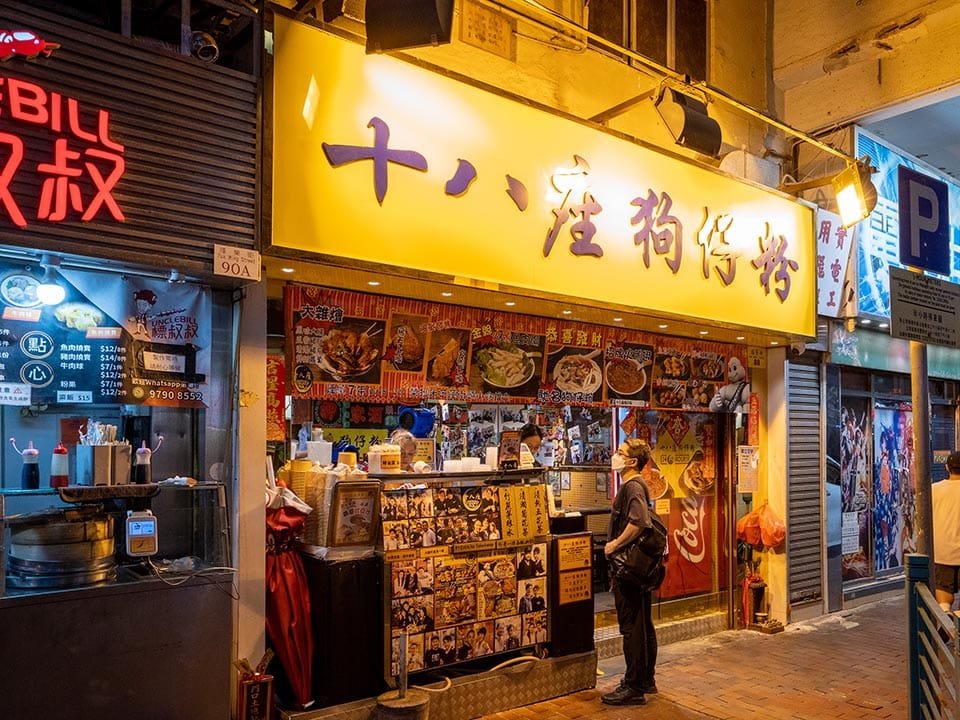
Ning Po Street and the Grammar of a Kowloon Noodle Shop
Approach Ning Po Street from the Jordan MTR end and the sensory register shifts almost immediately. The street runs through Yau Ma Tei with a density that is characteristic of older Kowloon: dried-seafood merchants, temple-adjacent market stalls, and a succession of low-margin food operations that have survived not on atmosphere but on consistency. Block 18 Doggie's Noodle sits at numbers 27 to 31, in a row of shopfronts that make no architectural argument for your attention. The signage is functional. The interior, glimpsed through open frontage, follows the format that has defined Hong Kong's dai pai dong-adjacent noodle counters for decades: communal seating, fluorescent overhead light, laminate surfaces, and a pace of service that reads as brusque until you understand it as efficient.
That format is not incidental. In a city where noodle shops have always competed on throughput as much as on flavour, the physical spareness of a place like this is itself a signal. Resources go into the bowl, not the room. That remains the operating principle at the cheaper, faster end of Hong Kong's noodle tradition, and Ning Po Street is one of the few corridors in Yau Ma Tei where that tradition is still largely intact at street level.
The shortlist, unlocked.
Hard-to-book tables, cellar releases, and concierge-planned trips.
Get Exclusive Access →What the Broth Represents: Ingredient Logic in a High-Pressure Food City
Hong Kong's noodle culture has always been ingredient-forward in a way that does not announce itself. The city's Cantonese cooking tradition places considerable emphasis on stock as the structural foundation of a dish, and the noodle shops that earn long-term neighbourhood loyalty tend to be those whose broths reflect genuine sourcing decisions rather than powder shortcuts. At the working-class end of the market, this means pork bones, dried flounder, and shrimp roe built into bases that take hours, sold at prices that leave almost no margin for error.
The name Doggie's Noodle gestures at a specific register within that tradition. In Cantonese food culture, informal nicknames attached to food operations often signal longevity and street-level credibility rather than formal branding. These are names that accumulate through use, the kind that appear on handwritten signs and in conversation rather than on corporate menus. Whether the name here carries that specific lineage is something the record does not confirm, but the address on Ning Po Street places it in a neighbourhood where that naming convention has real cultural weight.
The ingredient logic that underlies this category of Hong Kong noodle shop also reflects the city's relationship with its wet markets and specialist suppliers. Yau Ma Tei's market infrastructure, which runs from the wholesale fruit market on the waterfront through the temple market and into the residential streets behind, has historically supported a supplier ecosystem that small food operators depend on. A noodle shop at this address has access to that network in a way that a restaurant in a shopping mall does not. The sourcing advantage is geographic as much as it is intentional.
How Block 18 Sits Within Yau Ma Tei's Eating Scene
Yau Ma Tei and the broader Yau Tsim Mong district accommodate an unusually wide range of eating formats within a compressed geography. The district runs from the southern edge of Mong Kok down through Jordan and into Tsim Sha Tsui, and within that corridor you will find everything from hotel dining rooms to street-facing congee shops operating from six in the morning. Block 18 Doggie's Noodle occupies the neighbourhood-staple tier of that range, the kind of address that does not appear in hotel concierge lists but that locals in the surrounding blocks treat as a default rather than a destination.
That tier is represented across the district by a range of operators. Budaoweng Hotpot Cuisine works a different format in the same district, as does Coconut Soup, which brings Southeast Asian broth traditions into a neighbourhood already dense with Cantonese options. Carat Fine Indian and Mediterranean Cuisine and Ebeneezer's Kebabs and Pizzeria reflect the district's absorptive range, pulling in South Asian and Middle Eastern traditions alongside the dominant Cantonese thread. Cafe represents the cha chaan teng format that sits alongside noodle shops as one of Hong Kong's most durable eating institutions. The full picture of what Yau Ma Tei eats is in our full Yau Tsim Mong restaurants guide.
Set against the higher-register end of Hong Kong dining, which includes the tasting menus at Amber in Hong Kong and the patisserie format at Le Salon de Thé de Joël Robuchon Hong Kong (ifc mall) in Central, Block 18 operates in a register where the price of a bowl represents Hong Kong's most democratic food proposition. Across the harbour, AMMO in Central and Western occupies a sharply different bracket. The distance between these tiers is not just financial; it reflects two distinct relationships with ingredient sourcing, one that foregrounds technique and provenance through a premium lens, and one that compresses both into a bowl priced for the street.
Planning a Visit: What to Know Before You Go
Ning Po Street is a short walk from the Yau Ma Tei MTR station, making the address direct to reach from most parts of Kowloon or cross-harbour from Hong Kong Island. The surrounding blocks are active from early morning through late evening, with the market and temple complex drawing foot traffic throughout the day. For a noodle shop in this category, the practical advice that holds across the format applies here: midday and early evening tend to be peak periods, and the format does not typically accommodate advance booking. Arrival outside the lunch rush is generally the most comfortable approach for visitors unfamiliar with the pace of service.
Phone and website details are not publicly confirmed at time of writing. As with many operators in this category across Hong Kong, the relationship with digital infrastructure is minimal; the shop is found by walking the street rather than by searching a platform. That is not unusual for Ning Po Street, and it is part of what makes addresses in this part of Yau Ma Tei feel resistant to the homogenising pressure that has changed the character of more tourist-facing Hong Kong neighbourhoods.
Frequently Asked Questions
- What should I eat at Block 18 Doggie's Noodle?
- The address and format place Block 18 firmly within Hong Kong's wonton noodle and pork-based broth tradition, which means the bowl itself, in whichever form the kitchen runs it, is the object of the visit. Cantonese noodle shops at this tier typically offer a short, focused menu built around a small number of broth bases and protein variations. Ordering the house noodle in its simplest form is the clearest way to read what the kitchen prioritises. Specific menu items and current offerings are not confirmed at time of writing, so arriving with flexibility rather than a fixed order in mind is sensible. For a broader view of how Hong Kong's noodle tradition connects to formal fine dining, the gap is illustrated by kitchens like Amber at one end and street-level Yau Ma Tei addresses at the other.
- What is the leading way to book Block 18 Doggie's Noodle?
- Advance booking is not a feature of this category of Hong Kong noodle shop, and no booking platform or phone contact is confirmed at time of writing. The operating model, as is standard for this price tier in Yau Tsim Mong, is walk-in. Arriving before the midday peak or in the mid-afternoon between service rushes gives the most relaxed experience. Visitors used to the reservation systems required at higher-end Hong Kong addresses such as Le Salon de Thé de Joël Robuchon should adjust expectations accordingly: the queue, if any, moves fast.
- Is Block 18 Doggie's Noodle typical of the Yau Ma Tei neighbourhood eating style?
- Yes, in the sense that Yau Ma Tei has historically supported a dense cluster of no-frills Cantonese food operations where the local eating public, rather than tourist foot traffic, sets the standard. Ning Po Street sits within that tradition, in a district where proximity to wet markets and wholesale suppliers has long shaped what ends up in the bowl. For comparison with how Hong Kong's food culture operates at radically different price points and in different boroughs, the Chin Sik in Tsuen Wan and Lei Garden in Sha Tin offer useful reference points across the city.
Fast Comparison
A quick look at comparable venues, using the data we have on file.
| Venue | Cuisine | Price | Awards | Notes |
|---|---|---|---|---|
| Block 18 Doggie's Noodle | This venue | |||
| Budaoweng Hotpot Cuisine | ||||
| Cafe | ||||
| Carat Fine Indian and Mediterranean Cuisine | ||||
| Coconut Soup | ||||
| Ebeneezer's Kebabs & Pizzeria |
Need a table?
Our members enjoy priority alerts and concierge-led booking support for the world's most difficult tables.
Get Exclusive AccessThe shortlist, unlocked.
Hard-to-book tables, cellar releases, and concierge-planned trips.
Get Exclusive Access →