Our verdict
On Boulevard de l'Hôpital in the 5th arrondissement, Bibimbap sits at the intersection of Paris's expanding Korean dining scene and the Left Bank's long tradition of informal neighbourhood eating. The address places it within walking distance of the Jardin des Plantes and a short distance from the Sorbonne, in a quarter that has gradually absorbed several decades of Asian culinary influence.

Pearl is the En Primeur Club membership app — saves, bookings, and concierge access live there. Same editors, same standards.
- Address
- 32 Bd de l'Hôpital, 75005 Paris, France
- Phone
- +33143312742
- Hours
- Mon–Fri 11:45 AM–2:30 PM, 6:30–10:30 PMSat–Sun 12–2:30 PM, 6:30–10:30 PM
- Website
- bibimbap.fr
- Directions
- Get directions
- Booking
- Book on the venue's website
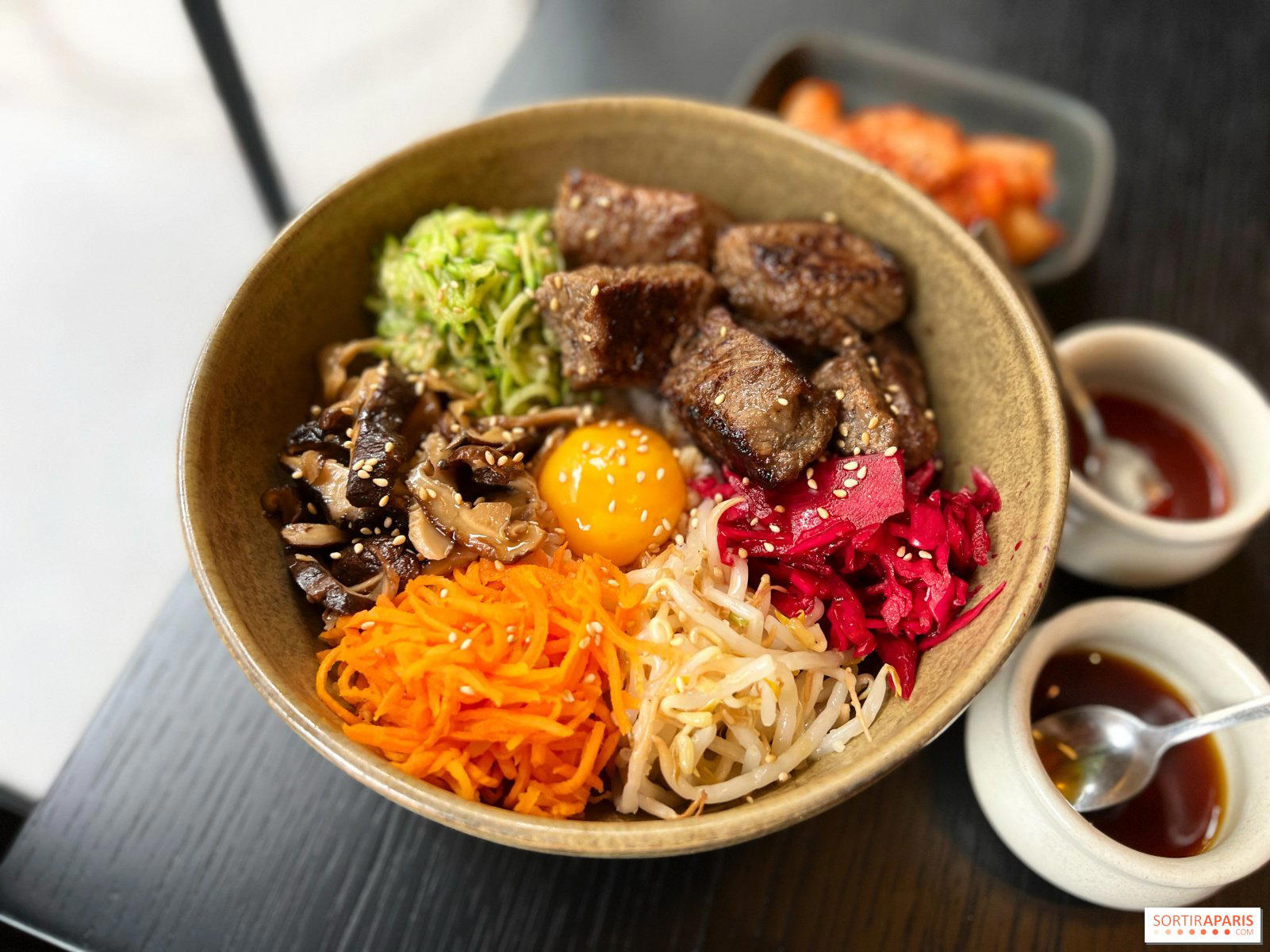
A Corner of Seoul on the Left Bank
Boulevard de l'Hôpital runs along the eastern edge of the 5th arrondissement, a stretch of Paris that rarely makes the glossy shortlists. The street connects the Gare d'Austerlitz rail terminus to the Jardin des Plantes, and its dining character has been shaped less by gastronomy guides than by the practical needs of hospital workers, university students, and the quietly international neighbourhood around it. It is into this context that Bibimbap — the restaurant named after Korea's most recognised rice dish — has settled at number 32.
That kind of address tells you something about where Korean dining in Paris has chosen to root itself. Unlike the high-profile fusion exercises near the Grands Boulevards or the tasting-menu formats at places like Kei, which translates Japanese-French cross-pollination into a formal €€€€ proposition, Korean restaurants in the capital have tended to cluster in less conspicuous postcodes, building their audiences through repetition and word of mouth rather than award cycles.
How Korean Dining in Paris Has Shifted
The evolution of Korean food in Paris follows a pattern visible across several European capitals. Through the 1990s and into the 2000s, the offer was almost exclusively domestic: bulgogi, bibimbap, doenjang jjigae, served in low-lit rooms to a largely Korean expatriate clientele. The food was correct and the prices were accessible, but the restaurants existed in a separate circuit from the city's critical conversation.
That began to change as Korean popular culture accelerated interest in the cuisine among younger French diners, and as a second generation of restaurateurs started to look at what Korean cooking could do in a more ambitious register. The shift did not produce a sudden crop of tasting menus, Paris's Korean scene has remained more democratic than that, but it did sharpen presentation, broaden the menu scope, and bring a more confident sense of identity to establishments that had previously kept a low profile.
Bibimbap, as a restaurant concept built around a single titular dish, sits at an interesting point in that arc. The bibimbap format, rice, seasoned vegetables, protein, gochujang, typically finished with a fried or raw egg, is deceptively complex in its balance. Getting the temperature gradient right between the scorched rice base in a dolsot (stone pot) version and the cool vegetables above it, and calibrating the heat of the paste against the richness of the egg, requires more precision than the dish's casual reputation suggests. A restaurant that chooses this as its signature and its name is either committing to do it properly or banking on familiarity. The distinction matters.
For comparison, consider how French haute cuisine has approached similar questions of identity and reinvention. At Arpège, the pivot toward a vegetable-forward kitchen represented a philosophical re-anchoring around a single idea, and it defined the restaurant's identity for a generation. At Alléno Paris au Pavillon Ledoyen, reinvention has taken a more technical, extractive direction. These are obviously different in scale and ambition from a neighbourhood Korean address, but the underlying question is the same: what does it mean to build a dining identity around a core commitment?
The 5th Arrondissement as Culinary Context
The quartier around Boulevard de l'Hôpital is not the Paris of L'Ambroisie on the Place des Vosges, nor the hotel-dining formality of Le Cinq in the 8th. It is a working arrondissement, and the restaurants here are answerable to a local clientele that prioritises consistency and value. That accountability shapes quality in a different but not lesser way than Michelin pressure does.
Korean cooking has found a natural home in this kind of neighbourhood across several French cities. The cuisine's emphasis on fermented bases, shared table condiments, and rice-centred meals maps well onto the informal eating culture of university districts. The 5th's density of students and researchers from the nearby institutions provides exactly the kind of regular, curious, price-sensitive audience that has historically incubated the most durable neighbourhood restaurants in Paris.
Elsewhere in France, the contrast is instructive. The institutional weight of places like Paul Bocuse - L'Auberge du Pont de Collonges or the refined regionalism of Auberge de l'Ill represent a very different relationship between a restaurant and its community, one built on decades of local identity. A Korean restaurant on Boulevard de l'Hôpital is constructing something smaller in scale but not dissimilar in function: a place that belongs to its street.
What the Name Signals
Naming a restaurant after its signature dish is a statement of confidence that cuts both ways. In the Korean dining world, it narrows expectations while raising them. A diner who walks through the door on the basis of the name carries a specific mental benchmark, almost certainly formed by some version of bibimbap eaten elsewhere. The restaurant's job is to recalibrate that benchmark upward.
The same logic applies at a different level to some of France's destination restaurants. Bras in Laguiole is, in a sense, named after a family whose identity became synonymous with a particular philosophy of cooking in Aubrac. Troisgros similarly carries its culinary lineage in its name. The scale is incomparable, but the naming logic is not: you are what you claim to be, and the claim creates the obligation.
For a broader picture of where Korean and other Asian-inflected formats sit within Paris's current dining conversation, our full Paris restaurants guide maps the city's key addresses across price tiers and neighbourhoods.
Planning Your Visit
Frequently asked questions
What's Bibimbap's location?
Bibimbap is located at 32 Bd de l'Hôpital, 75005 Paris, France, Paris.
Is Bibimbap in Paris a good restaurant for someone exploring Korean food beyond barbecue?
Yes, and specifically because it focuses on a dish that sits outside the galbi-and-samgyeopsal circuit that dominates Korean restaurants in many European cities. Bibimbap, the bowl of seasoned rice, vegetables, protein, and gochujang, is one of Korean cooking's most internationally recognised formats, and the 5th arrondissement address at Boulevard de l'Hôpital places it in a neighbourhood with an established Korean dining presence rather than a tourist-facing one.
What's the best thing to order at Bibimbap?
The name makes the answer clear: bibimbap is the dish to order. Where the dolsot version is available, the stone bowl arrives still crackling at the table, forming the scorched rice crust — nurungji — that is the dish's structural payoff. It is a more rewarding order than the standard bowl for anyone eating here for the first time.
How hard is it to get a table at Bibimbap?
Restaurants at this level in the 5th arrondissement's Korean dining tier, including the address at 32 Boulevard de l'Hôpital, generally do not operate on the advance reservation windows associated with Michelin-tracked rooms across Paris. Walk-ins are typically feasible, though lunch service on weekdays and early weekend evenings tend to fill faster. Arriving outside peak hours is the practical approach.
What's the defining dish or idea at Bibimbap?
The restaurant is built around a single culinary argument: that bibimbap, one of Korean cooking's most structurally complete preparations, is sufficient to anchor an entire menu. Naming the venue after the dish signals consolidation rather than breadth. In a Paris Korean dining scene that has historically defaulted to all-purpose menus, that narrowing of focus is itself a positioning statement.
A Pricing-First Comparison
Comparable venues nearby, for context on price, style, and recognition.
| Venue | Cuisine | Price | Notes |
|---|---|---|---|
| BibimbapThis venue — the venue you are viewing | Korean Bibimbap | $20–30 | Not listed |
| Go Oun | Korean Fusion | $20–30 | Louvre / Palais-Royal, Korean Fusion |
| JJIN | Korean Barbecue | $20–30 | Montparnasse, Korean Barbecue |
| JOAYO Montparnasse | Authentic Korean BBQ & Karaoke | $20–30 | Montparnasse, Authentic Korean BBQ & Karaoke |
| Kokodak | Korean-Italian Fusion | $20–30 | Montparnasse, Korean-Italian Fusion |
| Odori Restaurant | Authentic Korean Barbecue | $20–30 | Motte-Picquet, 15th Arrondissement, Authentic Korean Barbecue |
Continue exploring
More in Paris
Restaurants in Paris
Browse all →
Bars in Paris
Browse all →
Hotels in Paris
Browse all →



Details
- Cozy
- Modern
- Casual Hangout
- A La Carte
- Vegetarian Friendly
- Vegan Options
Current opening hours
- Monday
- 11:45 AM–2:30 PM, 6:30–10:30 PM
- Tuesday
- 11:45 AM–2:30 PM, 6:30–10:30 PM
- Wednesday
- 11:45 AM–2:30 PM, 6:30–10:30 PM
- Thursday
- 11:45 AM–2:30 PM, 6:30–10:30 PM
- Friday
- 11:45 AM–2:30 PM, 6:30–10:30 PM
- Saturday
- 12–2:30 PM, 6:30–10:30 PM
- Sunday
- 12–2:30 PM, 6:30–10:30 PM
Hours can change for holidays and private events. Last verified .
Uncluttered French setting with rough stonework and glass, providing conviviality.