Berenjak



Michelin Bib Gourmand · The Good Food Guide GFG Good
Our verdict
Berenjak channels the atmosphere of Tehran's hole-in-the-wall kabab houses from a compact Soho address on Romilly Street, earning consecutive Michelin Bib Gourmand recognition in 2024 and 2025. The menu moves through charcoal-cooked mezze, mangal-grilled kebabs, and saffron-scented khoresht stews at prices that keep the room reliably full. It is among the few London restaurants making a serious case for Persian cooking as an everyday dining tradition rather than an occasional curiosity.

Pearl is the En Primeur Club membership app, where members save venues, book tables and use the concierge.
Where Tehran's Street Food Tradition Lands in Soho
Step onto Romilly Street on any given evening and the queue outside number 27 tells you something useful about how London's mid-range dining market has shifted. A decade ago, the affordable end of Soho belonged almost entirely to Italian trattorias and pan-Asian canteens. Persian cooking, with its deep tradition of slow-charred meats, herb-forward stews, and fermented dairy, rarely appeared at this price point with any seriousness.
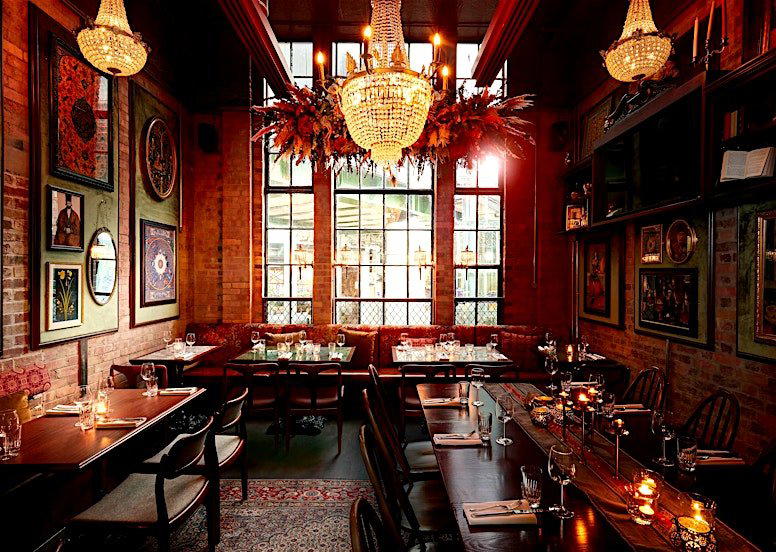
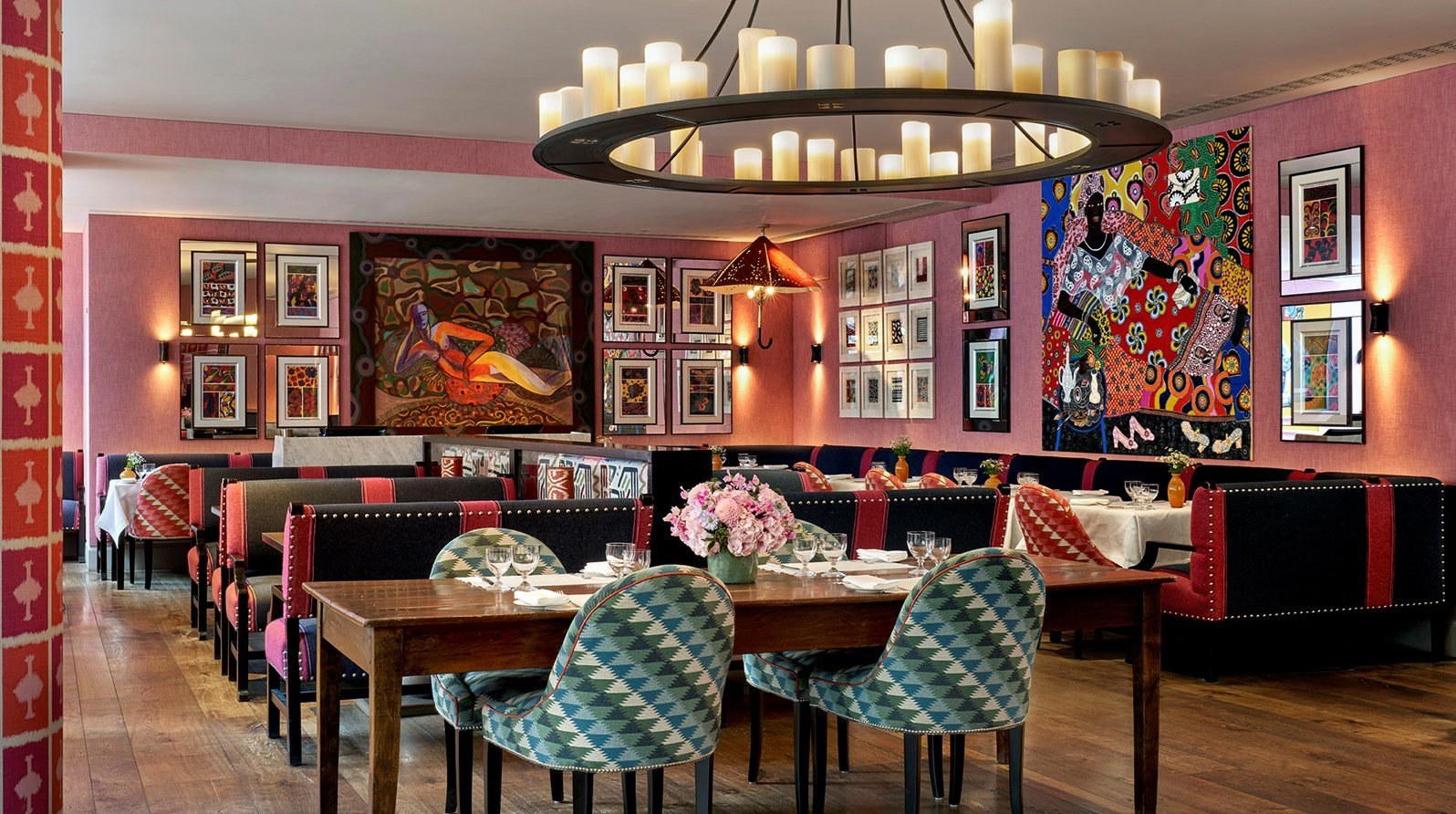
Inside, the room reads immediately as a deliberate translation rather than a romanticised recreation. Exposed brick, painted plasterwork worn to a deliberate patina, mosaic floors, and stained-glass windows borrow the visual grammar of Tehran's small kabab houses, the kind built around a single mangal grill and a handful of stools, and compress them into a compact Soho space with brown leather booths and a counter overlooking the open kitchen. The open flame is not decorative. A mangal barbecue and a tandoor oven dominate the kitchen sightline, and watching the two work in tandem gives a useful primer on the sourcing logic behind the menu.
The Sourcing Logic Behind the Menu
Persian cooking at its most direct is an argument for ingredient integrity over technique complexity. The mangal grill exists because high-quality meat and vegetables need relatively little intervention when the heat source is live charcoal. Berenjak applies that logic consistently. Coal-cooked aubergine, one of the most discussed dishes on the menu, depends almost entirely on the quality of the vegetable and the duration of its contact with the coal. The addition of tomato and Cacklebean eggs, a British free-range egg producer with a visible yolk distinction, shows how the kitchen maps Iranian technique onto locally sourced produce without creating a fusion hybrid. The dish reads as Persian; the provenance is English.
The sangak, the rectangular wholewheat flatbread baked directly on pebbles inside the tandoor, follows the same principle. Sangak in Iran is bakery bread, sold by the sheet and priced by weight, with a texture shaped entirely by the pebble-baking method that gives its underside an uneven, cratered surface. Replicating that at a Soho restaurant requires commitment to a method that prioritises authenticity of result over kitchen efficiency. The flatbread arrives warm and slightly charred in the right places, functioning as the primary vehicle for the mezze section of the menu rather than an afterthought.
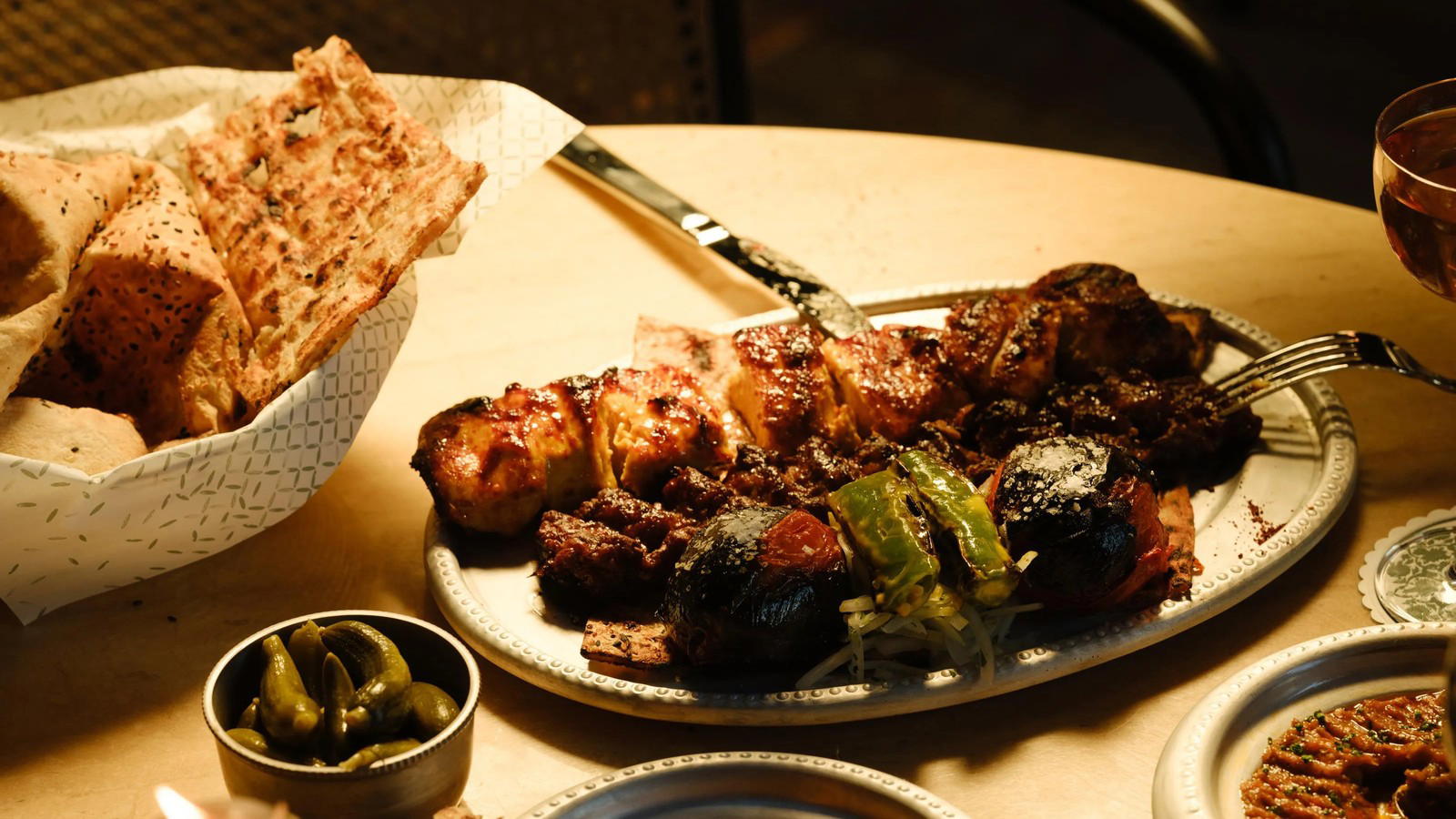
The lamb shoulder kebab, minced and grilled on the mangal, has drawn consistent attention from Michelin inspectors, who noted it as ‘wonderfully tender’. Minced kebab of this kind, known in Iran as koobideh, requires a specific fat ratio in the mince and a level of skill in the pressing and turning to hold its shape on the skewer without drying. Served with saffron rice described as fluffy and buttery, it illustrates why the Bib Gourmand recognition fits: serious technique at a price point (££) that sits well below London’s tasting-menu tier occupied by venues like CORE by Clare Smyth, Sketch, The Lecture Room and Library, or Dinner by Heston Blumenthal.
Berenjak in the Context of London's Persian Dining Scene
London has always had Persian restaurants, concentrated historically in Kensington and Olympia, where a large Iranian diaspora community settled from the 1970s onward. Those restaurants serve a different function: comfort food for people who grew up eating it, with portion sizes and pricing calibrated to regular neighbourhood use. Berenjak operates in a different register. It is backed by JKS Restaurants, the group responsible for Gymkhana, Hoppers, Sabor, Bao, and Kitchen Table, a portfolio that has done more than any single operator in London to argue that non-European cuisines deserve serious restaurant infrastructure rather than casual treatment. The group's model is consistent: find a cuisine underrepresented at the mid-to-upper-casual tier, apply rigorous sourcing and kitchen discipline, and price it accessibly enough to build a regular audience.
The result at Berenjak is a room that draws both Iranian Londoners recognising the references and Soho regulars encountering the cuisine for the first time. That dual audience is harder to sustain than it sounds. The risk with any restaurant translating a street food tradition is that it satisfies neither group: too polished for those who grew up with the original, too unfamiliar for those approaching it fresh. Michelin's consecutive Bib Gourmand awards in 2024 and 2025 suggest the kitchen has found a workable position.
For comparison within London's broader award-recognised dining scene, the Bib Gourmand tier specifically rewards value alongside quality, a different signal than the star categories occupied by The Ledbury or Restaurant Gordon Ramsay. Berenjak belongs to a cohort of London restaurants making the case that the most interesting cooking in the city is not concentrated at the ££££ level. That case is worth making, and Berenjak makes it with specificity rather than generality.
Chef Kian Samyani leads the kitchen, and the menu under his direction reflects a clear editorial position: the mezze, kebabs, and khoresht stews section structure maps directly to how Iranians actually eat rather than how Western restaurants tend to simplify Middle Eastern menus into a single undifferentiated mezze spread.
The Sharbat Question and the Drinks List
Iranian drinking culture, shaped by centuries of non-alcoholic tradition, produced sharbat, fruit cordials swirled with herbs, sometimes spiked with spirits in the Berenjak version. They are worth ordering as an orientation to the flavour register of the meal before it arrives. The combination of fruity acidity, green herb freshness, and mild spirit warmth runs parallel to the food's logic: sour, herbed, and direct. For those exploring the full scope of London’s dining options beyond Berenjak, the EP Club guides to London restaurants, London bars, London hotels, London wineries, and London experiences cover the wider picture.
A second Berenjak location in Borough Market extends the reach of the format to a neighbourhood already dense with food-focused operators, though the Soho original on Romilly Street retains the more atmospheric setting for a first visit.
For those building a broader UK itinerary around serious cooking, the comparison set extends well beyond London: The Fat Duck in Bray, L’Enclume in Cartmel, Moor Hall in Aughton, Gidleigh Park in Chagford, Hand and Flowers in Marlow, and Le Manoir aux Quat’ Saisons in Great Milton represent the country-house and destination-restaurant tier. Internationally, Le Bernardin in New York City and Atomix in New York City show how other cuisines with deep cultural roots operate at the top of their respective markets.
Know Before You Go
- Address: 27 Romilly St, London W1D 5AL
- Price range: ££
- Hours: Monday 5:30–11 pm; Tuesday to Friday 12–3 pm and 5:30–11 pm; Saturday 12–11 pm; Sunday closed
- Awards: Michelin Bib Gourmand 2024 and 2025
- Second location: Borough Market
- Booking: High demand; advance reservation recommended, particularly for counter seats overlooking the kitchen
Frequently asked questions
What should I expect atmosphere-wise at Berenjak?
Berenjak is compact, dimly lit, and deliberately informal, exposed brick, mosaic floors, stained-glass windows, and scuffed plasterwork all reference the visual register of Tehran's hole-in-the-wall kabab houses. Counter seats facing the mangal barbecue and tandoor oven give the clearest view of the kitchen. The Michelin inspector's note on 'full houses' is accurate: the room fills fast, and the noise level follows.
Is Berenjak open every day?
Hours at Berenjak: Hours: Monday 5:30–11 pm Tuesday 12–3 pm, 5:30–11 pm Wednesday 12–3 pm, 5:30–11 pm Thursday 12–3 pm, 5:30–11 pm Friday 12–3 pm, 5:30–11 pm Saturday 12–11 pm Sunday Closed.
What's Berenjak known for in terms of accolades?
Berenjak has received recognition including: Based on the hole-in-the-wall 'kabab' houses of Tehran, this is a terrifically fun little spot in the heart of Soho. Exposed brick and painted plasterwork suit the buzzy atmosphere, with the best place to sit being at the kitchen counter so….
What do regulars order at Berenjak?
The coal-cooked aubergine with tomato and Cacklebean eggs, eaten with sangak (wholewheat flatbread baked on pebbles), is the most cited entry point to the menu. The minced lamb shoulder kebab with saffron rice drew a 'wonderfully tender' note from the Michelin inspector. To drink, the sharbats, fruity herb cordials, some spiked with spirits, are worth ordering alongside the food rather than as an afterthought.
What's the price range at Berenjak?
Pricing at Berenjak is listed as ££.
A small set of peers for context, based on recorded venue fields.
| Venue | Cuisine | Price | Awards | Notes |
|---|---|---|---|---|
| BerenjakThis venue (the venue you are viewing) | Persian Kebabs & Mazeh | $30–50 | Michelin Bib Gourmand · The Good Food Guide GFG Good | Not listed |
| The Ledbury | Modern British Fine Dining | $300–500 | 3 Michelin Stars · World's 50 Best #42 | Modern European, Modern Cuisine |
| Sketch, The Lecture Room and Library | Modern French Fine Dining | $200–300 | 3 Michelin Stars · World's 50 Best #18 | Modern French |
| CORE by Clare Smyth | Modern British Fine Dining | $150–200 | 3 Michelin Stars · World's 50 Best #97 | Modern British |
| Restaurant Gordon Ramsay | French Fine Dining | $200–300 | 3 Michelin Stars · World's 50 Best #13 | Contemporary European, French |
| Dinner by Heston Blumenthal | Historic British Fine Dining | $200–300 | 2 Michelin Stars · World's 50 Best #45 | Modern British, Traditional British |
Recognition history
Dated appearances from independent guides and award organizations, with the underlying list record or original source where available.
Michelin Bib Gourmand
Michelin
Opinionated About Dining Casual in Europe Recommended
Opinionated About Dining
The Good Food Guide GFG Good
The Good Food Guide
Full recognition history (5 entries)
Michelin Bib Gourmand
Michelin
Michelin Bib Gourmand
Michelin
Berenjak
Featured Guides
Continue exploring
More in London
Restaurants in London
All restaurants in London →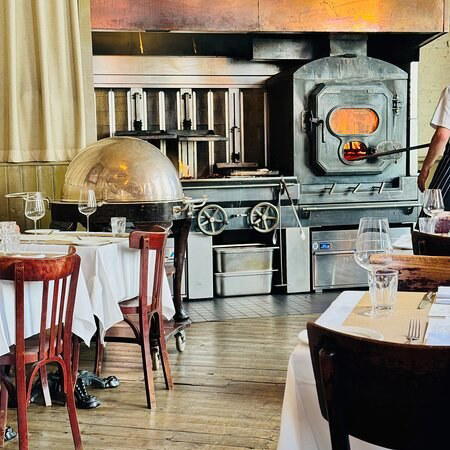
Bars in London
All bars in London →
Hotels in London
All hotels in London →


Details
- Lively
- Trendy
- Cozy
- Energetic
- Group Dining
- Casual Hangout
- Open Kitchen
- Small Plates
- A La Carte
- Vegetarian Friendly
- Halal
Current opening hours
- Monday
- 5:30–11 PM
- Tuesday
- 12–3 PM, 5:30–11 PM
- Wednesday
- 12–3 PM, 5:30–11 PM
- Thursday
- 12–3 PM, 5:30–11 PM
- Friday
- 12–3 PM, 5:30–11 PM
- Saturday
- 12–11 PM
- Sunday
- Closed
Hours can change for holidays and private events. Hours as of .
Buzzy and atmospheric with exposed brick, distressed plaster, open kitchen views of flaming tandoor and mangal barbecue, and snug leatherette booths.