Bayley & Sage
Bayley & Sage on Wimbledon High Street occupies a distinct position in London's food retail scene: a grocer built around ethical sourcing and seasonal British produce at a time when most high-street alternatives defaulted to global supply chains. The shop draws a neighbourhood clientele serious about provenance, and its prepared food counter reflects the same sourcing discipline as its raw ingredients.
Pearl is the En Primeur Club membership app — saves, bookings, and concierge access live there. Same editors, same standards.
- Address
- 60 High Street Wimbledon, London SW19 5EE, United Kingdom
- Phone
- +44 20 8946 9904
- Website
- bayley-sage.co.uk
- Directions
- Get directions
 Saves & bookings on Pearl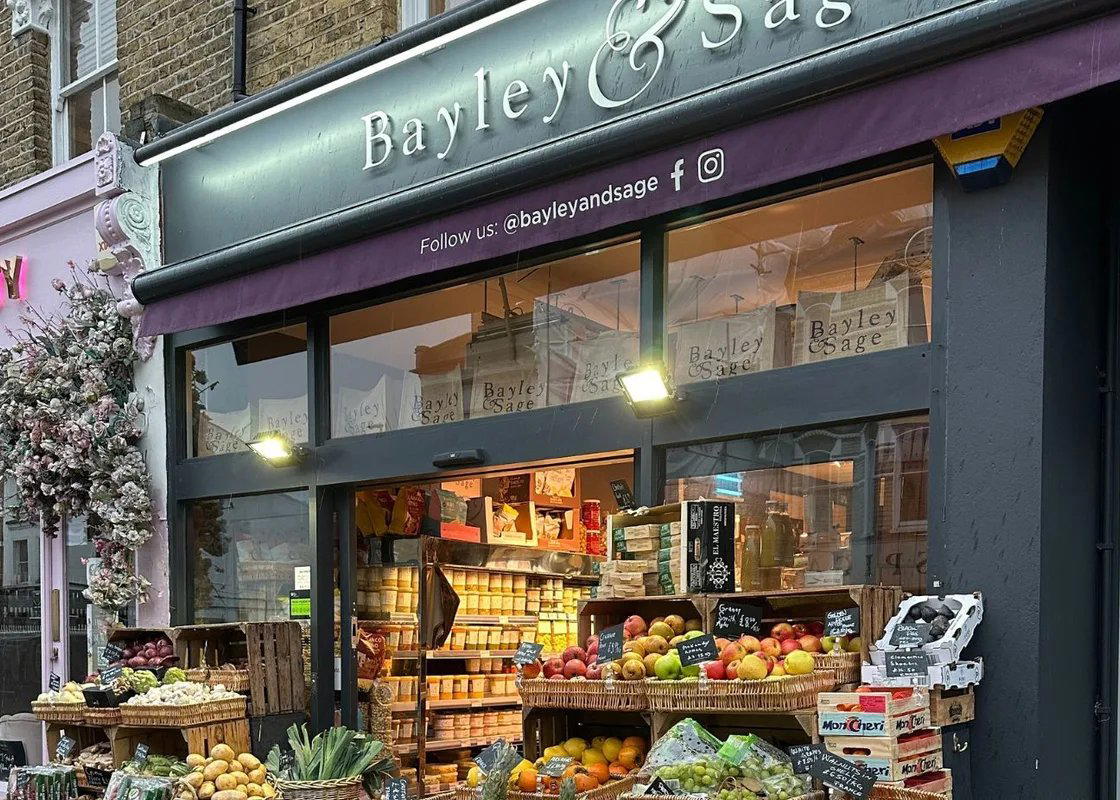
What a London Grocer Can Tell You About Where Fine Food Is Heading
Walk along Wimbledon High Street on a Saturday morning and you pass the familiar sequence of coffee chains and fashion retailers before arriving at something that operates on a different logic entirely. Bayley & Sage is a British deli at 60 High Street Wimbledon, London SW19 5EE, United Kingdom. Bayley & Sage at 60 High Street Wimbledon occupies physical space in the way that serious food shops do: the layout directs attention toward the produce rather than toward promotional signage, and the stock rotates with seasonal availability rather than year-round uniformity. In a city where premium grocery has increasingly split between large organic multiples and independent specialists, this is firmly a specialist operation.
That distinction matters because London's food retail tier has been quietly reorganising itself around provenance transparency. Consumers who once measured quality by country-of-origin labels now ask about farm relationships, harvest windows, and supply chain length. Bayley & Sage sits inside that shift, sourcing from British producers and presenting ingredients in ways that reflect their actual seasonality rather than supermarket-engineered continuity.
The Sustainability Framework Behind the Shelves
Ethical sourcing in food retail is a claim that ranges from credible to decorative depending on the operation making it. At the more credible end, sourcing discipline shows up in specific, verifiable ways: the range narrows in winter because genuine seasonal sourcing means fewer lines, not a warehouse workaround. Prepared foods use the same ingredients as the raw produce section, which closes the loop between what is sold as whole ingredients and what ends up in the kitchen. Waste reduction follows naturally from this structure because buying to a seasonal brief rather than a fixed catalogue means less unsellable surplus at the end of the week.
This model contrasts with what happens at the ££££ restaurant tier. Consider that CORE by Clare Smyth has built its Modern British menu around similar provenance principles, working with named British farms and centering the menu on ingredients at their seasonal peak. The Ledbury applies comparable sourcing rigour to its Modern European framework. The difference is that these restaurants translate ethical sourcing into a fixed tasting menu format at significant price points. Bayley & Sage translates the same ethos into retail, making the underlying ingredient philosophy accessible without a reservation and without a four-figure bill.
That accessibility is itself an editorial point. Discussions of sustainable food in London tend to concentrate on fine dining, where provenance is folded into a premium experience and priced accordingly. Retail operations that operate with similar sourcing depth but at everyday transaction volumes are doing different and harder work: they have to make ethical sourcing commercially viable at a per-unit margin rather than a per-head dining margin.
Where Wimbledon Fits in London's Food Geography
London's food geography is not uniform. The central tasting-menu circuit, represented by addresses like Sketch, The Lecture Room and Library, Restaurant Gordon Ramsay, and Dinner by Heston Blumenthal, operates in a different register from the neighbourhood food culture of SW19. Wimbledon has the residential density and income profile to support serious independent food retail, and Bayley & Sage has operated there long enough to have shaped local expectations rather than simply responding to them.
The broader context for this kind of neighbourhood specialist is worth noting across the UK. Outside London, operations like L'Enclume in Cartmel and Moor Hall in Aughton have built entire hospitality ecosystems around ethical sourcing, extending from their restaurant kitchens to on-site growing and local supply networks. Gidleigh Park in Chagford and Ynyshir Hall in Machynlleth pursue similar sourcing depth in rural settings where the supply chain is literally visible from the dining room window. What Bayley & Sage does is transpose comparable values into an urban retail format, which carries its own operational complexity.
The model also has international comparators. Le Bernardin in New York City has long treated ingredient sourcing as a culinary argument rather than a marketing position. Lazy Bear in San Francisco has built seasonal procurement into its booking and format design. The difference is that both of those operate in the restaurant format. Retail operations that carry the same sourcing conviction are less common and, when they exist, tend to occupy a community function that restaurants cannot replicate.
Bayley & Sage is located at 60 High Street Wimbledon, London SW19 5EE. As a walk-in-friendly retail operation, it is easy to work into a day.
For visitors to London who want to understand the city's food culture across multiple formats rather than just its headline dining, a visit to a serious neighbourhood food retailer like Bayley & Sage offers a different kind of information: what the local population actually buys, what seasonal British produce looks like at retail rather than plated in a kitchen, and how ethical sourcing translates into a commercial format built for daily use rather than special occasions.
Comparable independent specialists worth cross-referencing in a wider UK food itinerary include Hand and Flowers in Marlow, hide and fox in Saltwood, and Opheem in Birmingham, each of which represents a different regional interpretation of what sourcing-led food culture looks like outside the London centre.
A Minimal comparable set
Comparable venues nearby, for context on price, style, and recognition.
| Venue | Cuisine | Price | Notes |
|---|---|---|---|
| Bayley & SageThis venue — the venue you are viewing | Wimbledon, British Deli | $$ | Not listed |
| The Cross Keys | Chelsea, British Gastropub | $$ | Not listed |
| Mall Tavern | Not listed | $$ | Kensington Palace Gardens, British Gastropub |
| Holloway Model Bakery | Lower Holloway, Sourdough Bakery | $$ | Not listed |
| Good as Gold | Not listed | $$ | Brockley, Seasonal British with European Influences |
| The Pear Tree | Not listed | $$ | Deptford, Australian-Inspired Brunch & Dinner |
Continue exploring
More in London
Restaurants in London
Browse all →
Bars in London
Browse all →
Hotels in London
Browse all →




At a Glance
- Cozy
- Modern
- Rustic
- Casual Hangout
- Brunch
- Standalone
- Local Sourcing
Current opening hours
- Monday
- 8 AM–9:30 PM
- Tuesday
- 8 AM–9:30 PM
- Wednesday
- 8 AM–9:30 PM
- Thursday
- 8 AM–9:30 PM
- Friday
- 8 AM–9:30 PM
- Saturday
- 8 AM–9:30 PM
- Sunday
- 8 AM–9:30 PM
Hours can change for holidays and private events. Last verified .
Bright and welcoming village-like atmosphere focused on fresh, seasonal deli displays and quality produce.