
A'sur on Volkstraat brings a South American and French framework to Antwerp's restaurant scene, with Venezuelan chef Moisés Diaz positioning vegetables as central rather than supplementary. Expect ceviche with Leche de Tigre and tamarind, sea urchin with cauliflower and Salicornia, and a kitchen that treats produce combinations as the main event. The address sits in one of Antwerp's more locally frequented dining corridors, away from the tourist circuit.
 Discover on Pearl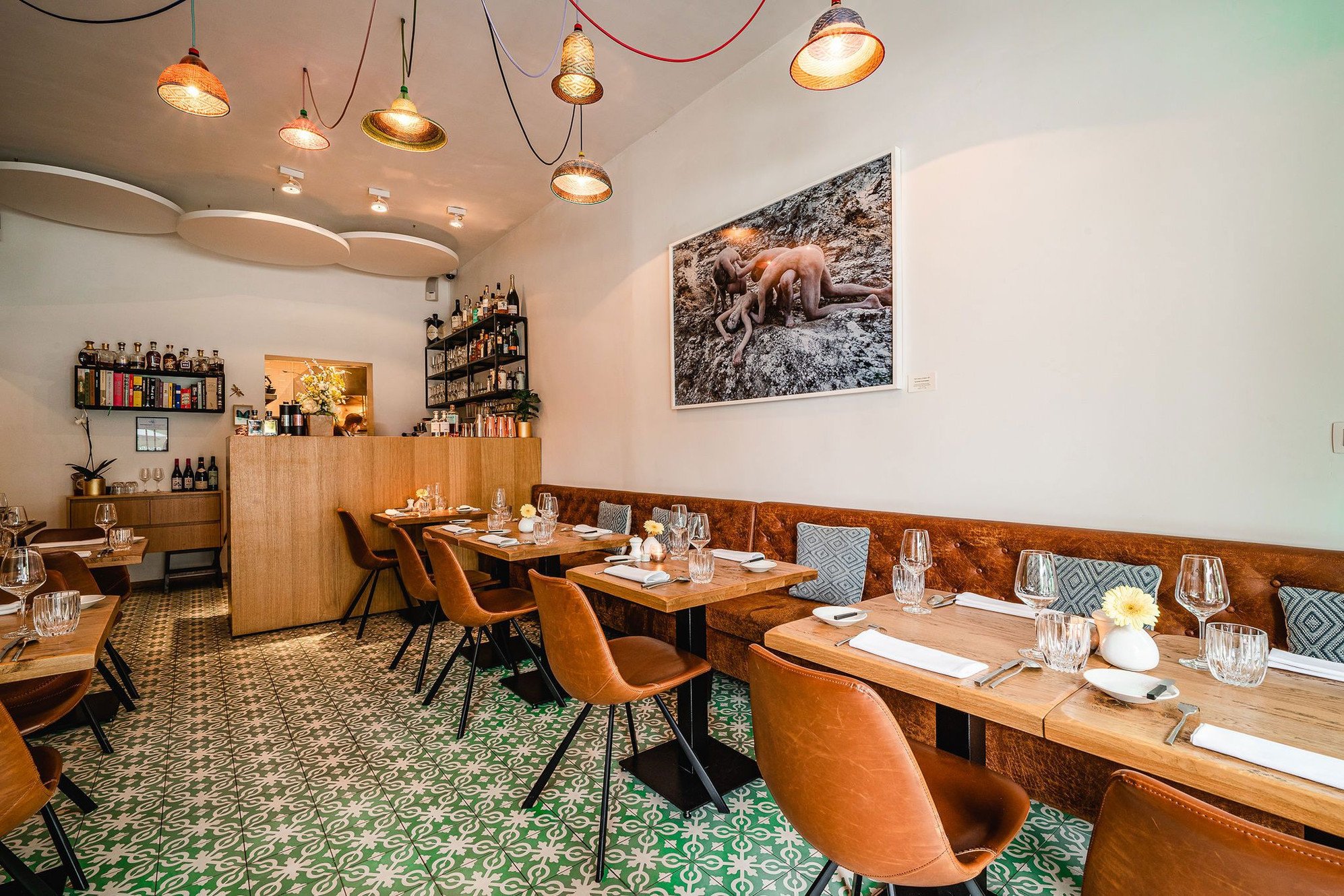
Where South American Acidity Meets the Flemish Table
Volkstraat runs through one of Antwerp's more quietly confident neighbourhoods, a street where independent restaurants have held ground against the city's expanding hospitality footprint. The area draws a local crowd rather than a hotel-concierge circuit, which shapes what kitchens here feel licensed to do. A'sur, at number 32, operates inside that context: a restaurant where South American acidity and French structural discipline share the same plate, and where the kitchen's relationship to vegetables is one of genuine primacy rather than garnish logic.
Belgium's restaurant culture has long favoured French classical training as a baseline, with creative departures filtered through Flemish ingredient networks. What makes A'sur worth attention in that context is the introduction of a Venezuelan perspective, a culinary tradition not widely represented in Belgian fine dining. Venezuelan cooking draws on Indigenous, African, and Spanish influences, producing a palate oriented around tropical acidity, brightness, and contrast rather than reduction and richness. When that sensibility is applied to a Franco-Belgian framework, the results are compositionally unusual in ways that the Antwerp dining scene, for all its sophistication, doesn't often produce.
The shortlist, unlocked.
Hard-to-book tables, cellar releases, and concierge-planned trips.
Get Exclusive Access →The Kitchen's Actual Argument
Chef Moisés Diaz's menu makes a specific case: that vegetables are not supporting material. This is a position taken by a number of European kitchens in the past decade, from Nordic tasting menus to the produce-led programs now appearing across the Low Countries. The distinction at A'sur is that the argument is made through South American flavour logic rather than European minimalism.
The salmon ceviche arrives with Leche de Tigre, the citrus and chilli-based marinade that is foundational to Peruvian and Venezuelan ceviche tradition, alongside beet and tamarind. Tamarind introduces a deeper, more complex sourness than citrus alone, and beet adds earthiness and colour saturation that repositions the dish from bright and clean to layered and textural. This is not ceviche simplified for European palates; it is ceviche extended.
The sea urchin composition pushes further. Cauliflower, Salicornia, and arugula are brought together with the urchin, a combination that places a delicate, iodine-forward shellfish product against a cruciferous vegetable, a salt marsh succulent, and a bitter green. Salicornia, common in Belgian coastal cooking, does real work here: its salinity bridges the marine quality of the sea urchin without the need for additional seasoning, and its crunch introduces a textural counterpoint. The pairing of sea urchin with a cauliflower-heavy composition reflects an understanding of how fat and bitterness interact, a technique with clear French roots, deployed in a framework that is anything but classical.
A third dish pairs avocado with chickpeas, fennel, arugula, and salmon eggs. Avocado in European fine dining tends to appear as a background element, a fat carrier for brighter flavours. Here it functions as a textural anchor in a composition that includes the anise softness of fennel, the slight bitterness of arugula, and the salted-ocean burst of salmon roe. Chickpeas provide density and protein. The dish is complete without meat or fish as a primary component, which reinforces the broader editorial point of the menu: vegetables and legumes carry the argument.
A'sur in Antwerp's Restaurant Field
Antwerp's higher-end restaurant field is well documented. Zilte in Antwerp holds Michelin recognition and operates at the leading of the city's fine dining tier. Elsewhere in Belgium, Hof van Cleve - Floris Van Der Veken in Kruishoutem and Boury in Roeselare represent the modern Flemish creative tradition at its most technically ambitious. Bozar Restaurant in Brussels and Willem Hiele in Oudenburg each occupy distinct positions in the Belgian scene through strong culinary identity.
A'sur is not competing in the Michelin-star tier or the grand-format tasting menu category. Its competitive peer set is better described as Antwerp's mid-to-upper creative independents: restaurants where a defined point of view, sourced produce, and kitchen originality matter more than ceremony or seat count. Locally, ALBUM and Bardin both represent the kind of independently minded cooking that Antwerp produces with consistency. Castor in Beveren and Cuchara in Lommel suggest the broader Flemish appetite for creative cooking that doesn't default to French classical form.
The South American angle specifically is rare in this field. Internationally, the integration of Peruvian and Venezuelan culinary techniques into fine dining frameworks has been most visible in London, New York, and Lima itself. In New York, Le Bernardin has long shown how French precision and marine-forward flavour can coexist at the highest level; in New Orleans, Emeril's in New Orleans demonstrated the durability of regionally rooted cooking in a fine dining context. A'sur's proposition is narrower and more specific, but it belongs in that broader conversation about how national culinary traditions are redeployed in European restaurant settings.
Within Belgium's creative restaurant field, the comparison that arguably sits closest is Bartholomeus in Heist for its willingness to let a singular coastal and geographic identity drive the menu, and d'Eugénie à Emilie in Baudour for its quieter, less publicised approach to original cooking. A'sur operates with a similar lack of fanfare relative to its culinary specificity.
Planning a Visit
A'sur is located at Volkstraat 32 in Antwerp's 2000 postal district, a walkable part of the city from the main retail and museum quarters. Phone and online booking details are not confirmed in current records; approaching the restaurant directly or through a concierge familiar with Antwerp's independent scene is the practical route. Given the kitchen's specificity and the neighbourhood's local rather than tourist composition, advance contact is advisable rather than assuming walk-in availability. Dress code and formal pricing are not publicly documented at this time.
For broader orientation to what Antwerp's hospitality scene offers across categories, our full Antwerpen restaurants guide covers the range from fine dining to neighbourhood cooking. Complementary reading includes our full Antwerpen hotels guide, our full Antwerpen bars guide, our full Antwerpen wineries guide, and our full Antwerpen experiences guide.
The shortlist, unlocked.
Hard-to-book tables, cellar releases, and concierge-planned trips.
Get Exclusive Access →Frequently Asked Questions
Cost and Credentials
These are the closest comparables we have in our database for quick context.
| Venue | Price | Awards | Notes |
|---|---|---|---|
| A’sur | Venezuelan chef Moisés Diaz brings a creative twist to South American and French… | This venue | |
| Boury | €€€€ | Michelin 3 Star | Modern Frlemish, Creative French, €€€€ |
| Comme chez Soi | €€€€ | Michelin 1 Star | French - Belgian, Classic Cuisine, €€€€ |
| Castor | €€€€ | Michelin 2 Star | Modern European, Modern French, €€€€ |
| Cuchara | €€€€ | Michelin 2 Star | Modern European, Creative, €€€€ |
| De Jonkman | €€€€ | Michelin 2 Star | Modern Flemish, Creative, €€€€ |
Need a table?
Our members enjoy priority alerts and concierge-led booking support for the world's most difficult tables.
Get Exclusive AccessThe shortlist, unlocked.
Hard-to-book tables, cellar releases, and concierge-planned trips.
Get Exclusive Access →