Google: 3.8 · 329 reviews
Omo Tuo: (pounded rice balls served with palm or groundnut soup.)
 Discover on Pearl
Pearl is the En Primeur Club membership app — saves, bookings, and concierge access live there. Same editors, same standards.
Where Accra Eats Its Own Way
There is a version of Accra dining that gets written about internationally: the hotel restaurants, the rooftop bars with Atlantic views, the new-wave spots putting Ghanaian ingredients through a fine-dining lens. Asanka Local Restaurant occupies a different register entirely. The name signals the premise. An asanka is the traditional Ghanaian clay grinding bowl, used for blending peppers, spices, and palm ingredients into the pastes that anchor the country's cooking. Choosing it as a namesake is a declaration about sourcing priority, about the kind of kitchen that works backward from the ingredient rather than forward from a plating concept.
In a city where restaurants like Midunu (Ghanaian Cuisine) are building international attention around refined local produce, Asanka sits in a parallel tier: places where the food is Ghanaian not as a creative proposition but as a daily operating reality. That distinction matters when thinking about what Accra's food scene actually consists of, beyond the venues that attract foreign press. See our full Accra restaurants guide for the broader picture.
The Sourcing Logic Behind Local Ghanaian Cooking
Ghanaian cuisine is built on a short, specific supply chain. Palm oil comes from local mills; kontomire (cocoyam leaves), garden eggs, and fresh fish travel from nearby markets into the pot the same day. The dishes that define the tradition, from light soup with fufu to red-red with fried plantain to groundnut soup, are not dishes that survive ingredient substitution well. Their character depends on produce that is geographically specific and seasonally immediate.
This is the sourcing logic that makes restaurants operating in the local Ghanaian register function differently from their counterparts in other culinary traditions. There is no global supply chain to fall back on, no imported workaround for a missing ingredient. When a kitchen calls itself local, that claim is either demonstrated in what arrives at the table or it is not. This is a different kind of accountability than the farm-to-table framing seen at venues like Atelier Moessmer Norbert Niederkofler in Brunico or Reale in Castel di Sangro, where the sourcing story is foregrounded as part of a premium narrative. At Asanka, local sourcing is operational fact rather than marketing angle.
The broader trajectory of ingredient-led cooking internationally confirms that this approach produces depth over time. Piazza Duomo in Alba and Uliassi in Senigallia both demonstrate what happens when a kitchen spends decades working within a specific regional ingredient vocabulary rather than across a global one. The Ghanaian local restaurant tradition operates on the same principle, without the Michelin scaffolding around it.
The Neighbourhood Context
Accra's restaurant geography has shifted considerably in recent years. Areas like Osu, Labone, and Airport Residential have absorbed the city's newer dining formats, from the cocktail-forward La Borracha to leisure destinations like Tortuga Island Gh. Asanka's location, registered with a plus code address rather than a formal street address, places it outside this more polished circuit. That geography is itself informative. Restaurants anchored in local Ghanaian cooking often operate in residential areas where their customer base lives, not in zones optimised for visitor traffic.
This mirrors patterns seen elsewhere on the continent and beyond. The kitchens producing the most direct expressions of a regional cuisine are rarely in the premium dining corridors. They are adjacent to the markets where they source, which keeps the supply chain short and the food accurate. For visitors, this means the most instructive eating in any city often requires moving away from the centre of the dining scene, not toward it. Roadside stops along major Ghanaian routes, like Linda-Dor Rest Stop in Tafo, operate on a similar premise: proximity to the source is both logistical and culinary.
What the Atmosphere Communicates
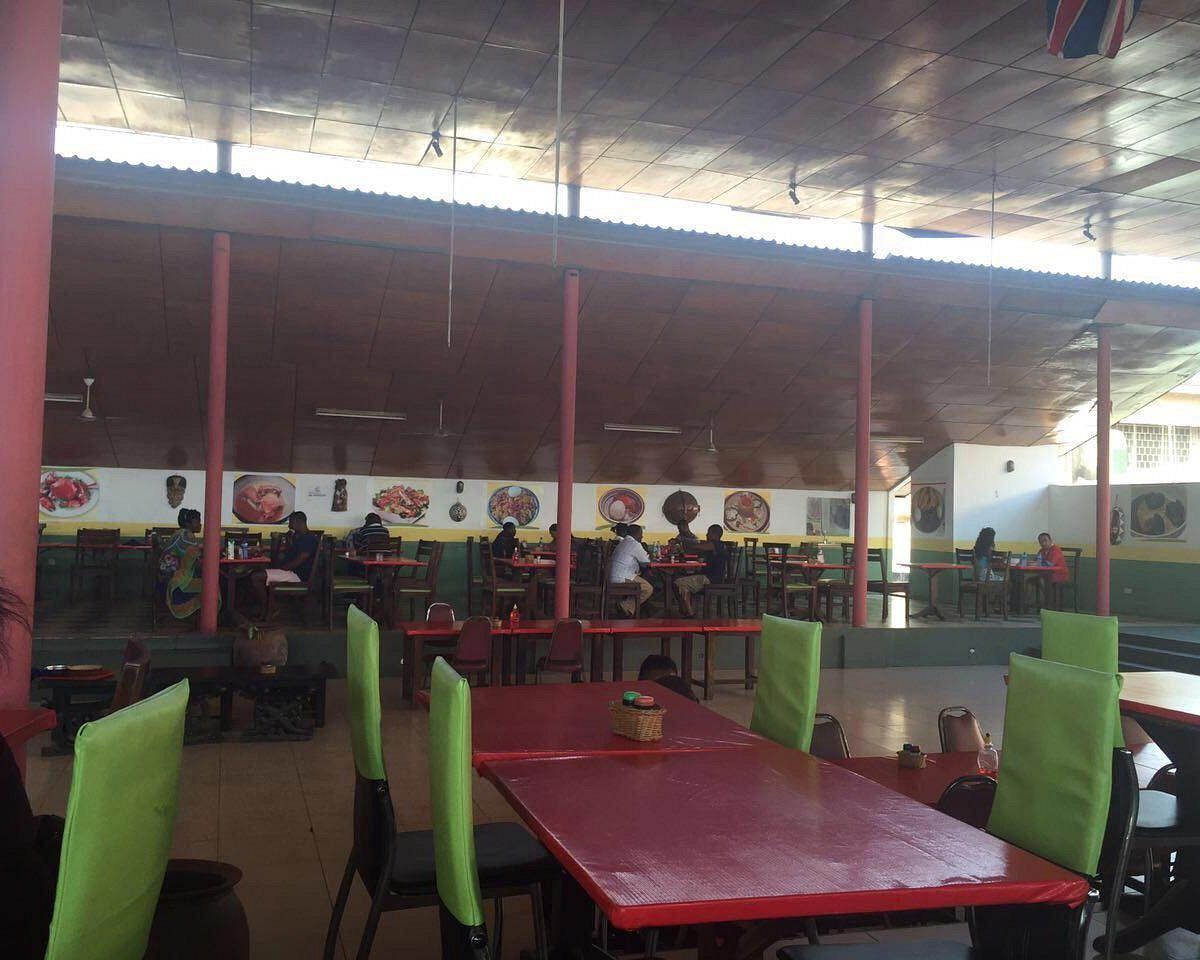
Restaurants in Accra that identify as local typically share a set of environmental signals: open-air or semi-open seating, communal tables, the sound of cooking audible from the dining area, and a pace shaped by the kitchen rather than by reservation windows. The absence of formal booking infrastructure at Asanka is consistent with this format. Walk-in access is standard for kitchens of this type across Accra, where availability depends on what has been prepared that day rather than on a fixed menu operating across service slots.
This format has precedents in formal dining contexts globally. Counter-only, supply-driven restaurants at the other end of the price spectrum, such as HAJIME in Osaka or Dal Pescatore in Runate, also prioritise ingredient availability over menu rigidity. The mechanism differs sharply across price tiers, but the underlying logic is the same: the ingredient sets the agenda.
For a visitor arriving from a high-formality dining background, adjusting to this format is direct. There is no dress code to consider, no tasting menu timeline to plan around. The question is whether what was sourced that morning aligns with what you want to eat. In a city with Accra's market infrastructure, including some of West Africa's most active fresh-produce trading, the answer is usually yes.
Placing Asanka in Accra's Broader Food Argument
Accra is currently in the middle of a genuine conversation about what its food culture should look like internationally. There are restaurants here building cases for Ghanaian cooking at a level of technical ambition that invites comparison with venues like Atomix in New York City or Le Bernardin in terms of the seriousness brought to sourcing and execution. There are also places like Asanka, which represent the undisrupted baseline from which any of those creative departures must eventually reckon with their own authenticity.
Both ends of that spectrum matter. The risk in any city's food evolution is that the local-format restaurants that carry the actual culinary memory get displaced by the formats that attract investment and press. The continued presence of kitchens working in the asanka tradition, using the same clay-ground pepper bases and palm-oil-heavy stews that have defined the cuisine for generations, is what gives Accra's food scene its actual depth. Fine-dining interpretations of Ghanaian food at venues like Midunu draw credibility from the existence of originals. The direction of influence, in culinary terms, runs from the local kitchen outward, not the other way around.
Planning Your Visit
Asanka Local Restaurant does not appear to operate a website or listed phone number, which means walk-in is the practical approach. For visitors, this positions it as a daytime or early-evening stop rather than a dinner reservation. Arriving mid-morning or at lunch gives access to dishes prepared from that day's market sourcing, when Ghanaian local restaurants typically serve their leading output. No dress code applies. The format suits families with children, given the informal seating and the absence of a tasting-menu structure that demands sustained attention across multiple courses. For solo diners or small groups, the communal nature of traditional Ghanaian eating, where dishes are often shared rather than individually plated, makes it an easy format to enter without ceremony.
A Quick Peer Check
These are the closest comparables we have in our database for quick context.
| Venue | Cuisine | Price | Awards | Notes |
|---|---|---|---|---|
| ASANKA LOCAL RESTAURANT | This venue | |||
| Midunu | Ghanaian Cuisine | Ghanaian Cuisine | ||
| La Borracha | ||||
| Tortuga Island Gh |
At a Glance
- Rustic
- Cozy
- Family
- Casual Hangout
- Group Dining
- Standalone
- Local Sourcing
Spacious, airy, and clean interior with a simple, traditional chop bar atmosphere.