Al's Breakfast



James Beard Award America's Classics · Diners, Drive-Ins and Dives Featured Restaurant
Our verdict
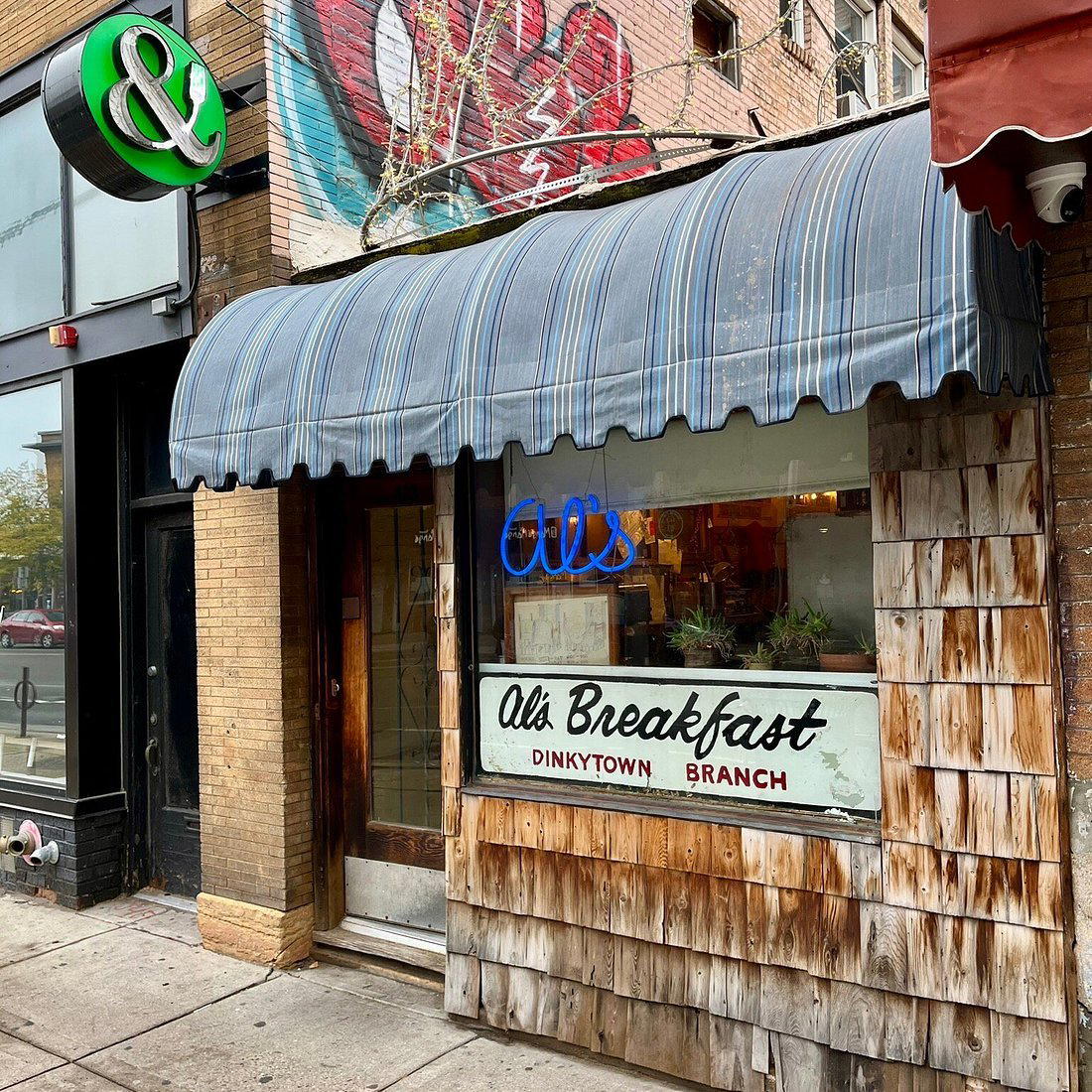
Al's Breakfast has occupied a narrow storefront on 14th Avenue SE in Minneapolis's Dinkytown neighborhood for decades, serving as one of the city's most discussed short-order breakfast counters. The space seats a small number of diners along a single counter, and the line that forms outside most mornings signals the kind of sustained local loyalty that advertising cannot manufacture. It is the type of place that defines a neighborhood's morning character more than any restaurant review could.

Pearl is the En Primeur Club membership app, where members save venues, book tables and use the concierge.
The menu
What to order
- Blueberry pancakes
- Fancy scrambled eggs
- Jose
Fourteen Seats, One Counter, Decades of Dinkytown Mornings
There is a particular kind of Minneapolis morning that begins on 14th Avenue SE, outside a storefront so narrow you could almost mistake it for a gap between buildings. Al's Breakfast occupies a sliver of Dinkytown, the neighborhood that sits just northeast of the University of Minnesota campus, and has done so long enough that the breakfast counter itself has become part of the neighborhood's physical memory. The smell of butter on a flat-leading griddle and the low hum of conversation inside reach the sidewalk before the door does. That queue forming outside, regardless of season, is the first thing most visitors notice: not a line for novelty, but one for repetition, assembled by the same people returning week after week.
Dinkytown's dining character is defined by the friction between transient student populations and a core of long-term residents who treat certain institutions as fixed points. Al's sits firmly in that second category. In a neighborhood where coffee shops and fast-casual spots turn over with academic calendars, a breakfast counter that has maintained its format and address across generations operates as a kind of civic anchor. The compressed physicality of the room, a short-order kitchen visible from every seat, neighbors pressed close enough that conversations overlap, makes it less a restaurant in the conventional sense and more a daily public ritual compressed into a few hundred square feet.
The Arithmetic of a Fourteen-Seat Counter
American breakfast culture produced two divergent formats. One prioritizes efficiency and scale: the diner with its long rows of booths, laminated menus running to multiple pages, and a kitchen geared for volume. The other prioritizes proximity and repetition: the counter, the visible cook, the short menu that changes only when something genuinely warrants it. Al's belongs unambiguously to the second format. With roughly fourteen seats along a single counter, the room operates at a capacity that most food service operations would consider impossibly limiting. That constraint is, in practice, the defining editorial choice. Every seat faces the kitchen. There is nowhere else to look, nothing else to attend to.
The math only works if the people who came last Saturday come back next Saturday, and the Saturday after that. That kind of loyalty is not generated by occasion dining; it is generated by a reliable daily experience delivered at a price point that makes repetition practical. Minneapolis has no shortage of ambitious weekend brunch operations, venues oriented toward the occasion diner, with cocktail menus and extended waits engineered for social media, but Al's operates in a different economy entirely, one based on regulars rather than discovery traffic.
Sensory Register: What the Room Actually Feels Like
The sensory experience of Al's Breakfast is inseparable from its physical constraints. Sounds in a fourteen-seat room with hard surfaces carry differently than in a full dining room: the crack of eggs, the scrape of a spatula, the clatter of ceramic mugs being set down travel clearly from one end of the counter to the other. There is no ambient music to manage the acoustic environment. The kitchen soundtrack is the ambient environment. This is either the appeal or the deterrent, depending on what a visitor expects from a morning meal.
Visually, the room operates with a kind of functional austerity that is common to long-running American short-order institutions. Nothing has been designed to photograph well; everything has been maintained to function reliably. The flat-leading griddle, the coffee setup, the counter surface, these are working elements of a working kitchen, not props. In a moment when many cities have produced breakfast and brunch operations where the room is the primary product and the food is secondary, Al's represents the inverse: the food and the act of eating it in proximity to its preparation are the entire point.
Morning timing shapes the experience considerably. The queue outside forms early on weekend mornings, and the turnover rhythm at a fourteen-seat counter means that waiting time is a real planning variable, not an abstract warning. Arriving at opening on a weekday shifts the calculus significantly. Minneapolis winters make the outdoor wait a more consequential factor than it would be in a temperate city, this is a detail that matters from October through March, when temperatures regularly drop below freezing and the line continues regardless.
Where Al's Sits in Minneapolis's Wider Breakfast and Dining Context
Minneapolis's dining scene spans a wider register than most cities its size would suggest. At the upper end, restaurants like Spoon & Stable and 112 Eatery have positioned the city within the national conversation about serious American cooking. Owamni has brought Indigenous cuisine into a format that has drawn national recognition, and Hai Hai has demonstrated the kind of creative range that sustains James Beard attention. These are restaurants that belong in the same conversation as Smyth in Chicago or, at greater distance, Blue Hill at Stone Barns in Tarrytown and The French Laundry in Napa.
Al's Breakfast does not compete with any of those operations and does not try to. It competes with the idea that breakfast requires either an occasion or a formula. The counter format, the neighborhood address, and the insistence on a limited physical footprint place it in a category that high-concept dining has largely abandoned: the daily-use institution that derives its authority from accumulated repetition rather than critical positioning. For visitors building a picture of Minneapolis's full dining range, the gap between a tasting menu at Spoon & Stable and a counter seat at Al's is precisely where a city's actual food culture lives. See our full Minneapolis restaurants guide for a broader map of where the city's dining sits across formats and neighborhoods.
Planning Your Visit
Al's Breakfast is located at 413 14th Ave SE, Minneapolis, in the Dinkytown neighborhood adjacent to the University of Minnesota campus. The counter-only format means that once the fourteen seats are occupied, the wait is outdoors, a factor that carries more weight in winter months than in summer. Weekday mornings offer a more manageable entry point than weekend mornings, when the queue extends noticeably. There is no reservation system; seating is entirely first-come. Cash has historically been the preferred payment format at similar counter institutions, though visitors should confirm current policy on arrival.
Frequently asked questions
Where do I go for Al's Breakfast?
Al's Breakfast is located at 413 14th Ave SE, Minneapolis, MN 55414, Minneapolis.
Is Al's Breakfast worth visiting if you're not a University of Minnesota student or Dinkytown local?
Al's Breakfast at 413 14th Ave SE has outlasted the student-turnover cycle that reshapes Dinkytown's commercial blocks every few years, which in a neighborhood tied to a university is its own form of credential. Visitors coming specifically for Minneapolis's dining scene treat it alongside the city's broader breakfast options not because of accolades but because longevity and format, a fourteen-seat counter with walk-in-only access, are increasingly rare. The draw is the room itself as much as the plate.
What's the best thing to order at Al's Breakfast?
What consistent reporting from Minneapolis food coverage makes clear is that the cooking follows classic American short-order formats: eggs, griddle items, and breakfast staples executed on a counter within arm's reach of the cook. The call at a fourteen-seat operation like this is usually whatever the person next to you just received.
Should I book Al's Breakfast in advance?
Al's does not operate a reservation system, so the only way in is to queue at 413 14th Ave SE in Dinkytown. Arriving early on weekends is the standard approach; the fourteen-seat counter fills quickly, and there is no holding list. If you routinely book ahead at reservation-only spots, this is a different format entirely.
What's the defining dish or idea at Al's Breakfast?
The defining idea is the format. A fourteen-seat counter with an open short-order kitchen and no reservation system puts the cooking in plain view and eliminates the distance between kitchen and guest that most dining rooms preserve. That constraint shapes everything: the pacing, the noise level, the interaction with the cook, and the sense that the room is operating at full capacity even when it holds fewer people than a midsize conference table.
Comparable Venues
Comparable venues nearby, for context on price, style, and recognition.
| Venue | Cuisine | Price | Awards | Notes |
|---|---|---|---|---|
| Al's BreakfastThis venue (the venue you are viewing) | Classic American Diner Breakfast | $10–20 | James Beard Award America's Classics · Diners, Drive-Ins and Dives Featured Restaurant | Not listed |
| Ideal Diner | Classic American Diner | $10–20 | Not listed | Northeast Minneapolis Arts District |
| Tilia | Mediterranean and New American | $30–50 | Not listed | Linden Hills |
| Hen House Eatery | All-Day Breakfast with Local Farm Ingredients | $20–30 | Not listed | WeDo |
| Carbon Kitchen + Market | Charcoal-Grilled American Grill | $20–30 | Not listed | Northeast Minneapolis Arts District |
| Longfellow Grill | American Comfort Grill | $20–30 | Not listed | Cooper |
Recognition history
Dated appearances from independent guides and award organizations, with the underlying list record or original source where available.
James Beard Award America's Classics
James Beard Award
Diners, Drive-Ins and Dives Featured Restaurant
Diners, Drive-Ins and Dives · 2026 Diners, Drive-Ins and Dives Featured Restaurants
Opinionated About Dining Cheap Eats in North America Recommended
Opinionated About Dining
Continue exploring
More in Minneapolis
Restaurants in Minneapolis
All restaurants in Minneapolis →
Bars in Minneapolis
All bars in Minneapolis →

Details
- Cozy
- Classic
- Well Known
- Casual Hangout
- Brunch
- Solo
- Historic Building
- A La Carte
- Counter Dining
- Vegetarian Friendly
- Vegan Options
Current opening hours
- Monday
- 6 AM–1 PM
- Tuesday
- 6 AM–1 PM
- Wednesday
- 6 AM–1 PM
- Thursday
- 6 AM–1 PM
- Friday
- 6 AM–1 PM
- Saturday
- 6 AM–1 PM
- Sunday
- 9 AM–1 PM
Hours can change for holidays and private events. Last verified .
Bustling, old-school diner atmosphere with a museum-like feel from vintage decor, upbeat music, and friendly chit-chat among counter patrons.