Alchemist







Few restaurants in Europe ask as much of a guest as Alchemist. Set inside a former industrial space on Copenhagen's Refshaleøen peninsula, Rasmus Munk's project runs to 50 'impressions' across roughly seven hours, folding art installation, theatre, and ingredient-driven cooking into a single sitting. Two Michelin stars, a #8 ranking on the World's 50 Best list in 2024, and the #1 position on Opinionated About Dining's European ranking for two consecutive years place it in a tier with very few peers.
 Discover on Pearl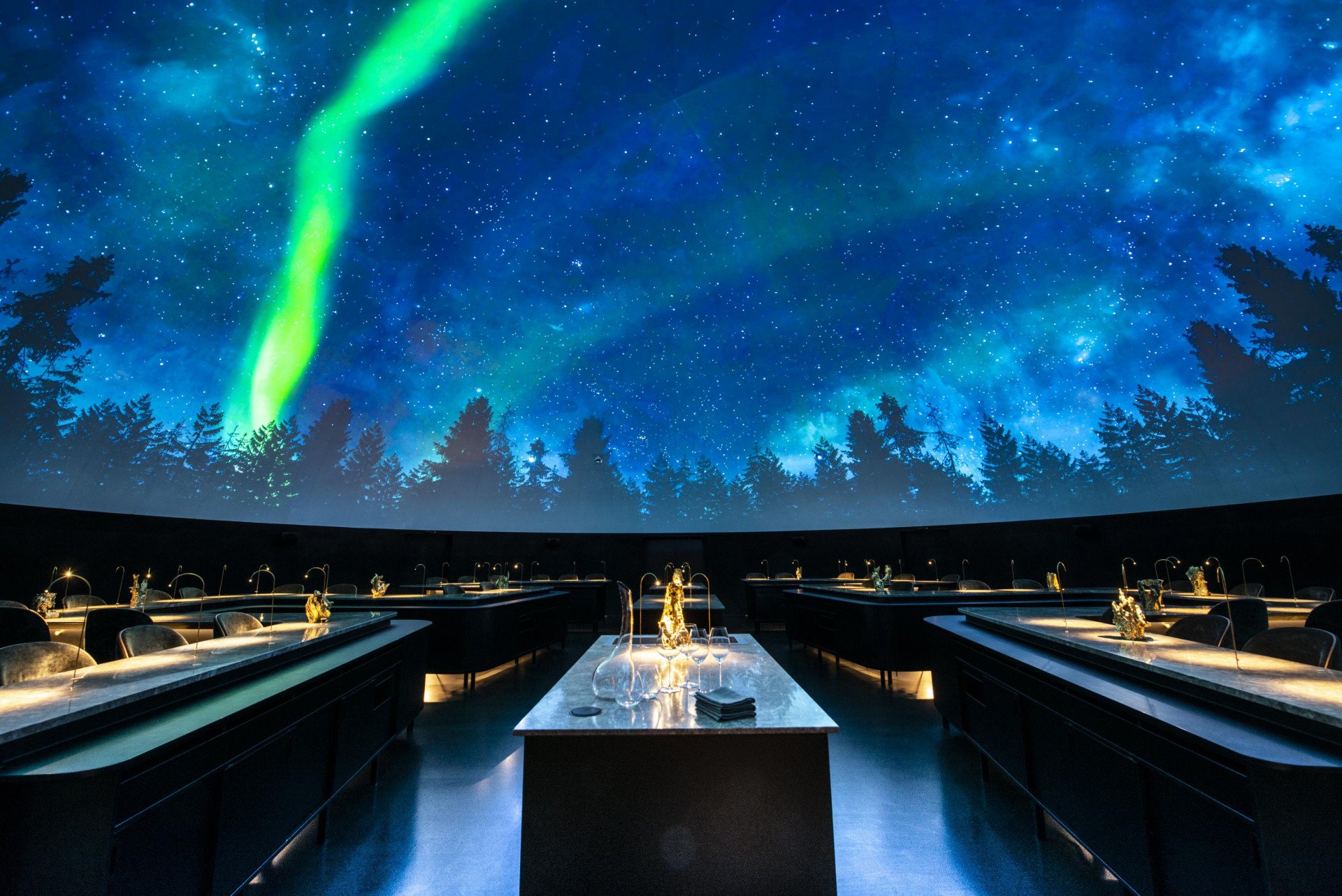
The approach to Alchemist does most of the orientation work before you cross the threshold. Refshaleøen is post-industrial Copenhagen: a former naval shipyard peninsula where warehouses have been converted into breweries, food halls, and ateliers. The restaurant sits at the far end of this stretch, announced by two-tonne bronze doors decorated in the manner of a fantasy epic. They open automatically. Nothing about the sequence is accidental.
A Format Category of Its Own
Copenhagen's fine-dining tier has fractured over the past decade into recognisably distinct formats. Geranium operates as a refined tasting progression from a twelfth-floor perch in Fælledparken. Noma built its reputation on seasonal rotation and ingredient archaeology. Koan layers New Nordic produce through a kaiseki structure. Alchemist occupies a different category altogether: what it offers is closer to a programmed evening than a meal, with food as the central medium but not the only one.
The shortlist, unlocked.
Hard-to-book tables, cellar releases, and concierge-planned trips.
Get Exclusive Access →The structure runs to 50 'impressions' — the restaurant's term for what other kitchens call courses — delivered across several acts and multiple physical spaces over approximately seven hours. Guests move through the building as the evening progresses, encountering different environments, installations, and presentations. The dome-shaped main dining space features a ceiling that projects changing graphic sceneries throughout the sitting. These are not decorative flourishes grafted onto a conventional menu; the spatial and visual sequences are designed to carry the same weight as the food itself.
Among the venues working in the progressive-creative register elsewhere in Europe, the closest structural comparisons are formats like Azurmendi in Larrabetzu and Disfrutar in Barcelona, both of which integrate theatrical presentation into technical cooking programs. Alchemist takes that integration further in terms of scale and duration.
What the Awards Record Implies
Trust signals accumulate differently at the leading of the market. A single Michelin star indicates a kitchen cooking at a reliably high level. Two stars, which Alchemist holds as of 2025, indicates cooking that warrants a detour. The World's 50 Best ranking, which placed Alchemist at #18 in 2022, #5 in 2023, and #8 in 2024, tracks something adjacent but distinct: industry and critical consensus about restaurants pushing the form forward. Both signal systems agree on Alchemist's position. Opinionated About Dining, which draws on a large pool of experienced repeat visitors rather than anonymous inspectors, has ranked it #1 among European restaurants in both 2024 and 2025 , a peer-driven endorsement that sits alongside the institutional recognition rather than duplicating it. La Liste, which aggregates critical scores across global publications, awarded 96 points in 2025 and 94 in 2026.
The wine program has attracted its own separate recognition. Star Wine List has consistently ranked Alchemist in its top tier for Denmark across every year from 2020 through 2025, with six consecutive top-one placements. At the price point and format this restaurant operates, the list is expected to perform at that level , and it does.
For broader context on where Alchemist sits within Denmark's fine-dining geography, see the comparable work being done at Jordnær in Gentofte, Frederikshøj in Aarhus, Henne Kirkeby Kro in Henne, Alimentum in Aalborg, ARO in Odense, and Domæne in Herning.
The Regulars' Calculus
Reservations at Alchemist sell out within minutes of release, with waiting lists running into five digits. That compression creates an unusual dynamic: the typical fine-dining regular who books a favourite table for a quarterly visit cannot operate here the way they might at a more conventionally available restaurant. Instead, the repeat-visitor cohort is made up of people who plan with long lead times and treat the booking process as part of the commitment.
What draws them back, based on the public record of how the format is structured, is not repetition of a known quantity but the expectation of evolution. The 50-impression format is not fixed; the content of individual acts shifts as the kitchen's research develops. Guests who have experienced a previous version return to assess what has changed and what has been refined. This is a different form of loyalty from the kind built around a signature dish or a consistent seasonal menu , it is closer to the relationship a theatre audience develops with a company whose program it follows across productions.
The broader engagement extends beyond the dining room. Rasmus Munk founded the non-profit Junk Food during the 2020 lockdown, using the restaurant's platform to fund meals for homeless people in Copenhagen and clean water initiatives internationally. For a segment of the restaurant's audience, that social dimension is part of what they are buying into when they secure a table. The impression-based format includes moments designed explicitly to provoke reflection on food systems and sustainability , a freeze-dried butterfly served as a protein source, for instance, or the 'Food for Thought' presentation involving a realistic cast of a human head from which guests scoop cherry meringue filled with lamb's brain mousse. These are not shock tactics for their own sake; they are propositions the kitchen expects guests to carry out of the building.
The Cuisine Foundation
The seven-hour multi-act structure only functions because the cooking underneath it can carry the weight. The avant-garde framing of Alchemist is sometimes discussed at the expense of its technical foundations, but the kitchen's approach is grounded in classical technique, modern research, and ingredient sourcing of the kind that defines the upper end of the Nordic fine-dining tier. Presentations documented in the public record include caviar-topped 'Space Bread' canapés, premium seafood, and pigeon aged in beeswax. These are not simplified vehicles for a concept; they require the same sourcing rigour and technical execution as any kitchen at this level.
Rasmus Munk was born in 1991 and opened the first iteration of Alchemist in 2015 at Østerbro, with limited capacity. After a deliberate pause in 2017, the restaurant reopened in 2019 in the current Refshaleøen space with a fully redesigned concept. He holds the #1 position in The Leading Chef Awards for both 2024 and 2025. Those credentials place him in the cohort of chefs whose work is considered generative rather than merely accomplished , kitchens that set the terms of discussion rather than responding to them. For a fuller picture of Copenhagen's creative-cuisine field, a|o|c and Kadeau represent other strong positions within it.
What the Format Demands of the Guest
Seven hours is a significant commitment, and the format's designers are aware of this. The evening is structured so that guests are not passive recipients of a program; there are layers of engagement available for those who want them, and none are compelled. Staff do not deliver lectures, but the material is there for anyone who wants to follow it further. The balance between accessibility and depth is itself a design decision , the restaurant is trying to reach people who would disengage from a didactic format while still putting substantive propositions in front of them.
The Google review average of 4.8 across 707 submissions is a relatively blunt instrument for evaluating a restaurant at this level, but the volume and consistency suggest that the format delivers on its own terms for the large majority of guests who reach it. The self-selection involved in booking so far in advance, and at this price tier, means the audience arrives prepared. That preparation is part of why the format works: Alchemist is not trying to surprise guests who expected something conventional.
Know Before You Go
- Address: Refshalevej 173C, 1432 København K, Denmark
- Hours: Tuesday to Friday, 5 pm–12 am. Closed Saturday, Sunday, and Monday.
- Price tier: €€€€
- Getting there: Refshaleøen is a post-industrial peninsula that requires deliberate navigation. The restaurant sits at the far end of the stretch; allow extra time for the journey from central Copenhagen. Taxis and rideshare are the most practical options.
- Booking: Reservations open and sell out within minutes. Waiting lists run into five digits. Plan considerably in advance and monitor release dates.
- Duration: Approximately seven hours across multiple acts and locations within the building.
- Format: 50 impressions, no conventional course structure.
Copenhagen in Broader Context
For visitors planning around Alchemist, the city's broader offer is covered in our full Copenhagen restaurants guide, with complementary coverage across hotels, bars, wineries, and experiences.
Refshalevej 173C, 1432 København K, Denmark
+45 31 71 61 61
The Short List
A compact peer snapshot based on similar venues we track.
Need a table?
Our members enjoy priority alerts and concierge-led booking support for the world's most difficult tables.
Get Exclusive AccessThe shortlist, unlocked.
Hard-to-book tables, cellar releases, and concierge-planned trips.
Get Exclusive Access →