
Acqua Pazza has held a Michelin star for two decades on the island of Ponza, where Luigi Pesce and Patrizia Ronca have built one of Italy's most committed seafood tables over more than thirty years. The kitchen leans hard into the Tyrrhenian's daily catch, presenting raw and simply treated seafood dishes that let the ingredient speak. The terraced setting above the port frames a view that stretches toward the uninhabited islands of Gavi and Zannone.
Pearl is the En Primeur Club membership app — saves, bookings, and concierge access live there. Same editors, same standards.
- Address
- via Dietro la Chiesa 3/4
- Phone
- +39 0771 80643
- Website
- acquapazza.com
- Directions
- Get directions
 Saves & bookings on Pearl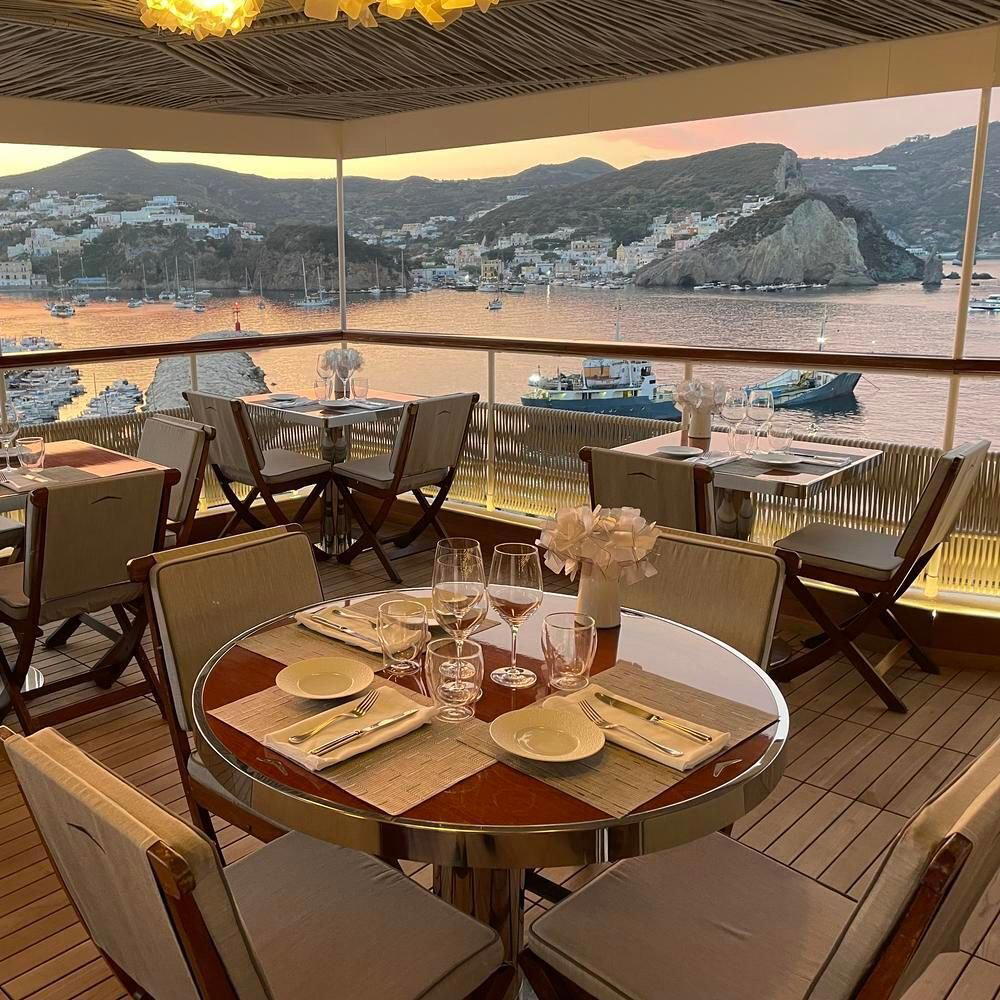
Ponza's Seafood Tradition and Where Acqua Pazza Sits Inside It
Italy's Michelin-starred restaurant map clusters predictably around Milan, Modena, Florence, and the Ligurian coast. Kitchens like Osteria Francescana in Modena, Enoteca Pinchiorri in Florence, or Le Calandre in Rubano sit inside food-literate cities with international visitor bases that sustain ambitious cooking year-round. A kitchen earning and holding a Michelin star for twenty consecutive years on a small Tyrrhenian island, accessible only by ferry or hydrofoil, is a different proposition entirely. It implies something about the quality of the raw material available locally, about the conviction behind the sourcing, and about a dining public willing to travel specifically to eat there.
Ponza is the largest of the Pontine Islands, roughly 33 nautical miles off the coast of Lazio. The island has a working fishing culture that predates any restaurant scene by centuries, and that culture is the direct supply chain for what appears on the plates at Acqua Pazza. When a kitchen operating in this context has sustained a Michelin star for two decades, the award is as much a validation of the island's waters as it is of the technique applied to their contents.
The Physical Setting: Terraces Over the Port
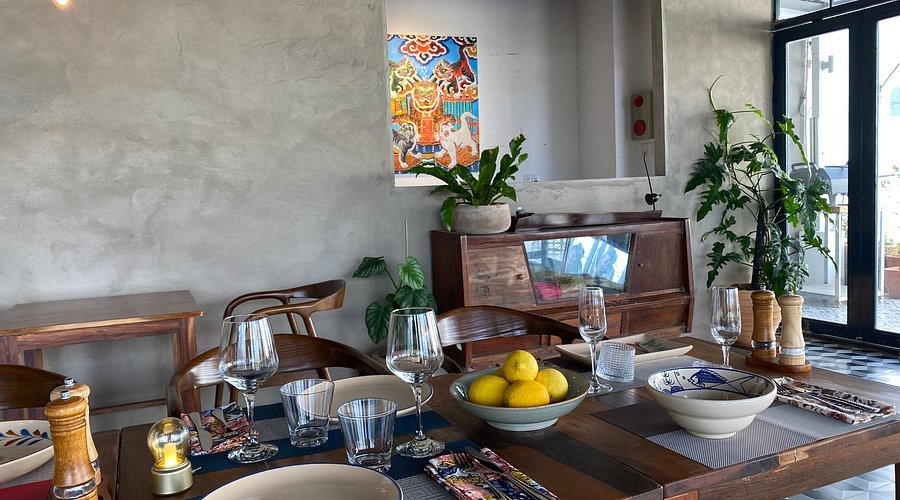
The address, via Dietro la Chiesa, sits in the hill above Ponza's semicircular port, and the restaurant occupies a series of multi-level terraces that descend toward a view of the harbour. The port at Ponza is one of the more photogenic anchorages in the Tyrrhenian, its curved breakwater lined with coloured houses, and from the upper terraces at Acqua Pazza the sightline extends further, past the harbour mouth toward the smaller islands of Gavi and Zannone on the clearer days. The setting is not incidental. Eating here while watching the boats that likely supplied your plate sit in the harbour below closes a loop that most seafood restaurants can only gesture toward rhetorically.
Italy has a handful of restaurants where the physical position is inseparable from the dining logic: Quattro Passi in Marina del Cantone works a similar principle along the Amalfi coast, and Uliassi in Senigallia has built its Adriatic identity partly on its proximity to the beach. What distinguishes the Ponza setting is the island's relative isolation: there is no mainland crowd easily driving in for dinner, which means the tables here are occupied by people who have made a deliberate effort to arrive.
Ingredient First: The Kitchen's Sourcing Logic
Especially instructive element among the menu structure at Acqua Pazza is the placement of raw seafood dishes at the opening of the menu. In a kitchen that has operated for over thirty years and held a Michelin star for twenty of them, the decision to foreground raw preparations is a statement about confidence in supply. Raw seafood is unmediated: there is no cooking technique to compensate for inferior material, no sauce to redirect attention, no aging process to develop complexity. The ingredient either carries the course or it does not.
This sourcing-first philosophy is relatively common at the highest level of seafood cooking globally. Le Bernardin in New York City built its reputation on a similar hierarchy, where the fish is treated as the primary subject and technique is applied only to the degree that it serves rather than obscures the ingredient. The difference in Ponza is that the supply chain is local in a way that few urban kitchens can replicate: the Tyrrhenian waters around the Pontine Islands are not industrial fishing grounds, and the catch arriving at a kitchen on the island has not traveled the distribution distances that intervene between ocean and city restaurant.
The remainder of the menu follows a consistent logic: classic treatment, ingredient-forward construction, no heavy reformulation of material that does not require it. This is not the kind of kitchen found at Reale in Castel di Sangro or Enrico Bartolini in Milan, where the cooking philosophy leans into technique-driven transformation. The restaurant sits in a different Italian tradition, closer to the restraint of kitchens like Dal Pescatore in Runate in its respect for inherited form, though the culinary register here is entirely marine rather than the river-valley produce that defines Runate's kitchen.
For comparison within the Italian seafood-Michelin tier, Eea (Seafood) also operates on Ponza and represents another angle on the island's seafood offer.
Wine and the List That Completes the Kitchen's Argument
A serious wine list at a seafood restaurant in this price and award tier is not optional: it is how the kitchen's sourcing logic extends through the full meal. The wine program at the restaurant is described as impressive, which in the context of a Michelin-holding kitchen on a remote island implies a deliberately curated selection rather than the generic regional rotation common at Italian coastal trattorias. Pairing white wine with fish from the Tyrrhenian basin means navigating Campanian Falanghina, Sicilian Carricante, and the mineral whites of the volcanic islands, alongside the broader Italian canon. A list that matches the ambition of the kitchen here is a logistical achievement in itself, given the island's supply infrastructure.
The Thirty-Year Arc and What It Signals
Longevity in the restaurant business is its own credential, and over thirty years of continuous operation in a seasonal island context is a specific kind of durability. Luigi Pesce and Patrizia Ronca have managed a business that must compress most of its revenue into the summer months while maintaining the standard that sustains a Michelin star through the year. The star itself has been held for twenty of those thirty-plus years, a sustained recognition that places the restaurant in a different category from kitchens that earn a star during a peak period and lose it as the team moves on. The sustained award signals consistency rather than a single moment of excellence, which in a remote seasonal location is considerably harder to maintain than in a city kitchen with year-round trade and a stable team.
For context on what Michelin-level consistency looks like across different Italian culinary traditions, Piazza Duomo in Alba and Atelier Moessmer Norbert Niederkofler in Brunico illustrate how long-running starred kitchens in regional Italy build identity through place-specific sourcing over time rather than through urban visibility.
Planning a Visit
The restaurant sits at via Dietro la Chiesa 3/4, uphill from the harbour, and the walk from the port is short. A visit to the restaurant is most coherently structured as part of at least a two-night stay on the island, giving time to understand the fishing-to-table supply chain that underpins what the kitchen delivers.
How It Stacks Up
Comparable venues nearby, for context on price, style, and recognition.
| Venue | Cuisine | Price | Awards | Notes |
|---|---|---|---|---|
| Acqua PazzaThis venue — the venue you are viewing | Michelin-Starred Italian Seafood | $$$$ | Michelin 1 Star | Not listed |
| Eea | Italian Seafood | $$$ | Michelin Plate | Ponza Harbor |
| Relais Blu | Modern Italian Fine Dining | $$$$ | Michelin 1 Star | Massa Lubrense |
| O Me O Il Mare | Contemporary Campanian Fine Dining | $$$$ | Michelin 1 Star | Historic Center of Gragnano |
| Al Madrigale | Nuova Cucina Rurale | Nuova Cucina Rurale | $$$$ | Michelin 1 Star | Tivoli |
| Mirabelle | Modern Italian Fine Dining | $$$$ | Michelin Plate | Ludovisi |
Recognition history
Dated appearances from independent guides and award organizations, with the underlying list record or original source where available.
Michelin 1 Star
Michelin
Continue exploring
More in Ponza
At a Glance
- Romantic
- Elegant
- Scenic
- Sophisticated
- Date Night
- Special Occasion
- Waterfront
- Terrace
- Panoramic View
- Extensive Wine List
- Sommelier Led
- Waterfront
Current opening hours
- Monday
- 7:29–11:30 PM
- Tuesday
- 7:29–11:30 PM
- Wednesday
- 7:29–11:30 PM
- Thursday
- 7:29–11:30 PM
- Friday
- 7:29–11:30 PM
- Saturday
- 7:29–11:30 PM
- Sunday
- 7:29–11:30 PM
Hours can change for holidays and private events. Last verified .
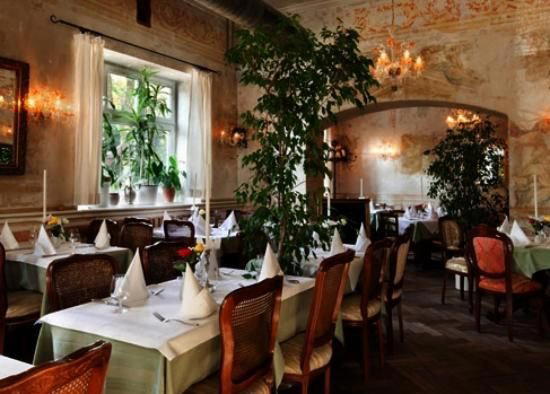
Elegant terrace dining with far-reaching panoramic sea views, yacht-style decor on upper levels, and romantic illuminated atmosphere.