
Michelin Selected
Wolwedans Dunes Lodge sits inside the NamibRand Nature Reserve, one of Africa's largest private nature reserves, and holds a MICHELIN Selected distinction for 2025. The lodge occupies refined dune terrain, placing guests above the red-sand plains of the southern Namib in a setting where the architecture works with the landscape rather than against it. For remote southern African lodges with serious design credentials, this is a meaningful reference point.

Pearl is the En Primeur Club membership app — saves, bookings, and concierge access live there. Same editors, same standards.
- Address
- 4WF2+HQ8 NamibRand Nature Reserve, Sesriem, Namibia
- Phone
- +27 21 001 1574
- Website
- naturalselection.travel
- Directions
- Get directions
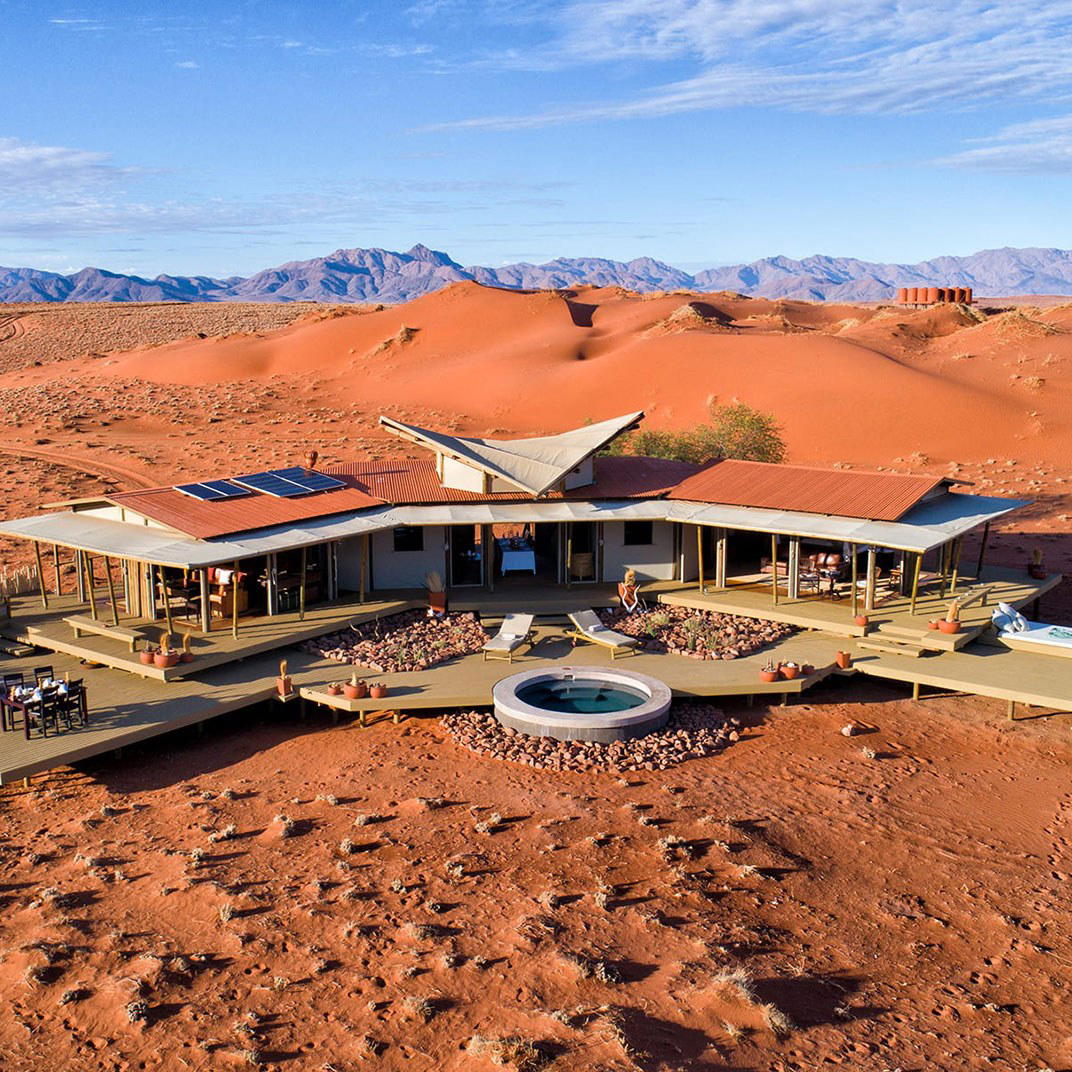
Where the Dunes Set the Design Brief
In southern Africa's premium safari lodge market, the tension between built environment and wilderness has produced two distinct schools. The first imports comfort conventions wholesale — thick walls, heavy furniture, air conditioning humming against the heat. The second treats the landscape as a co-author, with structures that dissolve into their terrain rather than dominate it. Wolwedans Dunes Lodge, occupying refined dune crests inside the NamibRand Nature Reserve in Namibia's Hardap Region, belongs firmly to the second school, and the distinction matters for understanding what kind of experience it actually delivers.
NamibRand itself frames everything here. At roughly 200,000 hectares, it is one of the largest private nature reserves in Africa, bordering the Namib-Naukluft National Park to the west. That scale means the lodge sits within a buffer of protected wilderness that keeps visible human infrastructure at a minimum. Approaching by light aircraft or 4x4 across the red-sand plains, the lodge appears at the dune's edge rather than rising above it, a design decision that reads as deliberate restraint rather than accident. The same philosophy governs the interiors: canvas and timber over concrete, open-sided decks that face the dune sea, and a spatial arrangement that prioritises sightlines over insulation from the elements. This positions Wolwedans in a different competitive set from walled lodge formats. Comparisons with andBeyond Sossusvlei Desert Lodge in Sesriem are instructive — both operate in the greater Namib dune environment, but they approach the architecture-landscape relationship from opposite directions.
Structure as Editorial Statement
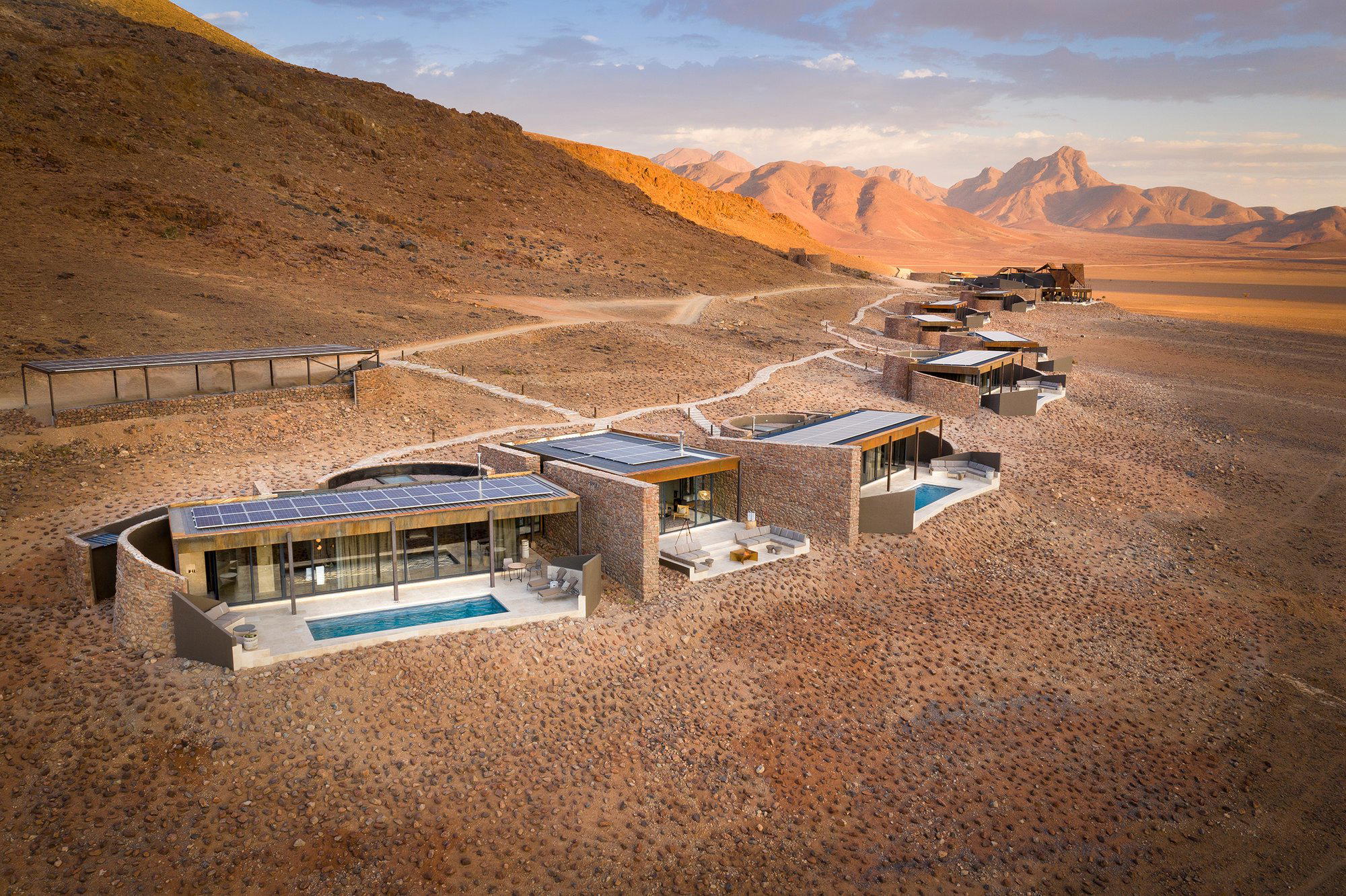
The lodge's physical configuration is a deliberate editorial stance on what luxury in remote environments should mean. Individual units are positioned along the dune ridge rather than clustered around a central building, a layout that maximises privacy and distributes the load of human presence across a wider footprint. Decks cantilever over the slope, placing guests at a height where the horizon runs uninterrupted for tens of kilometres. The open-plan construction allows wind, temperature, and sound to pass through rather than be managed out of existence, a choice that separates this category of lodge from the sealed-room resort format that dominates beach and city markets like Le Bristol Paris or Hôtel de Paris Monte-Carlo.
In the wider NamibRand lodge market, this architectural approach carries specific implications for the guest experience. The reserve's dark sky designation, awarded by the International Dark-Sky Association, is a verifiable credential that sets it apart from most safari destinations on the continent and explains why stargazing is treated as a programme centrepiece rather than an afterthought.
The NamibRand Reserve Context
Understanding the lodge requires understanding the reserve it sits within. NamibRand was established in 1992 through the consolidation of former farmland, and its management model prioritises ecological restoration alongside low-density tourism. The reserve supports oryx, springbok, cheetah, brown hyena, and a range of endemic Namib species adapted to the gravel plains and dune systems. Tourist capacity within the reserve is deliberately capped, which means the lodge operates in conditions of genuine isolation rather than managed proximity to other properties. This is the kind of credential that separates it from busier safari circuits in the Okavango or the Masai Mara, where multiple camps operate within hearing distance of each other.
Other properties operating in comparable remote southern African environments, including Sandfontein Lodge and Nature Reserve in Sandfontein, Shipwreck Lodge in Möwebaai, and Wilderness Hoanib Skeleton Coast Camp in Hoanib Valley, demonstrate that Namibia has developed a coherent school of remote lodge design that works within extreme landscapes rather than against them. Wolwedans sits within that tradition and is among the properties that helped define it.
MICHELIN Recognition and What It Signals
Wolwedans Dunes Lodge holds a MICHELIN Selected distinction for 2025, placing it within the Michelin Guide's hotels and stays programme. MICHELIN Selected, distinct from starred designations, reflects editorial recognition for quality and character rather than gastronomy specifically. In the context of remote African lodges, inclusion signals that the property meets international benchmarks for accommodation, service, and guest experience, the same framework applied to properties as varied as Zannier Omaanda in Windhoek and Zannier Sonop in the Namib Desert. For travellers using award recognition as a filtering tool, the designation provides a consistent reference point across otherwise difficult-to-compare remote properties.
The MICHELIN recognition also places Wolwedans in the same international conversation as properties with far greater urban profiles, Aman Venice, Badrutt's Palace Hotel in St. Moritz, or Hotel Du Cap-Eden-Roc in Cap d'Antibes. The distinction is useful not because those properties are comparable in format, but because it confirms that Wolwedans operates at a tier where international editorial scrutiny applies, not just regional safari market convention.
Planning Your Stay
The NamibRand Nature Reserve sits in Namibia's Hardap Region, accessible most practically by light aircraft to the Wolwedans private airstrip from Windhoek's Hosea Kutako International Airport, with scheduled charter services available from Windhoek. Driving access exists via Maltahöhe, though the transfer time is substantial and road conditions vary by season. The dry season, roughly May through October, delivers the cooler temperatures and clearest skies that make dune terrain most navigable on foot and in open vehicle. Summer months bring occasional rainfall that can transform the gravel plains dramatically, shifting the landscape's palette and attracting different wildlife, though humidity and heat require consideration.
Bookings for remote Namibian lodges of this type are typically managed through the lodge's own reservations team or specialist southern Africa travel operators, and advance planning of three to six months is standard for peak season travel. The lodge's position within a low-density reserve means that availability is genuinely constrained by design rather than by demand management alone. For broader context on what the Namibrand area offers, see our full Namibrand restaurants guide. Comparable properties in the broader Namibian market worth considering alongside Wolwedans include Epako Safari Lodge and Spa in the Omaruru district and Gmundner Lodge in Dordabis District, each operating within a different terrain and wildlife context but sharing the low-density, landscape-integrated approach that defines Namibia's stronger lodge offerings.
Frequently Asked Questions
- What is the atmosphere like at Wolwedans Dunes Lodge? The atmosphere is defined by open structure and spatial isolation rather than enclosed luxury. The MICHELIN Selected 2025 distinction confirms that the property meets international hospitality benchmarks, but the experience skews toward immersive wilderness rather than insulated resort comfort.
- What is the standout room type at Wolwedans Dunes Lodge? What the property's design philosophy suggests, based on its dune-ridge positioning and architectural approach, is that units oriented toward the open dune face offer the most direct engagement with the landscape. Confirming current room categories and rates directly with the lodge or a specialist Namibia operator is advisable given the property's remote location and the specificity of availability.
- What makes Wolwedans Dunes Lodge stand out in the NamibRand market? Three factors distinguish it within the region: its position inside a 200,000-hectare private reserve with capped tourist capacity; its architecture-as-restraint design philosophy that prioritises landscape integration over enclosed comfort; and the NamibRand's status as an International Dark Sky Reserve, which delivers a stargazing programme grounded in a verifiable environmental designation. The MICHELIN Selected 2025 recognition adds an international editorial benchmark that few remote African lodges carry.
- What is the ideal way to book Wolwedans Dunes Lodge? Direct contact with the lodge's reservations team or booking through a specialist southern Africa travel operator are both standard routes for properties at this level. Given the reserve's deliberately constrained capacity, advance planning of three to six months is advisable for peak dry-season dates between May and October.enprimeurclub.com/cities/namibrand) can provide current contact and booking pathways.
Comparable Venues
Comparable venues nearby, for context on price, style, and recognition.
| Venue | Cuisine | Price | Awards | Notes |
|---|---|---|---|---|
| Wolwedans Dunes LodgeThis venue — the venue you are viewing | Sustainable tented eco-lodge on dune plateau | $750–1,000 | Michelin Selected | Not listed |
| Atlantic Villa Boutique Guesthouse & Conferencing | Oceanfront boutique guesthouse with conferencing | Not listed | World Luxury Hotel Awards WLHA Continent Winner | Swakopmund |
| Sandfontein Lodge & Nature Reserve | Luxury eco-lodge in remote wilderness | Not listed | World Travel Awards | Sandfontein |
| The Windhoek | Luxurious guesthouse with designer suites | $100–200 | World Travel Awards | Klein Windhoek |
| Our Habitas Namibia | Sustainable luxury safari lodge focused on immersion in nature and communal experiences | $500–750 | Michelin Selected · Mr & Mrs Smith Seal of Approval | Farm Coas 501 |
| Wilderness Hoanib Skeleton Coast Camp | chic luxury tented camp | Not listed | World Travel Awards | Hoanib Valley |
Recognition history
Dated appearances from independent guides and award organizations, with the underlying list record or original source where available.
Michelin Selected
Michelin
Continue exploring
More in Namibrand
Details
- Scenic
- Quiet
- Rustic
- Elegant
- Intimate
- Honeymoon
- Romantic Getaway
- Wellness Retreat
- Weekend Escape
- Panoramic View
- Private Villa
- Pool
- Wi Fi
- Mountain
Serene and tranquil desert atmosphere with natural lighting from open canvas sides, evoking a peaceful connection to the wilderness under starry skies.