The Hollywood Roosevelt


Michelin Selected · Preferred Hotels Member
Few addresses in Los Angeles carry as much accumulated history as The Hollywood Roosevelt, a 300-room property on Hollywood Boulevard that has operated continuously since 1927. Where comparable Westside hotels trade on discretion and landscaped remove, the Roosevelt plants itself at the centre of Hollywood's mythology, the site of the first Academy Awards ceremony, and a hotel that has reinvented itself repeatedly without abandoning that foundational identity.

Pearl is the En Primeur Club membership app, where members save venues, book tables and use the concierge.
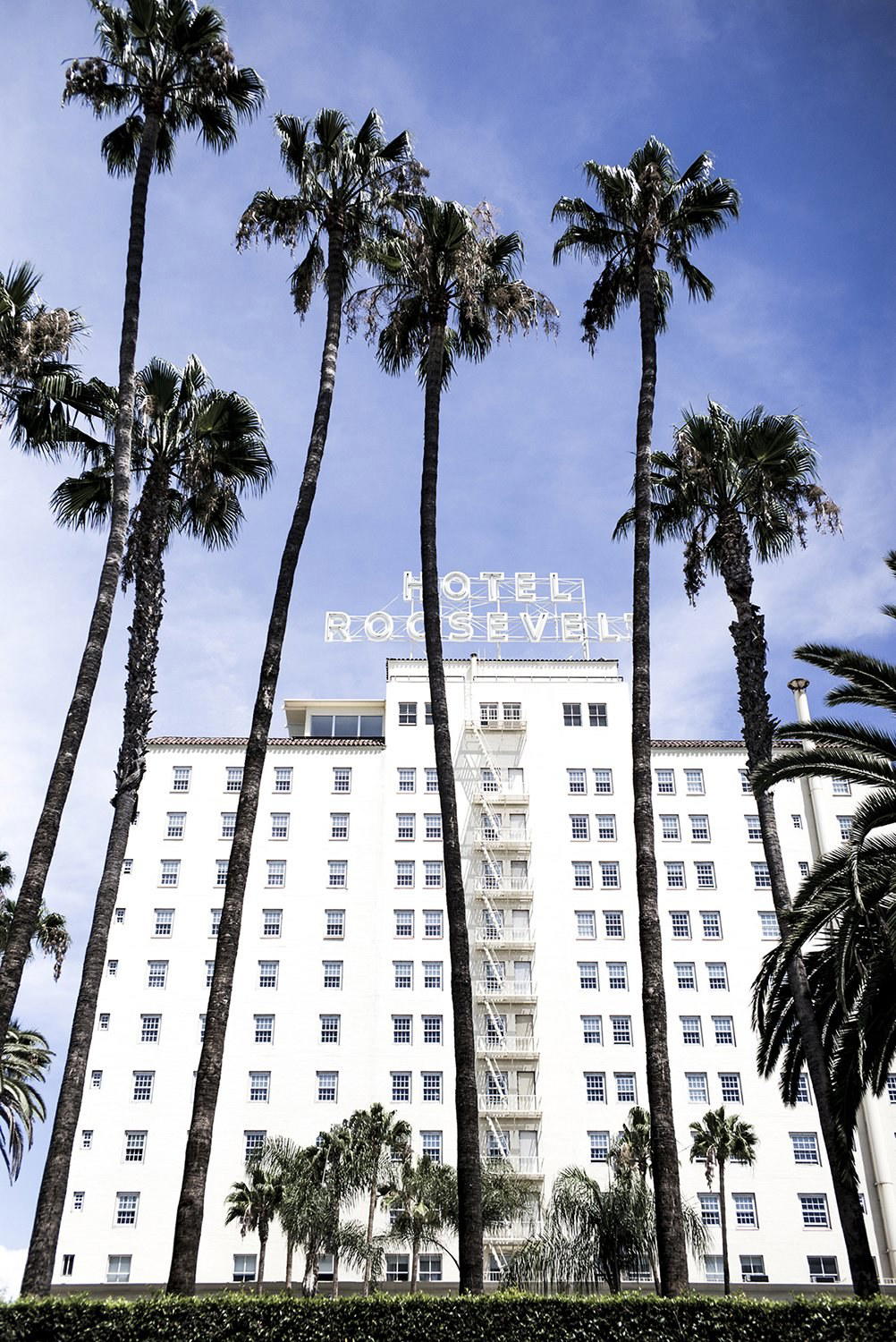
Hollywood Boulevard's Long Game
Walk the stretch of Hollywood Boulevard between Highland and La Brea on any given evening and the sensory register is impossible to ignore: tour buses idling, the Walk of Fame drawing selfie crowds, the Dolby Theatre marquee catching the last of the California light. The Hollywood Roosevelt sits inside all of this, not at a remove from it. That positioning is a deliberate choice, and it separates the property from the cluster of premium Los Angeles hotels that have built their identities around insulation from the city's noise. Hotel Bel-Air sells canyon silence. The Beverly Hills Hotel sells the leafy, guarded calm of 90210. The Roosevelt sells proximity to where Hollywood's mythology was actually made.
That mythology has a specific start date: 1927, when the hotel opened its doors, and 1929, when the first Academy Awards ceremony was held in its Blossom Room. Nearly a century of operation means the Roosevelt has cycled through more identities than most properties ever attempt, grand opening-era glamour, mid-century decline, 1980s renovation, a poolside art installation phase, and successive repositionings that have each tried to reconcile the weight of the building's history with whoever happens to be booking rooms that decade. Few urban hotels carry that kind of accumulated reinvention, and fewer still manage to keep the original fabric intact through it.
The Architecture of Reinvention
The evolution of Hollywood as a neighbourhood maps almost directly onto the evolution of the Roosevelt as a property. When the hotel opened, Hollywood Boulevard was a legitimate civic address, lined with studios, premiere venues, and the kind of foot traffic that the neighbourhood has spent the last thirty years trying to reconstruct. The hotel's Spanish Colonial Revival facade, with its courtyard, colonnaded lobby, and the proportions of a building designed to impress, made architectural sense in that context. It was built to be seen from the street, and the street was worth being seen from.
The mid-century decades were harder on both the hotel and the boulevard. Hollywood's production infrastructure migrated west and south; the Boulevard's prestige thinned. The Roosevelt went through a period of functional anonymity that was common to many grand urban hotels of that era, over-managed, under-invested, surviving on location inertia rather than intention. What followed in the 1980s and 1990s was a renovation cycle that tried to recover the glamour without fully committing to a contemporary identity. The result, for a stretch, was a hotel caught between eras.
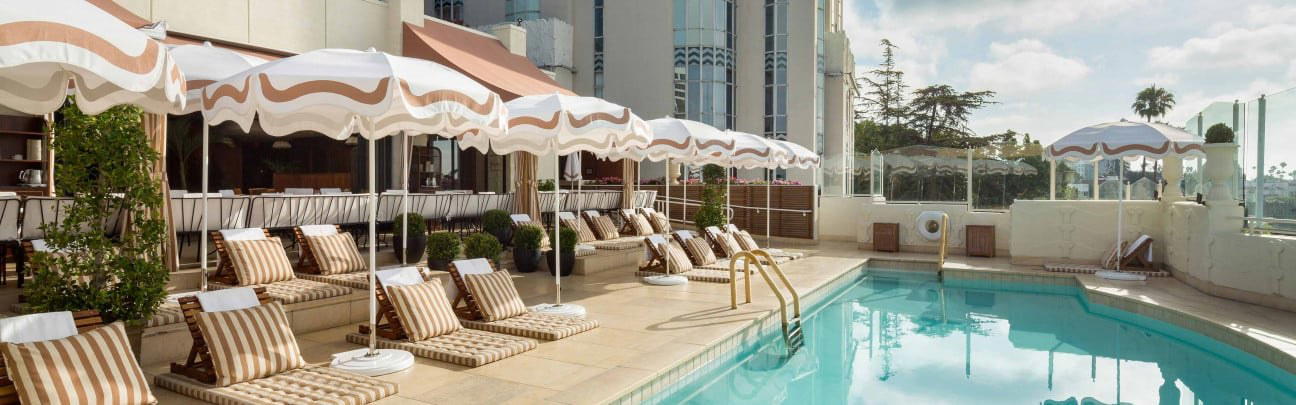
More consequential reinvention came in the early 2000s, when the property leaned into its poolside identity and became a fixture of a specific strand of Hollywood social life. David Hockney's painted pool mural became a reference point; the Tropicana Bar drew a crowd that was less interested in the hotel's historical weight and more interested in its current energy. That shift, from monument to operating social venue, changed the Roosevelt's competitive set. It was no longer asking to be compared only to Westside flagships like The Peninsula Beverly Hills or L'Ermitage Beverly Hills. It was staking a claim to a different kind of Los Angeles hotel experience: louder, more visible, more culturally embedded in a specific zip code.
300 Rooms, One Address
At 300 rooms, the Roosevelt operates at a scale that separates it from the boutique end of the Hollywood hotel market, where properties have gravitated toward smaller key counts and higher per-room price points. That scale has implications for the guest experience: a 300-room hotel on Hollywood Boulevard has a different lobby energy, a different pace of arrivals, a different relationship to the street than a 40-key design hotel. Chateau Marmont, a few miles west on Sunset, operates at much lower volume and trades explicitly on privacy and discretion. The Sun Rose West Hollywood sits in a newer, more curated tier. The Roosevelt's scale is part of its character, not a compromise of it.
For guests choosing between the Roosevelt and properties on the Westside, The Maybourne Beverly Hills, Downtown LA Proper Hotel, or further afield options like Post Ranch Inn in Big Sur, the decision comes down to what kind of Los Angeles access you want. The Roosevelt's Hollywood Boulevard address puts you within walking distance of the Dolby Theatre, the TCL Chinese Theatre, and the Metro Red Line station at Hollywood/Highland, which connects directly to Union Station and the broader transit network. That kind of walkable connectivity is rare in a city built around the car, and it makes the Roosevelt a genuinely practical base for visitors whose itineraries include more than poolside time.
The Current Direction
The most recent chapter of the Roosevelt's evolution has involved pulling the property back toward its historical weight while retaining the social energy that defined its 2000s identity. The Blossom Room, where the first Oscars were held, has been maintained as a functioning event space rather than converted into something unrecognisable. The pool remains a focal point. The lobby, with its double-height proportions and original architectural detailing, reads as a genuine historical interior rather than a period reproduction.
That balance, between operational venue and historical site, is harder to maintain than it looks. Properties that lean too hard into heritage risk becoming museums; those that chase contemporary relevance too aggressively risk erasing the very thing that made them worth staying in. The Roosevelt's current positioning acknowledges both pressures without fully surrendering to either. It sits in a category of American urban hotels that have had to negotiate their own mythology: properties like The Fifth Avenue Hotel in New York City or Raffles Boston, where the building's history is the product as much as the room itself.
For readers planning a Los Angeles stay with a heavier schedule of industry events, awards season activity, or simply a preference for being inside Hollywood's operational centre rather than viewing it from the Westside, the Roosevelt makes a specific kind of sense. It is not the quietest option, not the most secluded, and not the most intimate. What it offers is density of context: nearly a century of Hollywood history concentrated into a single address on the boulevard where that history happened. See our full Los Angeles restaurants and hotels guide for how the Roosevelt fits into the wider city picture.
Just the Basics
Comparable venues nearby, for context on price, style, and recognition.
| Venue | Price | Awards | Notes |
|---|---|---|---|
| The Hollywood RooseveltThis venue (the venue you are viewing) | $300–500 | Michelin Selected · Preferred Hotels Member | Not listed |
| Hotel June West L.A. | Not listed | Michelin Selected · Design Hotels Member | Westchester, Boutique hotel inspired by California's laid-back spirit with mid-century design. |
| Palihotel Hollywood | Not listed | Michelin Selected | Hollywood, Eclectic boutique hotel blending vintage 1950s motor lodge architecture with contemporary design and California sensibility. |
| The Hoxton, Downtown LA | $100–200 | Michelin Selected | Downtown LA, Adaptive reuse of 1922 Beaux Arts landmark with convivial urban escape vibe. |
| Hotel Erwin Venice Beach | $200–300 | Michelin Selected | Venice Beach, Polished beachfront boutique blending bold design with Venice Beach culture |
| Mt. Ada | $500–750 | Forbes 4-Star | Avalon, Historic Georgian Colonial mansion operated as an ultra-luxury bed and breakfast with period-appropriate furnishings and decor. |
Recognition history
Dated appearances from independent guides and award organizations, with the underlying list record or original source where available.
Michelin Selected
Michelin
Preferred Hotels Member
Preferred Hotels
Continue exploring
More in Los Angeles
Hotels in Los Angeles
All hotels in Los Angeles →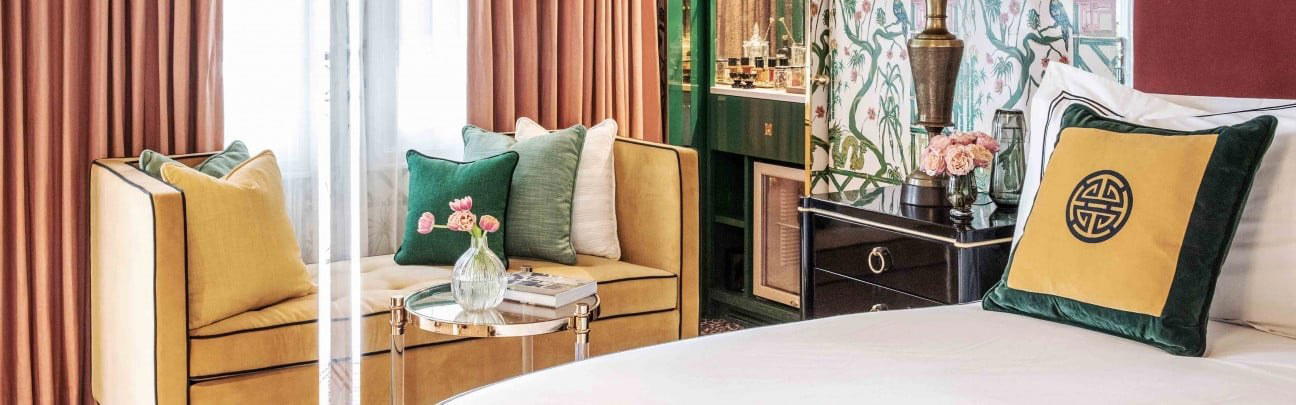
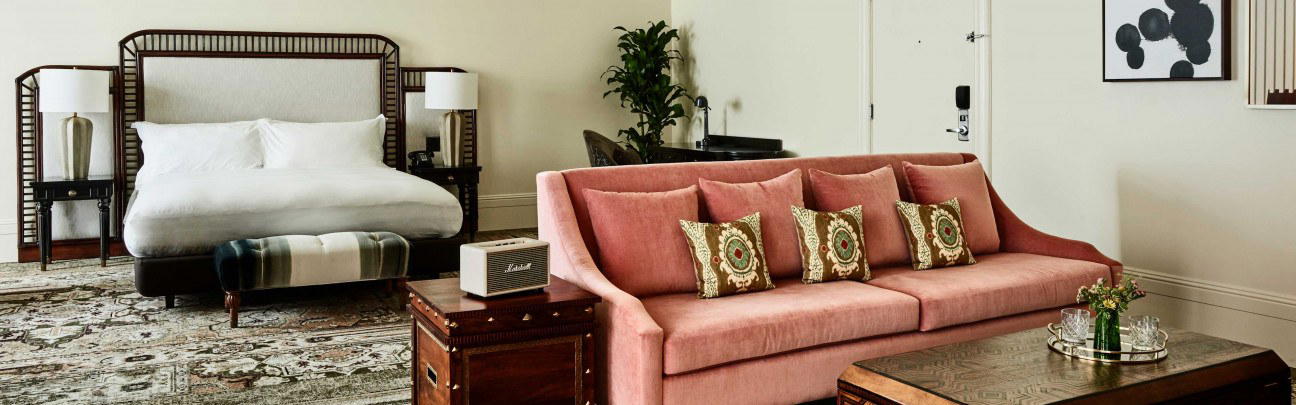
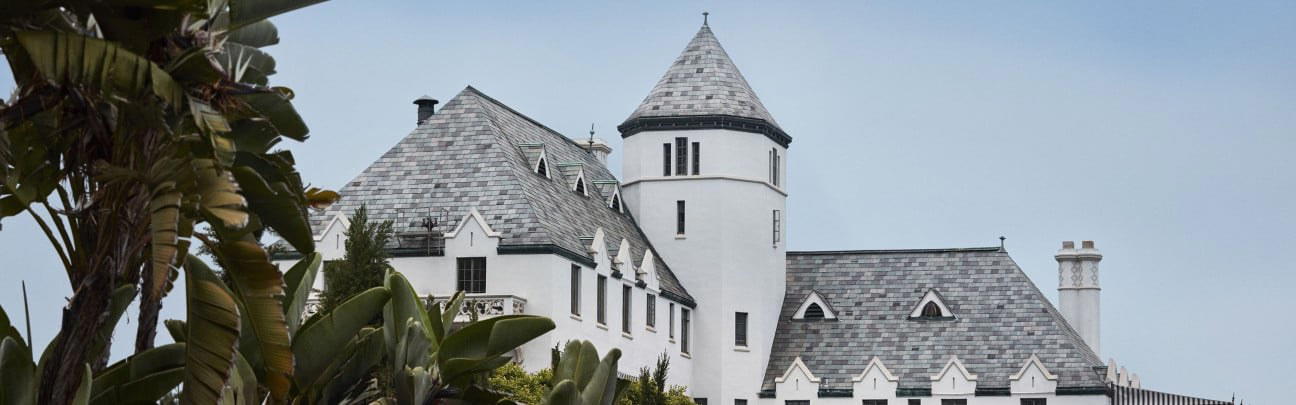
Bars in Los Angeles
All bars in Los Angeles →
Restaurants in Los Angeles
All restaurants in Los Angeles →
Wineries in Los Angeles
All wineries in Los Angeles →
Details
- Well Known
- Elegant
- Sophisticated
- Classic
- Lively
- Romantic Getaway
- Weekend Escape
- Celebration
- Rooftop Pool
- Historic Building
- Terrace
- Pool
- Spa
- Fitness Center
- Room Service
- Concierge
- Wi Fi
- Valet Parking
- Business Center
- EV Charging
- Garden
- Wheelchair Accessible
- Elevator
- Accessible Parking
- Step Free Entrance
Glamorous nostalgic atmosphere with chandeliers, long drapes, and lively poolside energy from guest reviews.