Tembo Plains Camp

Set inside the Sapi Private Reserve on the Zambezi escarpment, Tembo Plains Camp operates at the quieter, more exclusive end of Zimbabwe's safari circuit. Large canvas suites, a private swimming pool, and direct access to Mana Pools-adjacent wilderness place it firmly in the specialist, low-volume tier. A Google rating of 4.9 from verified guests signals consistent delivery on a high-promise format.
 Discover on Pearl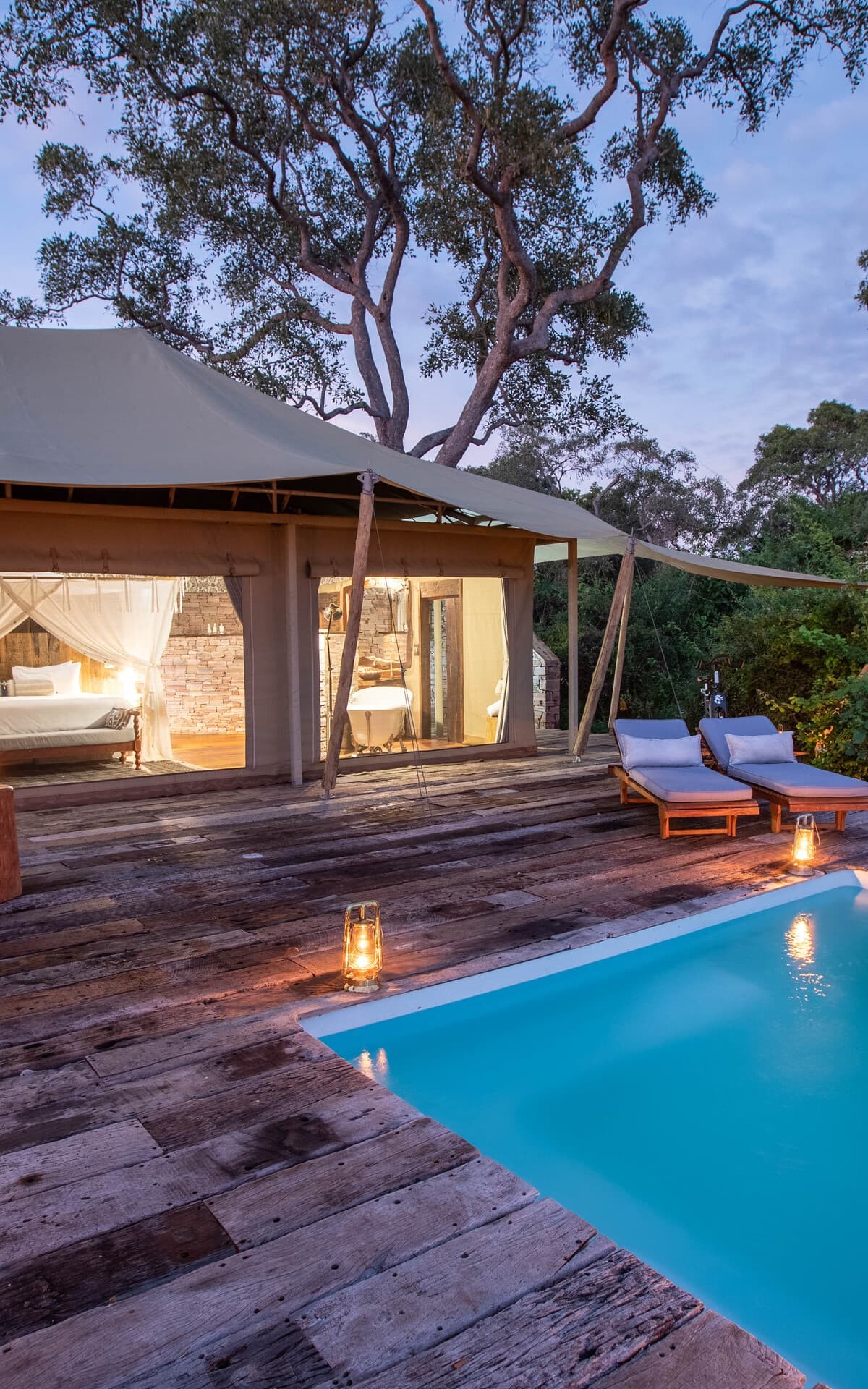
Canvas, Space, and the Sapi Reserve
The design logic of remote African safari camps has split into two distinct schools over the past decade. One favours permanent lodge architecture, stone and hardwood structures that read as boutique hotels transplanted into wilderness. The other stays committed to the canvas tradition, treating impermanence as an aesthetic choice rather than a constraint. Tembo Plains Camp sits firmly in the second school, and the distinction matters. Canvas walls and open structural frames mean the boundary between interior and exterior is deliberately porous. At dawn, the sounds of the Zambezi floodplain move through the suite before you open a door. The design is not rustic by default; it is a considered argument that in a reserve like Sapi, the architecture should yield to the environment rather than compete with it.
Sapi Private Reserve itself anchors the camp's position in the market. Bordering Mana Pools National Park, a UNESCO World Heritage Site, Sapi operates under a wildlife concession model that limits visitor numbers and concentrates access rights. That scarcity is structural, not incidental. Camps operating in these concession zones belong to a different competitive tier than mainstream national-park lodges with multiple operators sharing the same roads. The nearest comparable access points in Zimbabwe, such as Singita Pamushana Lodge & Malilangwe House in Chiredzi or Somalisa Camp in Hwange, operate on similar private-concession principles, and the comparison is instructive: exclusivity here is a function of land tenure, not just price.
The Large Canvas Suite Format
Private-concession camps in southern Africa have increasingly standardised around the large canvas suite as their signature accommodation unit, and Tembo Plains follows that logic with its own interpretation. The format typically means a sleeping area, a bathroom with outdoor or semi-outdoor features, and a private deck or veranda oriented toward a specific view corridor. At Sapi, those view corridors face the Zambezi floodplain, where elephant movement is frequent enough to be a design consideration rather than a lucky encounter.
The private swimming pool at each suite is less an amenity than a practical architectural response to the Zambezi Valley's heat. In a region where midday temperatures during the dry season regularly exceed 40°C, a private pool changes the rhythm of the day. Guests can extend their time outdoors through the midday hours rather than retreating entirely indoors, which matters in a place where animal activity does not always respect the conventional pre-dawn and late-afternoon safari schedule. The pool also functions as a viewing platform: positioned on the deck, it creates a reason to remain still and watch, which is often when the most significant wildlife sightings occur.
Conservation Architecture and the Sapi Model
Zimbabwe's wildlife conservation program at Sapi operates through a partnership structure between private operators and the Zimbabwe Parks and Wildlife Management Authority. The underlying principle is that high-value, low-volume tourism generates more conservation revenue per hectare than high-volume alternatives, which shapes every physical decision about the camp. The number of suites is kept low, vehicle access is restricted to the concession, and infrastructure is designed for minimal footprint. This is a departure from the model at larger national park operations, where multiple camps share the same wildlife corridors and vehicle pressure on sensitive areas is a persistent management challenge.
The conservation program at Tembo Plains is listed among the property's defining highlights. That framing is significant: in the premium safari sector, conservation credentials have moved from marketing footnote to primary differentiator. Camps that can demonstrate measurable conservation outcomes, documented wildlife population data, or anti-poaching program results now occupy a different credibility tier from those that use conservation language without the operational substance behind it. The Sapi concession's adjacency to Mana Pools, one of Africa's most closely monitored wildlife ecosystems, provides the monitoring infrastructure and ecological continuity that makes those claims verifiable.
Zambezi River Access and the Safari Format
Mana Pools' reputation in the safari world rests partly on its walking safari tradition, which is more developed here than in almost any other African wilderness. Guides in Mana and its adjacent concessions are trained to operate without vehicles, reading terrain and animal behaviour at ground level in a way that most East African safari formats do not permit. The Zambezi River component adds a second activity layer. River safaris by canoe or motorboat shift the viewing angle entirely: elephant and buffalo crossings, hippo pods, and the dense birdlife along the riverine forest are experienced from water level, where there is no vehicle frame, no refined platform, and no glass between the guest and the scene.
Access to Tembo Plains requires a flight into the region from Harare International Airport, approximately 281 kilometres from the camp. The standard routing uses a charter connection from Harare to a bush airstrip in or near the Sapi concession, a pattern common across premium Zimbabwe safari properties. Matetsi Victoria Falls follows a similar fly-in model at the other end of the Zambezi corridor, and the comparison points to a broader truth about premium Zimbabwe lodges: the remoteness that defines the experience also defines the access. Planning a stay at Tembo Plains means planning the full routing from an international hub, typically Johannesburg or Nairobi, through Harare and then by charter to Sapi.
Where Tembo Plains Sits in the Zimbabwe Safari Tier
Zimbabwe's high-end safari market is smaller and less crowded than Botswana's or Tanzania's, which means the camps that operate in its leading concessions face less domestic competition but more pressure to justify the routing complexity to international travellers. Tembo Plains holds a 4.9 Google rating from verified guests, a signal worth noting in a category where reviews are infrequent and tend to be written by experienced safari travellers with reference points across multiple African destinations. That rating does not need embellishment; it reflects consistent delivery in a format where the margin for operational error is narrow and the guests arrive with high expectations.
For readers building a Zimbabwe itinerary, our full Mana Pools Region hotels guide covers the broader accommodation landscape in the region. Those researching dining and activity options can also consult our Mana Pools Region restaurants guide, bars guide, wineries guide, and experiences guide. Elsewhere in the EP Club network, properties operating in comparable private-concession wilderness formats include Amangiri in Canyon Point, where the design-led approach to remote landscape is the primary architectural argument, and Castello di Reschio in Lisciano Niccone, which similarly treats material restraint as a design position rather than a budget compromise. For those whose travel circuits extend beyond Africa, properties such as Hotel Esencia in Tulum, Casa Maria Luigia in Modena, and Aman Venice represent different regional expressions of the same low-volume, design-attentive philosophy that Tembo Plains applies to the Zambezi Valley. Further reference points in the EP Club collection include Cheval Blanc Paris, Hotel Plaza Athénée in Paris, Bvlgari Hotel Tokyo, Hotel Bel-Air in Los Angeles, Badrutt's Palace Hotel in St. Moritz, Hôtel de Paris Monte-Carlo, Hotel Du Cap-Eden-Roc in Cap d'Antibes, Cipriani, A Belmond Hotel, Venice, Aman New York, The Fifth Avenue Hotel in New York City, Hotel Sacher Wien in Vienna, and HOTEL THE MITSUI KYOTO in Kyoto.
Frequently Asked Questions
Comparison Snapshot
These are the closest comparables we have in our database for quick context.
| Venue | Cuisine | Price | Awards | Notes |
|---|---|---|---|---|
| Tembo Plains Camp | HIGHLIGHTS: • LARGE CANVAS SUITES • WILDLIFE CONSERVATION PROGRAM • ZAMBEZI RIVE… | This venue | ||
| Matetsi Victoria Falls | ||||
| Singita Pamushana Lodge & Malilangwe House | ||||
| Somalisa Camp |
Preferential Rates?
Our members enjoy concierge-led booking support and priority upgrades at the world's finest hotels.
Get Exclusive Access