
Conde Nast Gold List
Somalisa Camp sits on a private concession inside Hwange National Park, Zimbabwe's largest wildlife reserve, and has built its reputation on a single, repeatable phenomenon: elephants drinking from the camp's waterhole within metres of seated guests. The format is intimate by design, placing guests inside the natural rhythm of the park rather than at a remove from it.

Pearl is the En Primeur Club membership app, where members save venues, book tables and use the concierge.
Where the Waterhole Is the Architecture
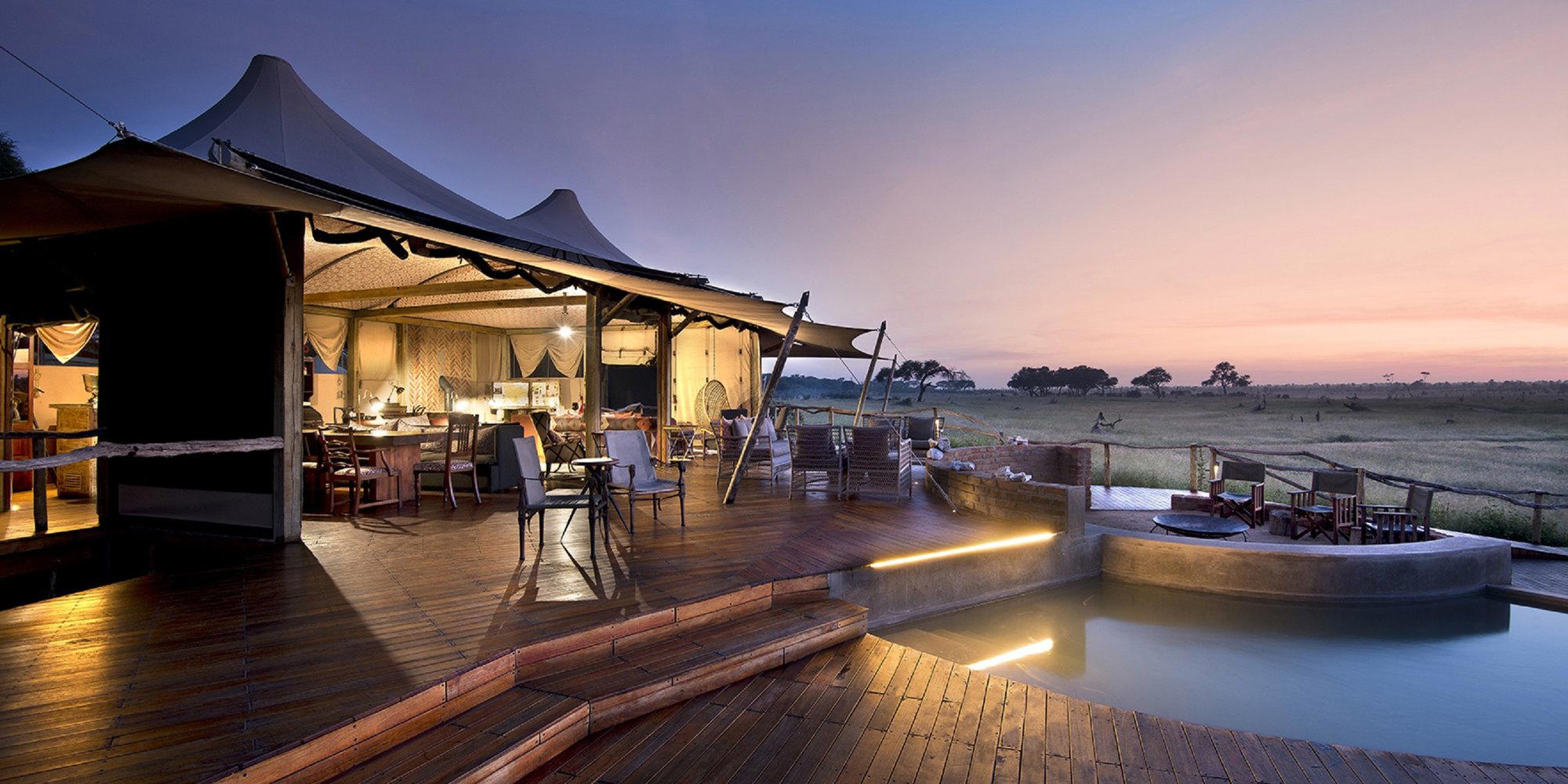
In safari design, the relationship between built structure and surrounding wilderness falls on a spectrum. At one end sit the large lodge complexes that treat the bush as backdrop, framing it through picture windows and infinity pools. At the other end sit camps that have essentially dissolved that boundary, where the primary design decision is proximity: how close can guests be placed to the ecosystem without disrupting it. Somalisa Camp, on a private concession inside Hwange National Park, operates firmly at that second end of the spectrum. The camp's defining spatial feature is a natural waterhole positioned directly in front of the main guest area, and the camp's layout has been arranged so that this waterhole functions as the central room. Everything else, the dining area, the viewing platforms, the communal space, is oriented toward it.
This is a meaningful design choice in a region where Zimbabwe's largest national park draws herds of elephant that number among the highest concentrations on the continent. Hwange's ecosystem is built on its pans and waterholes; the park's wildlife rhythms are organized around them. Somalisa's architects understood that the most honest response to this environment was not to impose a structure that competes with it, but to build one that defers to it. The waterhole is not a feature; it is the venue.
The Elephant Pool: Understanding What Makes It Different
Safari camps in southern Africa often position themselves near water sources, but the specific dynamic at Somalisa has earned the camp a distinct reputation. Elephants regularly drink from the pool directly in front of guests, at distances that remove any mediation between observer and animal. There is no vehicle, no glass, no buffer of managed distance. The experience is sedentary, which is an important distinction: rather than tracking animals across terrain, guests wait, and the animals arrive on their own schedule.
This format places Somalisa in a different category from the mobile safari model, where activity is organized around game drives into the park. Both approaches are legitimate and draw different travellers. The waterhole-centred, fixed-point model rewards patience and close observation; a single afternoon at the waterhole can deliver more sustained elephant contact than hours of driving across open terrain. Compared to properties like Wilderness Little Makalolo, which sits further into Hwange and emphasises guided drive and walk programmes, Somalisa's design anchors the experience to a single, predictable natural event that recurs daily.
For context on how this approach compares across Zimbabwe's wider safari circuit, properties such as Wilderness Ruckomechi in Mana Pools and Tembo Plains Camp in the same region offer their own versions of close wilderness immersion, but the Hwange elephant density gives Somalisa a specific ecological argument that those properties, exceptional in their own right, cannot replicate.
The Physical Language of an Authentic Bush Camp
The word "authentic" is applied so broadly across African safari marketing that it has nearly been emptied of meaning. In Somalisa's case, it refers to something specific: the camp uses a low-footprint, tented structure format rather than the permanent, resort-grade construction that has become increasingly common at the upper end of the African safari market. Tented camps have a longer history on the continent than fixed lodges; the format emerged from early expedition travel and carries a material honesty that stone-and-glass architecture cannot reproduce.
This is not a compromise position. The tented structure keeps the sensory threshold between interior and exterior porous. Guests hear the bush at night. Temperature and humidity are not entirely eliminated by climate control. The sounds that signal an elephant's approach, the low rumble, the cracking of vegetation, arrive before the animal comes into view. That permeability is a deliberate spatial condition, not an oversight. In this sense, Somalisa's design philosophy is closer to the principles at work in properties like Amangiri in Utah, where architecture is organized around a specific landscape rather than imposed upon it, than to the model of urban luxury hotels transplanted into a natural setting.
The contrast with that second model is worth noting. Zimbabwe's neighbouring safari markets have seen significant investment in large, architecturally ambitious lodges that deliver full resort amenities in remote locations. Singita Pamushana in Chiredzi, for instance, operates at a substantially different scale and price point, offering villa-style accommodation across a private reserve. Somalisa's intimacy and its deliberate restraint in built form occupy a different position in the market, one where the camp itself recedes and the waterhole advances.
Sustainability as Structural Logic
The camp's sustainability credentials are not ornamental. In Hwange, where the pressure on water resources during dry season is significant and elephant populations move in patterns directly shaped by water availability, a camp that positions itself at a waterhole carries a specific responsibility. Operating on a private concession within the national park means Somalisa's footprint is bounded by the concession terms, which typically require low-impact construction and limits on guest numbers. The intimacy of the camp, which is small by design, is both an aesthetic choice and a conservation commitment. Smaller guest numbers mean lower environmental loading on a sensitive ecosystem.
This links Somalisa to a broader movement in southern African conservation-led tourism, where the currency is not amenity count but ecological integrity. Properties that operate within this framework often carry credibility signals in conservation circles that are distinct from the hotel award systems applied to urban luxury. Anantara Stanley and Livingstone in Victoria Falls approaches conservation through a white rhino sanctuary adjacent to the property; Somalisa's method is different, embedding itself inside Hwange's functioning elephant ecosystem rather than managing a separate conservation programme alongside a hotel operation.
Planning Your Stay
Hwange National Park's peak wildlife concentration runs through the dry season, broadly from May through October, when animals cluster around water sources including the very pans and waterholes that define the camp's design logic. During the wet season, from November through April, vegetation thickens and wildlife disperses across the park, which changes the character of the waterhole experience substantially. Travellers whose primary interest is the elephant pool dynamic should plan accordingly. Reaching Somalisa typically involves a charter flight from Victoria Falls or Bulawayo to one of Hwange's private airstrips, followed by a road transfer, a routing that places it firmly within the network of camps and lodges that operate across Zimbabwe's western safari circuit. For those building a multi-camp itinerary through Zimbabwe, Somalisa pairs logically with a Mana Pools stop, such as Wilderness Ruckomechi or Tembo Plains Camp, covering two of the country's most significant wilderness areas within a single trip.
In Context: Similar Options
| Venue | Awards |
|---|---|
| Somalisa CampThis venue (the venue you are viewing) | Conde Nast Gold List |
| Tembo Plains Camp | Relais Chateaux Award |
| Anantara Stanley & Livingstone Victoria Falls Hotel - Virtuoso Preview | Virtuoso Luxury Hotel Partner |
| Matetsi Victoria Falls | La Liste Top Hotels · Virtuoso Luxury Hotel Partner |
| Victoria Falls River Lodge | Virtuoso Luxury Hotel Partner |
| Singita Pamushana Lodge & Malilangwe House | La Liste Top Hotels · Virtuoso Luxury Hotel Partner |
Recognition history
Dated appearances from independent guides and award organizations, with the underlying list record or original source where available.
Conde Nast Gold List
Conde Nast
Details
- Scenic
- Intimate
- Elegant
- Rustic
- Sophisticated
- Romantic Getaway
- Anniversary
- Weekend Escape
- Panoramic View
- Design Destination
- Terrace
- Pool
- Concierge
- Bar
- Garden
Elegant and authentic bush-camp atmosphere with natural wood, copper accents, Kudhinda fabrics, and an intimate firelit lounge-and-deck setting overlooking wildlife waterholes.