

Six Senses Shaharut sits at the southern edge of the Negev Desert, where the landscape drops toward the Arava valley and the horizon stretches uninterrupted into Jordan. Recognised by La Liste's Top Hotels with 90 points in 2026, it represents the more considered end of Israeli resort hospitality — remote by design, with architecture that reads from the terrain rather than against it. Book well ahead; proximity to nothing is the point.
 Discover on Pearl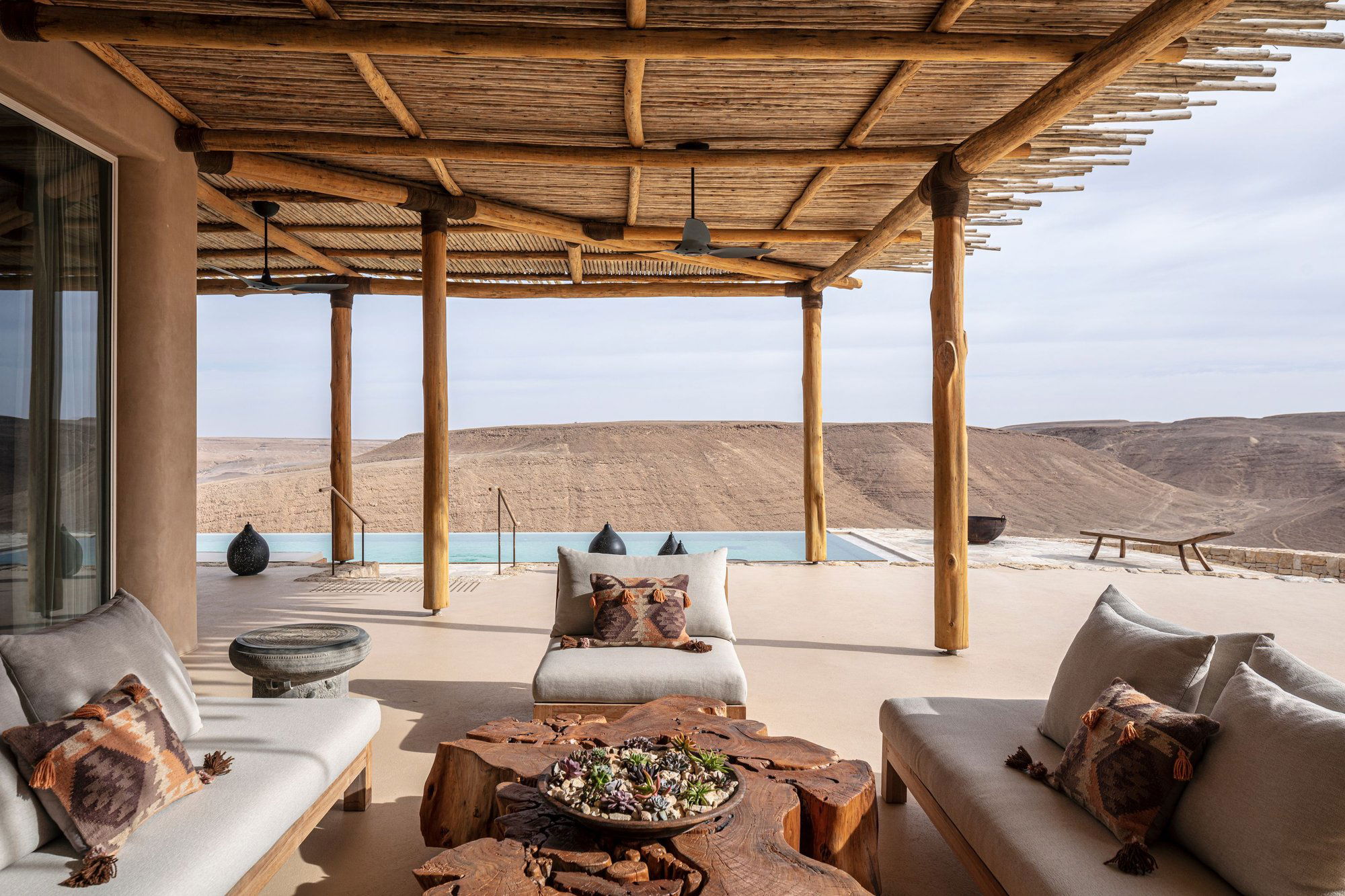
Stone, Desert, and the Logic of Extreme Remoteness
There is a particular category of luxury property that only makes sense when the site itself is the premise. Amangiri in Canyon Point operates on this logic in the American Southwest. So does Six Senses Shaharut in Israel's Negev Desert, positioned on a ridge above the Hevel-Eilot region where the southern desert breaks toward the Arava rift valley. The views extend into Jordan. The silence is architectural in its own right. This is not a property that competes on city access or cultural programming — it competes on the quality of its remove, and on how deliberately the built environment inhabits that remove.
La Liste's 2026 Leading Hotels ranking awarded Six Senses Shaharut 90 points, placing it within a peer set that includes some of the most scrutinised properties in the world. That recognition matters here not as a badge but as a signal: the property is being evaluated against global desert-resort benchmarks, not just against Israeli hospitality. For context, Israel's more urban luxury tier — properties like Dan Tel Aviv and The American Colony Hotel in Jerusalem , operates in a completely different competitive register, one shaped by city access and historical layering. Shaharut answers a different question entirely.
Architecture as Geological Response
The design conversation around desert luxury properties has shifted considerably over the past two decades. Early-generation resort architecture in arid environments often imposed imported aesthetic vocabularies , modernist planes, imported stone, international-hotel uniformity , onto landscapes that demanded something more responsive. The more compelling properties built since have worked in the opposite direction, reading the terrain before they draw a line.
Six Senses Shaharut belongs to that second tendency. The Negev's geology is characterised by eroded sandstone ridges, dry wadis, and a colour palette that moves from pale ochre at midday to deep amber at dusk. The property's architecture responds to this through material choices and massing that sit low against the ridge rather than announcing themselves against the skyline. This approach is not unique to Shaharut , Castello di Reschio in Lisciano Niccone operates on a similar philosophy of architectural restraint governed by landscape , but in a desert context, where light changes the surface reading of every material across a single day, the calibration required is more demanding.
The Six Senses brand has made this kind of site-responsive design a consistent priority across its portfolio. Where properties like Cheval Blanc Paris or Hotel Plaza Athénée work within established urban architectural languages, Six Senses Shaharut is operating in a category where the absence of prior context is the design brief. The structure has to justify its presence in the landscape, not merely fit within a streetscape.
Positioning Within Israeli Desert Tourism
The Negev has been developing as a serious travel destination for longer than international coverage might suggest. The region around Mitzpe Ramon, approximately an hour north of Shaharut, established an early foothold for desert tourism built around the Ramon Crater, one of the world's largest erosion cirques. Shaharut sits further south, in a less-visited section of the desert, which amplifies the sense of remove that the property appears designed to deliver.
Israeli luxury hospitality has traditionally concentrated in Tel Aviv and Jerusalem, where visitor infrastructure is dense and the cultural draw is immediate. The desert properties that have succeeded , and Shaharut's La Liste score suggests this one has , do so by making the case that the landscape itself is the programme. This is a harder argument to make commercially, which is why the category remains small. For travellers who have done urban Israel thoroughly, the full Shaharut hotels guide maps the available options at this end of the desert in more detail.
The Six Senses Wellness Framework
Six Senses as a brand is built around a wellness and sustainability philosophy that it has applied consistently across its global portfolio, from the Maldives to Bhutan to the Swiss Alps. In a desert context, that framework takes on a specific character: the landscape enforces a particular kind of slowing down that urban wellness programming can only simulate. The Negev's extreme temperature range , cold winter nights, intense summer heat, and dramatic shoulder-season light , creates conditions where the body's relationship to time and environment becomes unusually legible. Properties in this category, when well-executed, turn that physical calibration into the core of the guest experience rather than an amenity to be managed around. For experiences in and around Shaharut, the surrounding desert terrain provides the programme: hiking the Incense Route, stargazing in one of the lowest light-pollution zones in the country, and guided wadi walks that require no infrastructure beyond the land itself.
Dining and drinking at a property this remote operates on different logic than at an urban hotel. The Shaharut restaurants guide and Shaharut bars guide reflect a scene where the property itself is the primary option, rather than one node in a broader neighbourhood offer. That consolidation can be a strength , it tends to push on-property food and beverage to take the terrain seriously , or a weakness, depending on execution. Six Senses properties globally have shown a consistent interest in sourcing and in building F&B programmes that reflect the local environment, which at Shaharut would logically engage with Negev wine production, a sector that has grown considerably in seriousness over the past decade. The Shaharut wineries guide covers that thread further.
Planning and Peer Set
For travellers calibrating where Six Senses Shaharut sits relative to comparable international properties, the relevant peer group is not other Israeli hotels but other remote, design-led desert or terrain-anchored properties. Amangiri is the obvious reference point in terms of positioning and philosophy. Hotel Esencia in Tulum operates a similarly remote, landscape-first model in a different biome. At the European end of the Six Senses competitive frame, La Réserve Paris and Aman Venice occupy the brand's urban tier, which is a different product entirely. The Negev property belongs to the group that treats remoteness as a premium attribute rather than a constraint to be overcome.
Logistics are direct in outline: the nearest major airport is Eilat's Ramon Airport (ETM), which operates domestic routes from Tel Aviv and some international connections; Ben Gurion Airport in Tel Aviv is the main international gateway, with the drive south to Shaharut running approximately three hours through the Arava highway. The booking window for Six Senses properties at this level typically runs two to four months ahead for standard stays, and further out for peak periods around major Jewish holidays and the cooler October-to-April season when desert conditions are most comfortable for outdoor activity. There are no direct booking details in the current record, so approaching through the Six Senses central reservations system is the reliable route.
For travellers building an Israeli itinerary that combines desert and city, the pairing with Tel Aviv's urban hotel tier , including Dan Tel Aviv at the coastal end , provides a clean contrast. Those approaching from Jerusalem can reference The American Colony Hotel as the city's most historically layered option before heading south. The full Shaharut hotels guide and Shaharut restaurants guide complete the picture at the desert end.
Frequently Asked Questions
- What's the vibe at Six Senses Shaharut?
- The property operates at the quieter, more self-contained end of the resort spectrum. Its position on a Negev ridge, recognised by La Liste's 2026 Leading Hotels at 90 points, signals a calibration toward landscape immersion rather than social programming. If you are coming from a city-hotel context, the adjustment is real: this is a property where the desert is the primary event. The absence of a nearby town or dining district is a feature of the design, not a gap in the offer.
- What's the leading suite at Six Senses Shaharut?
- Specific suite configurations and naming conventions are not confirmed in the current record. Six Senses properties generally offer a top-tier villa or suite category with private outdoor space and unobstructed views, and at a desert property at this La Liste scoring level, the premium accommodation is typically designed to maximise the horizon rather than add interior amenity. Confirm suite categories directly with Six Senses reservations for current availability and pricing.
- Why do people go to Six Senses Shaharut?
- The pull is the combination of extreme landscape and considered infrastructure. The Negev's southern reaches offer some of Israel's lowest light pollution, most dramatic wadis, and least-visited terrain. Six Senses Shaharut provides the logistics , the shelter, the wellness programming, the guided access , that make extended time in that environment comfortable without softening what makes it compelling. The La Liste 90-point recognition in 2026 confirms it is delivering at a level that holds against global desert-resort comparisons.
- How far ahead should I plan for Six Senses Shaharut?
- The cooler season running from October through April is when the Negev is most accessible for outdoor activity, and demand concentrates in those months. Plan a minimum of two to three months ahead for that window; for major Jewish holidays or long weekends, earlier is more reliable. Six Senses operates a central reservations system , direct contact through their global platform is the most efficient route given no local phone or website details are currently listed in the public record.
- Does Six Senses Shaharut connect to the Negev's Incense Route heritage?
- The ancient Incense Route, a UNESCO World Heritage Site, passes through the Negev highlands and encompasses several Nabataean cities including Avdat, Mamshit, and Shivta. Shaharut's position in the Hevel-Eilot region places it within the broader Negev heritage corridor, and Six Senses properties globally have shown consistent interest in connecting guests with local cultural and historical context. Whether specific guided Incense Route programming is offered should be confirmed with the property directly, but the geographical proximity makes it a logical element of any Shaharut itinerary , the Shaharut experiences guide covers regional options in more detail.
In Context: Similar Options
These are the closest comparables we have in our database for quick context.
| Venue | Cuisine | Price | Awards | Notes |
|---|---|---|---|---|
| Six Senses Shaharut | La Liste Top Hotels: 90pts | This venue | ||
| The Drisco Tel Aviv | ||||
| Dan Tel Aviv | ||||
| The American Colony Hotel | ||||
| The Jaffa Hotel, Tel Aviv | ||||
| The King David |
Preferential Rates?
Our members enjoy concierge-led booking support and priority upgrades at the world's finest hotels.
Get Exclusive Access