



Named Türkiye's Leading Luxury Resort at the 2025 World Travel Awards, Six Senses Kaplankaya sits on the Aegean coast across the bay from Bodrum, accessible only by speedboat, helicopter, or road. Its 141 accommodations span hillside rooms and ridge-top villas, set within low-slung architecture that draws on authentically Turkish visual references. A 38-treatment-room spa anchors the wellness program, supported by multiple restaurants covering everything from grilled meats to raw and vegan menus.
 Discover on Pearl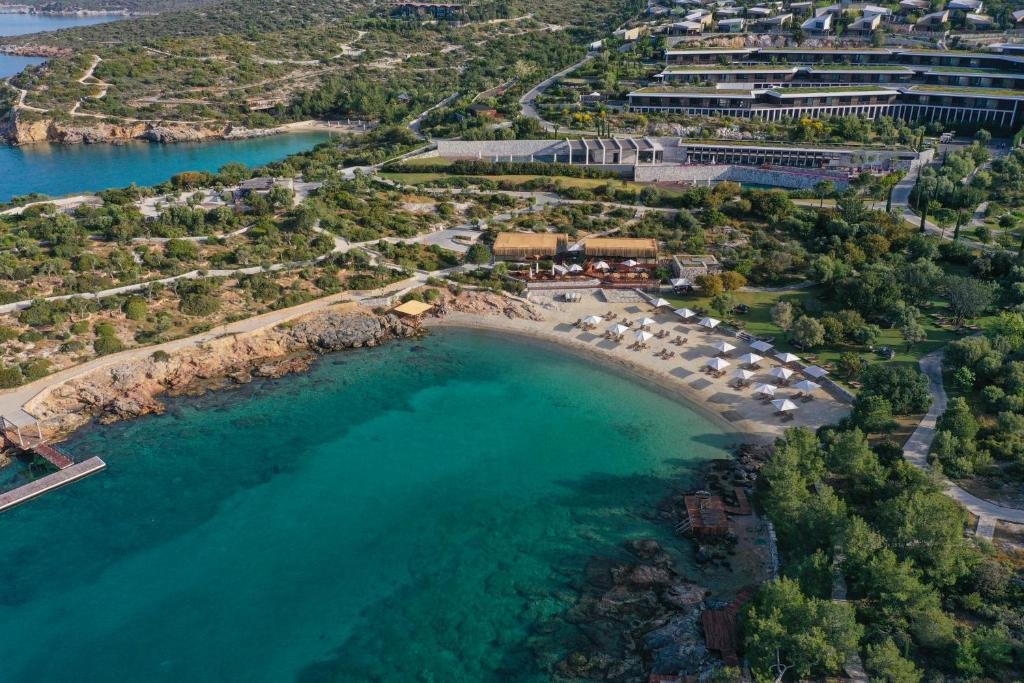
Arriving at the Edge of the Aegean
The approach sets the register before you check in. Guests reaching Six Senses Kaplankaya by speedboat cross the bay from Bodrum and arrive at a hillside that appears to have grown out of the rock rather than been placed on leading of it. The architecture is low-slung and horizontal, following the contours of the terrain rather than asserting itself above them. This is a deliberate posture: where many large-scale luxury resorts announce themselves through height or grandeur, Kaplankaya reads as restrained from a distance, even as the interior scale reveals itself only once you are inside. The road approach, or arrival by helicopter, gives a different perspective on the same quality: a campus of buildings that sit in the Aegean hillside rather than dominate it.
This stretch of the Muğla coastline, an hour and a half past the Bodrum Peninsula, was largely uncharted territory for international luxury travel before this property arrived. Tourism has long been familiar with Bodrum itself, where properties like MACAKIZI BODRUM have established their own identities within the peninsula's social circuit. Kaplankaya operates on a different logic: its seclusion is the product, not an inconvenience to be managed.
The shortlist, unlocked.
Hard-to-book tables, cellar releases, and concierge-planned trips.
Get Exclusive Access →Architecture as Editorial Statement
Inside the buildings, the design moves between contemporary structure and deeply Turkish visual language. Warm organic colours, textured surfaces, and authentically local reference points define the interiors without tipping into folkloric decoration. This is a harder balance to achieve than it looks. Many internationally operated luxury resorts in Turkey opt for a generically Mediterranean aesthetic that could be transplanted to Croatia or the Greek islands without much loss of coherence. Six Senses Kaplankaya is more specific in its references, which gives the interiors a sense of place that reads as considered rather than applied.
The 141 accommodations divide into two typologies that serve distinct priorities. The hillside rooms and suites, approximately 75 keys in total, are integrated into the main resort campus with access to communal spaces. The 66 Ridge Terrace Rooms sit above the main buildings, positioned for unobstructed Aegean views. Across both categories, the layout logic is consistent: clean, uncluttered floorplans anchored by warm materials and textures. The architecture does not compete with the sea view; it frames it. This approach places Kaplankaya in a specific tier of Turkish coastal luxury, alongside design-driven properties in the Aegean region that prioritise spatial quality over amenity accumulation. For a comparison point in a different coastal geography, Hillside Beach Club in Fethiye represents a different interpretation of premium Aegean hospitality, while D Maris Bay in Hisarönü occupies a comparable bracket on the peninsula side of the coast.
The Spa as Infrastructure, Not Amenity
Wellness at Six Senses is not a secondary offering bolted onto a beach resort. Across the brand's portfolio, the spa program functions as a primary reason to visit, and Kaplankaya's facility scale reflects that positioning. The 38 treatment rooms represent a number significant enough to serve a full resort of 141 keys without the bottlenecks that affect smaller spa operations. The supporting infrastructure includes hammams, a Finnish sauna, a crystal steam room, and what the property describes as experiential rains, a format that falls somewhere between hydrotherapy and sensory installation.
Turkish hammam culture has a specific weight in this region, and integrating it within a contemporary wellness framework is both a nod to local tradition and a functional programme decision. The hammam at Kaplankaya sits within a broader spa vocabulary rather than being positioned as a standalone cultural attraction, which allows it to function within treatment sequences rather than as a separate ticketed experience. For those comparing wellness-led properties across Turkey, BN Hotel Thermal and Wellness in Mersin represents a different, more thermal-spring-centred approach, while NG AFYON in Afyonkarahisar draws on the country's thermal geography in a landlocked context.
Dining Across Dietary Registers
Multiple restaurants cover a range that runs from grilled meats to raw and vegan menus. This is a structural decision typical of large-format Six Senses properties, where the dining program is expected to serve guests across extended stays and varied dietary commitments rather than anchoring around a single cuisine identity. The Aegean setting supplies a natural framework: the region's cooking tradition draws on olive oil, vegetables, and seafood in proportions that align naturally with health-conscious menus, while also supporting the grilled-meat end of the spectrum that remains central to Turkish table culture.
For guests comparing Turkish coastal dining contexts, the range of options at Kaplankaya is broader than the more focused dining programs found at some smaller properties in the region. The multi-restaurant format is a deliberate choice for a resort of this scale and stay duration.
Position in the Turkish Luxury Market
Six Senses Kaplankaya was named Türkiye's Leading Luxury Resort at the 2025 World Travel Awards, a designation that places it at the leading of a competitive field that includes Istanbul's landmark properties. The Istanbul luxury market operates differently: concentrated within the Bosphorus corridor, properties like the Çırağan Palace Kempinski and the Four Seasons at Sultanahmet compete on history and urban proximity. Kaplankaya's competition is drawn from a different set entirely, one defined by seclusion, natural setting, and wellness depth rather than city access or heritage architecture.
Across Turkey's broader luxury hotel spectrum, the range of contexts is wide. Cappadocia's cave-hotel tier, represented by properties like Argos in Cappadocia, Ajwa Cappadocia, and Hu of Cappadocia, operates on terrain-specific logic that has no parallel on the coast. Alaçatı's design-hotel circuit, including properties like Alavya and KestelINN Alaçatı, serves a different market, one centred on the town's restaurant and windsurfing culture. Kaplankaya sits apart from both: larger in scale, further from existing tourist infrastructure, and anchored by a wellness proposition that demands a minimum stay long enough to actually use the facility.
For Mediterranean-adjacent comparisons at the international level, the Six Senses positioning at Kaplankaya mirrors the logic that drives destination spa resorts in Southeast Asia and the Middle East, where arrival complexity is accepted as the price of genuine remoteness. Properties like Ahãma in Göcek occupy a smaller, more boutique tier of the same coastal region.
Planning Your Stay
Arrival logistics are genuinely part of the experience here. The speedboat transfer from Bodrum is the most direct option and takes approximately 25 minutes across the bay; helicopter transfer covers the distance faster and lands directly on the property. Road access is available via Milas, a journey of roughly an hour and a half from Bodrum. The address, Bozbük, Merkez Sokak No:198 in Milas/Muğla, places the resort firmly outside the Bodrum Peninsula's road network, which means the seclusion is structural rather than cosmetic. With 141 rooms and 66 ridge villas, the property is large enough that advance booking is advisable for peak Aegean summer months, particularly for the Ridge Terrace accommodations that attract the highest demand. For broader regional context, our full Akbük restaurants guide covers the surrounding area. Travellers building a wider Turkish itinerary might also consider how Kaplankaya fits alongside coastal alternatives such as Allium Bodrum Resort and Spa or the Antalya coast's offering at Kempinski Hotel The Dome Belek and Regnum Carya in Belek.
The shortlist, unlocked.
Hard-to-book tables, cellar releases, and concierge-planned trips.
Get Exclusive Access →Frequently Asked Questions
At-a-Glance Comparison
These are the closest comparables we have in our database for quick context.
Preferential Rates?
Our members enjoy concierge-led booking support and priority upgrades at the world's finest hotels.
Get Exclusive AccessThe shortlist, unlocked.
Hard-to-book tables, cellar releases, and concierge-planned trips.
Get Exclusive Access →