Shadow Creek Golf Course
Shadow Creek Golf Course in North Las Vegas occupies a different tier from the city's resort fairways, a private-access layout carved from the Mojave desert floor and long regarded among the more architecturally deliberate courses in the American Southwest. Access is restricted to guests of MGM Resorts properties, which shapes both the pace of play and the character of the experience.
Pearl is the En Primeur Club membership app — saves, bookings, and concierge access live there. Same editors, same standards.
- Address
- 3 Shadow Creek Dr, North Las Vegas, NV 89081
- Phone
- +1 702 399 7111
- Website
- shadowcreek.com
- Directions
- Get directions
 Saves & bookings on Pearl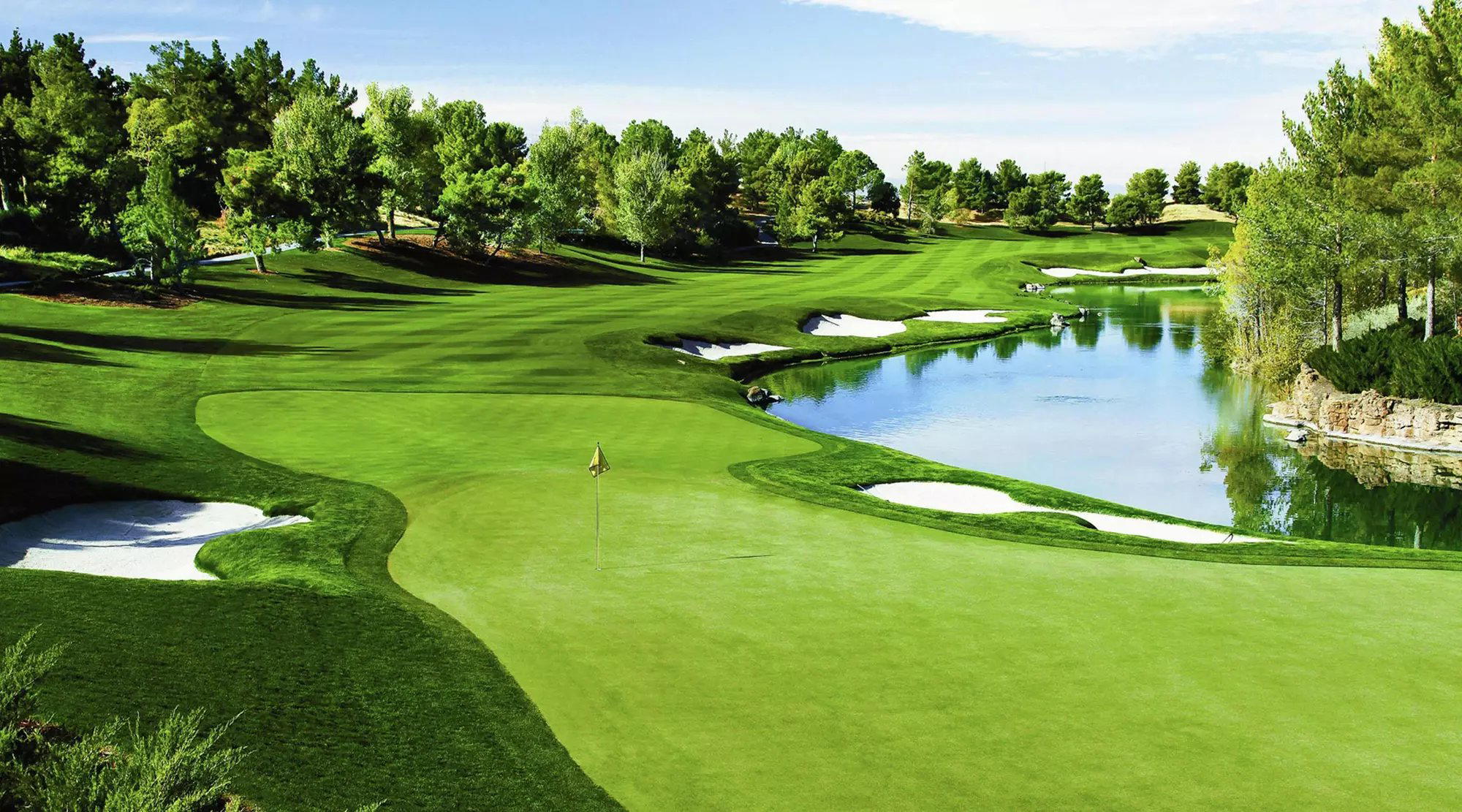
A Course Built Where No Course Should Exist
The dominant story in American golf design has long been about working with terrain: following ridgelines, routing holes through existing topography, letting the land set the architectural agenda. Shadow Creek in North Las Vegas is the deliberate inversion of that tradition. The Mojave desert floor on which it sits offered virtually nothing, flat scrubland without natural contour, water, or shade. What exists there now is entirely constructed: tens of thousands of mature trees transplanted at considerable expense, an artificial creek system that winds through the property, and a sequence of holes shaped from imported earth. The result is a course that reads, visually, like a displaced patch of the Carolina Piedmont or the Pacific Northwest, dropped without explanation into the Nevada desert. That incongruity is not an accident. It was the design intention from the outset, and it remains the defining architectural statement of the course.
The Architecture of Controlled Illusion
Golf architecture, at its most ambitious, is an exercise in controlled perception. Designers use mounding, tree lines, water placement, and green contouring to shape how a player reads a hole, anticipates distance, and makes decisions. Shadow Creek applies those tools at a scale that goes well beyond most private American clubs. The tree canopy, now fully matured, effectively walls off each hole from the next, creating a sense of enclosure that erases any reminder of the surrounding desert. Players moving between holes have no sightlines to the Las Vegas Strip or to the flatness beyond the course boundary. The environment is hermetically constructed, a total design environment in a way that few courses anywhere attempt.
Tom Fazio, who shaped the course, is among the figures most associated with high-specification private construction in American golf. Shadow Creek sits at the far end of that spectrum: a project where budget constraints were, by most accounts, deliberately set aside to produce something without practical precedent. Mature specimen trees were sourced and relocated. The creek system required significant hydrological engineering. The greens complexes are built to exacting tolerances. In the context of American golf design history, the course is frequently cited alongside Augusta National and Cypress Point as a study in what happens when construction resources are unconstrained, though Shadow Creek's artifice is more overt, and more unapologetic, than either of those precedents.
Access, Format, and What That Means in Practice
Shadow Creek is not a public course. It operates under a restricted-access model tied to MGM Resorts International, which means play is available only to guests of MGM-affiliated properties on the Las Vegas Strip and nearby. The access model shapes the entire pace-of-play dynamic: tee times are limited, the course does not experience the throughput of a resort track, and the round is structured more like a private club experience than a standard hotel amenity. For travellers planning a visit, that means the booking window matters and the hotel stay is a prerequisite, not a formality. Amangiri in Canyon Point or Amangani in Jackson Hole, where the physical environment is as deliberately curated as the amenity list.
The round includes a caddie, and transportation from Strip hotels is arranged through the resort concierge system. The fee structure places it at the upper end of resort golf in the United States.
North Las Vegas as Context
Shadow Creek sits in North Las Vegas, technically outside the Strip corridor, and that geography is worth noting. The address at 3 Shadow Creek Drive places it in a district that has little of the hospitality density of the central resort zone. The surrounding area is largely industrial and residential, which makes the transition through the course gates, from flat, undistinguished surroundings into the manufactured forest interior, more dramatic than it would be if the course were set among comparable resort infrastructure. That contrast is part of the experience, even if it is rarely acknowledged in the way the course is discussed. For travellers whose base is on the Strip, the transfer to the course is a short drive, but the environmental shift on arrival is substantial.
Where Shadow Creek Sits in the Wider Range of Resort Golf Design
The broader category of high-specification American resort golf has expanded considerably since Shadow Creek was developed. Properties like Blackberry Farm in Walland, Bernardus Lodge in Carmel Valley, and Auberge du Soleil in Napa represent a design-led approach to resort experiences where the physical environment is treated as a primary amenity. Shadow Creek belongs to a parallel conversation in golf specifically, a small group of resort-adjacent courses where the design ambition is the primary draw rather than the weather, the setting, or the tradition. Other resort properties that operate at the upper register of environmental curation, such as Post Ranch Inn in Big Sur or Canyon Ranch Tucson, make comparable arguments about constructed environment as amenity, though in non-golf formats. Shadow Creek makes the same argument through turf, hydrology, and tree canopy.
For travellers whose interest in golf is primarily about course design rather than competitive history or natural landscape, Shadow Creek is one of a small number of American courses that rewards close architectural attention. The artificial genesis of the environment does not diminish its coherence; if anything, it makes the design choices more legible, because every element is chosen rather than inherited.
Planning a Visit
Access requires a current stay at an MGM Resorts property on or near the Las Vegas Strip. The concierge team at the host property arranges the transfer and tee time coordination. Given the limited daily tee sheet, guests travelling specifically to play Shadow Creek should arrange the booking as early as possible within the hotel's reservation window, ideally at the time of room booking rather than on arrival. The caddie programme is included in the round format. Travellers combining a Las Vegas trip with broader Southwest resort visits might look at Ambiente in Sedona or Alpine Falls Ranch in Superior for comparable design-forward hospitality in the region. Those extending further afield toward luxury properties with similarly considered physical environments might also consider Kona Village in Kailua Kona or Little Palm Island in Little Torch Key.
At-a-Glance Comparison
Comparable venues nearby, for context on price, style, and recognition.
| Venue | Cuisine | Price | Awards | Notes |
|---|---|---|---|---|
| Shadow Creek Golf CourseThis venue — the venue you are viewing | luxurious engineered golf resort | $$$$ | Not listed | Not listed |
| Circa Resort & Casino | Retro-modern Vegas hospitality blending vintage glamour with contemporary luxury. | $$$$ | Not listed | Downtown |
| Sierra Transportation & Technologies | serviced apartment | $ | Not listed | Henderson |
| Hard Rock Las Vegas Guitar Hotel | Large-scale Hard Rock casino-resort anchored by a signature guitar-shaped tower and extensive gaming, entertainment, and dining facilities. | $$$$ | Not listed | Las Vegas Strip |
| Red Rock Casino Resort Spa | Luxury casino resort with desert-inspired luxury | $$$$ | 4-Star | The Vistas |
| Boulder Dam Hotel | Historic boutique hotel offering classic era experience with modern amenities. | $$ | 3-Star | historic district |
Continue exploring
More in North Las Vegas
Hotels in North Las Vegas
Browse all →
Bars in North Las Vegas
Browse all →

At a Glance
- Scenic
- Elegant
- Sophisticated
- Business Trip
- Weekend Escape
- Celebration
- Golf Course
- Golf Course
- Golf Course
Current opening hours
- Monday
- 8 AM–5 PM
- Tuesday
- 8 AM–5 PM
- Wednesday
- 8 AM–5 PM
- Thursday
- 8 AM–5 PM
- Friday
- 8 AM–5 PM
- Saturday
- 8 AM–5 PM
- Sunday
- Closed
Hours can change for holidays and private events. Last verified .
Lush, green fantasy with gurgling streams, pastoral front nine flanked by towering pines, and dramatic back nine featuring prominent water features and rockwork under a serene, intimate atmosphere.