
Designed by American architect Carlos Zapata and inspired by the mythological dragon, JW Marriott Hotel Hanoi occupies the Vietnam National Convention Center campus in South Tu Liem district, roughly six miles from the Old Quarter. The 450-room property carries a 4.7 Google rating across more than 10,000 reviews and combines five restaurants, a suspended eighth-floor pool, and over 5,000 square metres of event space with a complimentary shuttle to downtown Hanoi.
 Discover on Pearl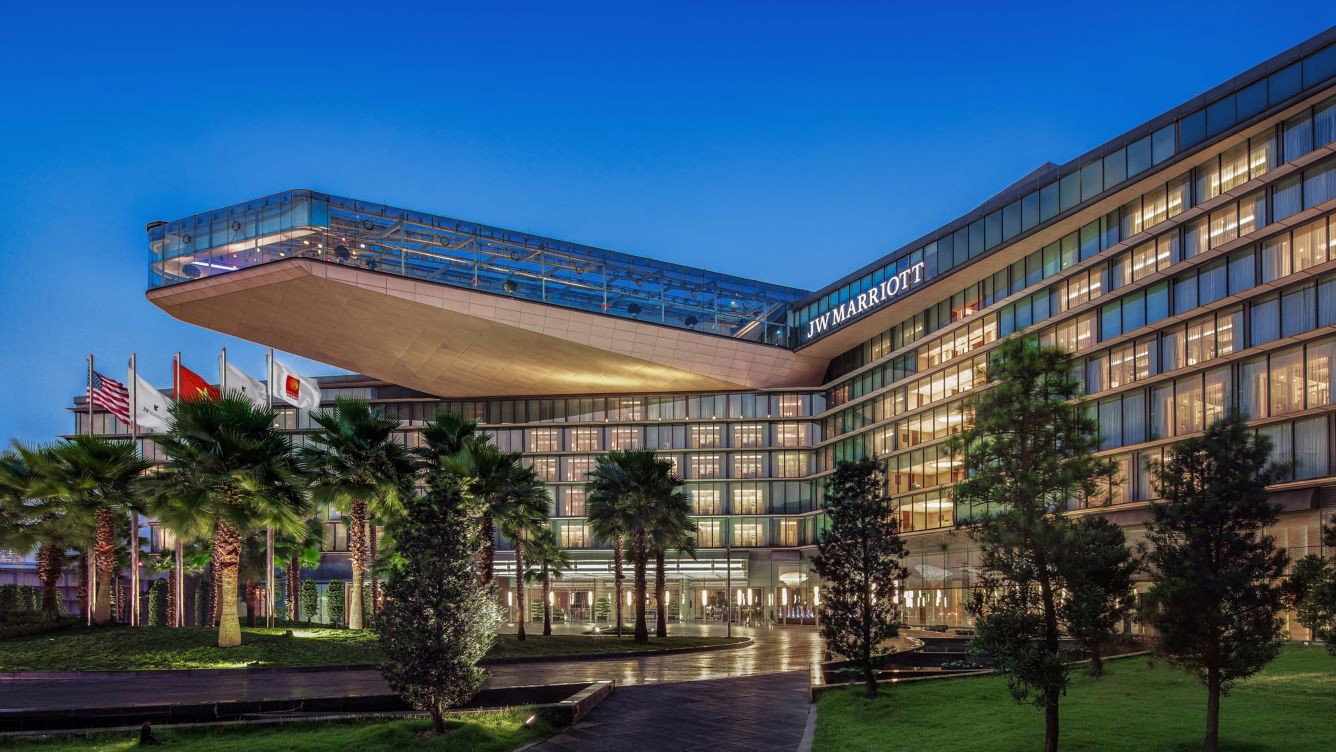
A Building With a Story Before You Step Inside
Not every large-scale hotel earns its architecture. The JW Marriott Hotel Hanoi does. Carlos Zapata, the American architect behind the project, drew the building's sweeping, curved form from the dragon of Vietnamese mythology and from the sinuous coastline that defines the country's geography. The result is a structure that reads as more than decoration: the dragon silhouette is visible in the roofline and the massing, and the floor-to-ceiling glass facade catches the light in ways that shift hour by hour. In Hanoi's broader hotel market, where colonial heritage properties like Sofitel Legend Metropole Hanoi anchor the Old Quarter end of the prestige spectrum, JW Marriott occupies the opposite pole: a purpose-built contemporary landmark designed for scale and spectacle rather than intimacy and patina. Neither is a lesser choice; they serve different travel agendas.
The hotel sits on the Vietnam National Convention Center campus in South Tu Liem district, roughly six miles from the Old Quarter. That distance is a trade-off worth understanding before you book. You are not in walking distance of Hoan Kiem Lake or the street-food lanes of Hang Be Market, but the hotel runs a complimentary shuttle downtown, which removes much of the friction. For delegates at the Convention Center, or for travellers whose Hanoi programme is event- or meeting-driven, the location is an advantage rather than a compromise.
Arrival and the Impression It Makes
The approach to the hotel is deliberate. Massive floor-to-ceiling glass doors frame an entrance sequence that staff, wearing ao dai in the property's earth-tone palette, manage with considerable composure. The interior holds to a colour register of gold, chocolate, and cream, applied across soft furnishings and stone surfaces without tipping into heaviness. It is a design language that reads as international luxury while keeping Vietnamese textile and craft references visible rather than buried.
Among the small details that accumulate into a broader impression: freshly baked chocolate chip cookies, available to guests as part of the arrival experience. This kind of offering sits in a long tradition of luxury hotels using food at threshold moments to signal hospitality rather than transaction. At Capella Hanoi, a comparable property in a very different physical register, the welcome sequence leans on mid-century Indochine references. The JW opts for warmth through scale and sensory immediacy.
Five Restaurants and What They Signal
Large convention-adjacent hotels in Asia often treat their food and beverage offering as an afterthought, maintaining restaurants that function as convenience rather than destination. The JW Marriott Hanoi takes a different position. Five restaurants cover Chinese, Japanese, and French cuisine alongside JW Café, an international buffet operation. The range reflects the hotel's primary guest profile: international business and conference travellers who need options across cuisines and meal formats without leaving the property. That is a practical calculation, but executing five distinct restaurant concepts at a consistent standard across a 450-room property is operationally demanding. For Hanoi dining more broadly, see our full Hanoi restaurants guide.
The hotel's annual programming adds another layer. Oktoberfest and a Charity Christmas Village in early December are established events in the Hanoi social calendar, attracting attendance beyond hotel guests. Events of this kind are a reliable indicator of a hotel that has embedded itself in local life rather than operating as a sealed international enclave.
The Eighth Floor: Pool, Spa, and Vertical Garden
The eighth floor is where the JW Marriott Hanoi makes its most architecturally ambitious gesture. The suspended pool, positioned to frame city views at elevation, belongs to a category of rooftop water features that have become a marker of premium urban hotels across Southeast Asia. What distinguishes this example is the floor's broader composition: a Vichy room, a full spa, a vertical garden, and rattan furniture with paper lanterns in the surrounding spaces. The vertical garden in particular is worth noting. In a district defined by the Convention Center's hard infrastructure, the introduction of dense planting at height creates a counterpoint that works both aesthetically and as a guest amenity.
For travellers comparing wellness-led properties in Vietnam, the JW Marriott's spa tier sits below dedicated resort properties such as Amanoi in Vinh Hy or Six Senses Con Dao, where the wellness offer is the primary value proposition. Within Hanoi's city hotel market, it represents a more comprehensive wellness floor than most direct competitors.
450 Rooms: Scale, Format, and the Suite Tier
At 450 keys, the JW Marriott Hanoi operates at a scale that shapes the experience in both directions. On the positive side: the infrastructure can support five restaurants, a full convention offer, and a multi-treatment spa simultaneously without one compromising another. On the less intimate side: the lobby, corridors, and public spaces are sized for volume, and the hotel hums with conference traffic that smaller properties in Hanoi do not carry.
Rooms start at 516 square feet, which is generous for an urban hotel in this price tier across Southeast Asia. Floor-to-ceiling windows are standard throughout, and warm-toned marble bathrooms with separate bathtubs feature in all accommodation categories. A recent suite refresh across 56 rooms has introduced updated finishes and enhanced services; nine of those refreshed suites include private balconies with lake views, which represent the most sought-after room type in the inventory. Sliding screen separators between bedroom and bathroom allow guests to engage with the city views during bathing, a design detail that appears in several upscale Asian hotels but is executed thoughtfully here.
Executive-level rooms and suites unlock access to the sixth-floor Executive Lounge, where complimentary breakfast, afternoon tea, and evening cocktails are included. For solo business travellers or couples on a longer stay, the Lounge access shifts the value proposition meaningfully: three included food and beverage occasions per day across a private floor changes the calculus on overall spend.
JW Lakeside Gardens and the Quieter Register
One of the more considered amenities at the JW Marriott Hanoi is its Lakeside Gardens, a landscaped outdoor area within the hotel grounds offering seating, shade, and a degree of separation from the main building's activity. In a property that otherwise runs at high operational pitch, the Gardens provide a slower register for guests who want it. The presence of a genuinely usable outdoor garden within a city hotel of this scale is less common in Hanoi than in some regional peers.
Planning Your Stay
Noi Bai International Airport is approximately 40 minutes from the property. The hotel can arrange a private Mercedes transfer for arrivals who prefer a managed door-to-door service. The complimentary downtown shuttle removes the need for private transport during day visits to heritage sites and the Old Quarter. For travellers extending into Vietnam more broadly, the JW Marriott sits within a country where the premium hotel tier spans a wide geographic and stylistic range: from Four Seasons Resort The Nam Hai, Hoi An in Dien Duong and InterContinental Danang Sun Peninsula Resort on the coast, to Regent Phu Quoc in the south, to Anantara Quy Nhon Villas in Quy Nhon and Jiva Hoa Lu Retreat in Ninh Binh for those drawn to quieter settings. The JW Marriott Hanoi holds a 4.7 Google rating across more than 10,750 reviews, a signal of consistent delivery at scale that is difficult to sustain. For the full city picture, see our full Hanoi hotels guide, our full Hanoi bars guide, and our full Hanoi experiences guide.
Travellers comparing this property against other Marriott International-affiliated addresses internationally, or against design-led urban hotels in other markets such as Aman New York, The Fifth Avenue Hotel in New York City, or Aman Venice, will find that the JW Marriott Hanoi occupies a different tier in terms of intimacy but competes directly on infrastructure, F&B; breadth, and delivery consistency.
Frequently Asked Questions
- What is the leading suite at JW Marriott Hotel Hanoi?
- The most sought-after accommodation follows the hotel's recent 56-suite refresh, which created nine rooms with private balconies offering lake and city views. Suites at the Executive tier also include access to the sixth-floor Executive Lounge, with complimentary breakfast, afternoon tea, and evening cocktails. All suites feature the hotel's warm marble bathrooms with separate bathtubs and floor-to-ceiling windows.
- What should I know about JW Marriott Hotel Hanoi before I go?
- The hotel is roughly six miles from Hanoi's Old Quarter in the South Tu Liem district, on the Vietnam National Convention Center campus. It offers a complimentary shuttle to downtown Hanoi for guests who want to explore heritage sites and markets. The 450-room scale means the property runs at higher operational volume than boutique alternatives in the city, and is particularly suited to business travel, large group stays, and event attendance.
- Should I book JW Marriott Hotel Hanoi in advance?
- The hotel's convention-adjacent location means room availability can tighten sharply around major events at the National Convention Center. Its popular seasonal events, including the December Charity Christmas Village and Oktoberfest, also draw non-guest attendance and increase demand during those windows. Booking several weeks ahead for those periods is advisable. The hotel holds a 4.7 rating across over 10,750 Google reviews, indicating sustained demand year-round.
- What is JW Marriott Hotel Hanoi a good pick for?
- If you are attending an event at the Vietnam National Convention Center, travelling on a corporate itinerary that requires flexible meeting space and multi-cuisine dining on-site, or want a large-format luxury hotel with a functional wellness floor and consistent service delivery, the JW Marriott Hanoi fits that profile well. If your priority is proximity to the Old Quarter, colonial atmosphere, or a lower-key residential scale, properties like Sofitel Legend Metropole Hanoi or Capella Hanoi serve that agenda more directly.
- Does JW Marriott Hotel Hanoi have an airport transfer option?
- Yes. The hotel is approximately 40 minutes from Noi Bai International Airport, and a private Mercedes transfer can be arranged for arrivals and departures. For guests who prefer not to use a private transfer during their stay, a complimentary shuttle to downtown Hanoi is available, providing access to the Old Quarter, Hoan Kiem Lake, and surrounding heritage areas without additional transport cost.
Nearby-ish Comparables
A short peer set to help you calibrate price, style, and recognition.
Preferential Rates?
Our members enjoy concierge-led booking support and priority upgrades at the world's finest hotels.
Get Exclusive Access