
Located at No. 3360 Xinhua Road in Binhai New Area, InterContinental Tianjin Yujiapu Hotel & Residences occupies among the more architecturally deliberate addresses in China's emerging financial district. The property carries a 2025 MICHELIN Selected distinction, placing it in a comparable set defined by consistent service standards and physical presence rather than scale alone. For stays combining business access with considered design, it represents the serious option in this part of the Bohai Rim.
Pearl is the En Primeur Club membership app — saves, bookings, and concierge access live there. Same editors, same standards.
- Address
- No.3360, Xinhua Road, Binhai, China
- Phone
- +86 22 5986 8888
- Directions
- Get directions
 Saves & bookings on Pearl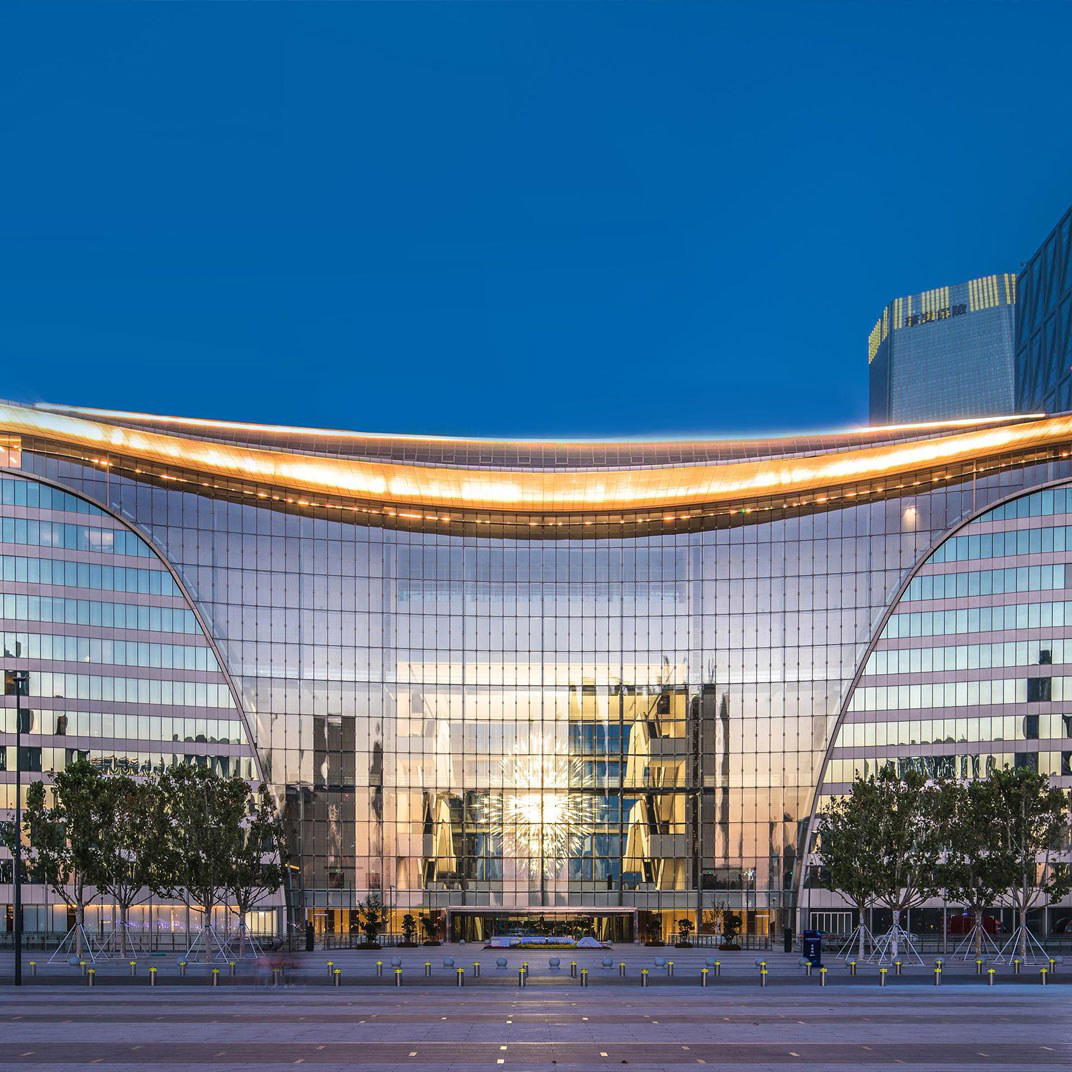
A Financial District Built for Ambition, and a Hotel Scaled to Match
Yujiapu, the peninsula district of Binhai New Area that shares its skyline with Tianjin's broader economic ambitions, was conceived as one of China's most deliberate attempts to build a financial hub from the ground up. The towers that define its profile are not incidental; they are the architecture of an intention. Against that backdrop, the InterContinental Tianjin Yujiapu Hotel & Residences at No. 3360 Xinhua Road positions itself as the address where the district's professional class stays, meets, and in some cases, lives. The building does not pretend to be a boutique retreat from the urban density around it. It reads the room correctly: this is a district that prizes verticality, glass, and the grammar of international commerce, and the hotel speaks that language with some fluency.
Binhai New Area sits roughly 45 kilometres from central Tianjin and is served by a metro network that connects to Tianjin proper and, by extension, the broader Jing-Jin-Ji megalopolis corridor. For travellers arriving from Beijing, the combination of high-speed rail to Tianjin and metro to Binhai means the journey is manageable in under two hours, which places the hotel within reach of both the capital's business travellers and the port city's own commercial centre. That geography matters when choosing an accommodation anchor in a district that can feel physically large and under-animated on evenings and weekends.
The Architecture of Aspiration: Reading Yujiapu Through Its Built Form
Yujiapu's development model drew explicit comparisons to Manhattan's financial district during its planning phase, with clusters of high-rise towers arranged around transit nodes and pedestrian plazas. The InterContinental property reflects that planning logic: a tower-format hotel integrated with a residences component, the combined-use typology that has become the dominant model for premium hotels across China's second and third financial hubs. This is not a formula exclusive to Binhai. JW Marriott Hotel Shanghai at Tomorrow Square operates under a similar integrated tower logic in Puxi. InterContinental Chongqing Raffles City takes the combined-use model further, embedding hotel keys within a mixed retail and residential superstructure. What the Yujiapu property adds to this conversation is its specific context: a district still maturing, where the hotel functions partly as an anchor institution rather than a follower of established neighbourhood density.
The residences component of the property signals something important about how the address is positioned. In Chinese premium hospitality, the hotel-plus-residences format tends to indicate a property calibrated for extended-stay business travel as much as transient bookings. The guest profile here likely includes project-based professionals on multi-week assignments in the Binhai financial and port sectors, a different demand pattern than the leisure-weighted properties in destinations like Banyan Tree Sanya or the culturally positioned stays at Yihe Mansions in Nanjing. Understanding that guest profile clarifies the hotel's design priorities: the emphasis is on spatial functionality, consistent service infrastructure, and the kind of lobby presence that works for both checked-in residents and business-meeting drop-ins.
MICHELIN Selected: What the Distinction Actually Signals
The 2025 MICHELIN Selected designation signals a vetted standard of service, facilities, and presentation. For a hotel in Binhai, a district that sits outside the primary tourist circuits of Beijing or Shanghai, inclusion in the 2025 cohort positions the InterContinental Tianjin Yujiapu among a small set of Bohai Rim properties recognised at international editorial level. That is a meaningful signal for travellers who are not already familiar with the district and are calibrating their accommodation choice against limited local reference points.
Across the broader IHG portfolio in China, the InterContinental brand has a track record of anchoring new financial and commercial districts before those districts fully mature. InterContinental Chengdu Global Center and InterContinental Quanzhou follow similar positioning logic. In each case, the brand functions as a quality signal in markets where independent editorial coverage is thin, and the MICHELIN Selected flag reinforces that function for an international audience. For travellers comparing this property against alternatives in cities with denser competitive sets, such as Mandarin Oriental Qianmen in Beijing or The St. Regis Shenzhen Bao'an, the Yujiapu property operates in a different context: it is the credentialed option in a specific district, not one of several competing at the same address.
Placing the Stay in Its Regional Context
Decisions about where to stay in the Bohai Rim often come down to which city centre the traveller's programme is weighted toward. Binhai is not Tianjin city centre, and Tianjin city centre is not Beijing. Travellers whose work or itinerary is anchored in the Yujiapu financial zone or the Tianjin port authority districts will find the Xinhua Road address functional in a way that a hotel in a more touristic setting would not be. Those planning to split time between Binhai and Beijing should weigh the metro connectivity carefully, particularly during peak commuting periods when journey times extend.
For a wider sense of how Chinese luxury hospitality varies by geography and guest profile, the contrast between this property and something like Songtsam Linka Retreat Lhasa or Hylla Vintage Hotel in Lijiang is instructive. Those properties operate in landscape-driven, culturally specific contexts where the setting is the primary reason to stay. The InterContinental Tianjin Yujiapu works from the opposite premise: the city, the district's economic function, and the professional programme bring the guest, and the hotel's role is to execute consistently within that frame. Both models are legitimate; they simply serve different travel purposes. Comparable internationally branded options in similarly purpose-built financial districts include Le Meridien Zhengzhou and LN Hotel Five in Guangzhou, though each sits in a market with different maturity and competitive density.
Planning Your Stay
The hotel is located at No. 3360 Xinhua Road, Binhai, accessible via the Tianjin Metro network that connects the district to Tianjin Railway Station and broader intercity rail links. The residences component of the property may offer extended-stay configurations suitable for longer business assignments, though specific terms should be confirmed directly.
Quick Comparison
Comparable venues nearby, for context on price, style, and recognition.
| Venue | Cuisine | Price | Awards | Notes |
|---|---|---|---|---|
| InterContinental Tianjin Yujiapu Hotel & ResidencesThis venue — the venue you are viewing | international luxury landmark hotel | $$$$ | 5-Star | Not listed |
| Artyzen NEW BUND 31 Shanghai | modern lifestyle hotel | $$$$ | 5-Star | Qiantan |
| InterContinental Haikou Seaview | Luxury beachfront resort with seaside gardens and marina proximity | $$$$ | 5-Star | Meilan District |
| Pullman Lijiang Resort and Spa | Low-rise designer resort inspired by Naxi ethnic architecture blended with contemporary Chinese interiors set amid gardens. | $$$$ | 5-Star | Shuhe Ancient Town |
| HUALUXE Xiamen Haicang | Contemporary luxury Chinese hospitality brand with wave-inspired architecture | $$$$ | 5-Star | Haicang District |
| MGM Cotai | Forbes Five-Star luxury resort designed as the 'jewelry box' of Cotai with integrated entertainment, art, and dining experiences. | $$$$ | 5-Star | Cotai |
Recognition history
Dated appearances from independent guides and award organizations, with the underlying list record or original source where available.
Michelin Selected
Michelin
Continue exploring
More in Binhai
Restaurants in Binhai
Browse all →
At a Glance
- Modern
- Elegant
- Sophisticated
- Business Trip
- Weekend Escape
- Panoramic View
- Rooftop Pool
- Pool
- Indoor Pool
- Fitness Center
- Spa
- Sauna
- Room Service
- Concierge
- Business Center
- Wi Fi
- EV Charging
- Waterfront
- Skyline
- Pool
- Indoor Pool
- Fitness Center
- Spa
- Sauna
- Room Service
- Concierge
- Business Center
- Wi Fi
- EV Charging
Modern and elegant with natural light from expansive river-view windows, creating a sophisticated retreat atmosphere.