
Artyzen NEW BUND 31 Shanghai occupies a deliberate position in Pudong's Qiantan district, where design-led hospitality has taken root alongside the area's rapid urban development. Carrying a 2025 MICHELIN Selected designation, the property aligns with a cohort of Chinese hotels that prioritise architectural identity over international-brand familiarity. Its address on Hai Yang West Road places guests within reach of the New Bund's river-facing promenades and emerging dining corridor.
Pearl is the En Primeur Club membership app — saves, bookings, and concierge access live there. Same editors, same standards.
- Address
- No.20, 666 Hai Yang West Road, Qiantan, Pudong, Pudong, China
 Saves & bookings on Pearl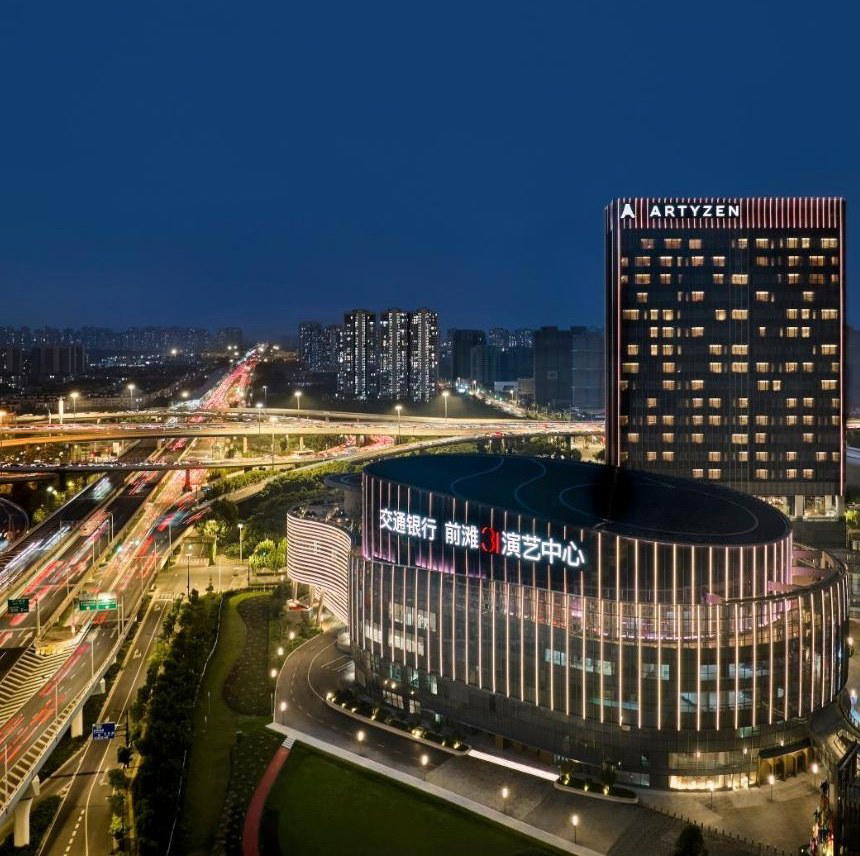
Where Qiantan's Architectural Ambition Takes Form
Pudong's hotel development has followed two distinct tracks over the past decade. The first is the high-rise international brand tower, planted along Century Avenue or the Lujiazui skyline, optimized for corporate transit and conference volume. The second is a smaller, slower-moving cohort of design-led properties that have begun appearing in Qiantan, the district stretching south from the New Bund waterfront, where city planners have zoned for cultural and creative density rather than pure financial infrastructure. Artyzen NEW BUND 31 Shanghai belongs to the second track, and its placement on Hai Yang West Road in Qiantan is a signal of intent as much as a geographic fact.
Artyzen NEW BUND 31 Shanghai sits within this design-conscious segment in Greater China. In Shanghai specifically, where the luxury hotel market is among the more competitive in Asia, earning a MICHELIN Selected designation for 2025 places a property inside a curated tier reserved for hotels demonstrating consistent quality of space, service, and experience. That credential reflects assessors' judgment that the physical environment and hospitality delivery meet a threshold that guests can rely on.
The New Bund as a Design Context
To understand the positioning of any hotel in this part of Pudong, it helps to understand what the New Bund area has become. Unlike the historic Bund on the Puxi side, which carries the weight of colonial-era architecture and a century of accumulated prestige, the New Bund is a planned waterfront zone developed with deliberate cultural ambition. The 2010 World Expo left infrastructure and momentum that accelerated Qiantan's transformation from light industrial land into a district of contemporary museums, performance venues, and retail. Hotels that opened here in the years following did so against a backdrop of freshly poured concrete and architectural competition rather than inherited neighbourhood character.
That context shapes what guests experience arriving at a property like Artyzen NEW BUND 31 Shanghai. The approach is not the layered, historical street fabric of the former French Concession or the spectacle of Lujiazui glass towers viewed from across the Huangpu. It is planned urbanism executed at speed, which means the individual buildings carry more of the aesthetic load. A hotel in this environment either commits to its design identity or disappears into the generic. The Artyzen brand, across its properties in the region, has consistently chosen the former, and the Shanghai address reflects that orientation. For comparable design-forward properties operating in different Chinese cities, Conrad Xiamen in Xiamen and The Ritz-Carlton, Xi'an in Xi'an demonstrate how international-aligned hotels pursue similar credentials in markets with distinct architectural inheritances.
Inside the Property: Space as Editorial Statement
The MICHELIN hotel guide assesses stays on criteria that include room quality, common-area design, and the coherence of the overall experience. For a property carrying the Selected designation in the 2025 edition, there is an implied standard of spatial integrity: rooms that function as well as they photograph, public spaces that have a legible point of view, and transitions between areas that feel considered rather than accidental. These are not trivial achievements in a market where construction timelines are aggressive and interior fitouts sometimes lag the architectural promise of a building's shell.
Artyzen as a brand positions itself in the upper-midscale to luxury adjacency tier in Greater China, competing with design-led independents and soft-brand collections rather than the full-service flagships of Rosewood or Mandarin Oriental. Within Shanghai's broader hotel hierarchy, this places it in a bracket that appeals to guests who find the largest international flagships either over-engineered or too impersonal, but who still require a verifiable quality standard. The MICHELIN Selected mark provides that verification. Guests researching comparable properties in the Yangtze Delta region might also consider The Hanyu Garden Reserve Suzhou in Suzhou or Hangzhou Muh Shoou Xixi Hotel in Hangzhou, both of which operate in the design-conscious segment with different geographic and cultural contexts.
Pudong's Expanding Hospitality Geography
Pudong is no longer a single hospitality district. The Lujiazui financial core remains the address most associated with the area's skyline hotels, but Qiantan has developed enough density of its own to function as a destination rather than a transit point. The riverfront proximity, the cluster of performance and exhibition venues, and the growing restaurant corridor along the New Bund make the sub-district viable for guests whose itineraries extend beyond the financial quarter.
For travellers moving across China's major cities, design-led hotels in newly developed urban districts often perform well by offering a considered space in place of historical neighbourhood texture. This is visible in Chongqing, where InterContinental Chongqing Raffles City in Chongqing anchors a mixed-use development; in Shenzhen, where The St. Regis Shenzhen Bao'an in Shenzhen operates in a district undergoing comparable transformation; and in Chengdu, where InterContinental Chengdu Global Center in Chengdu serves a similar function within a purpose-built mega-complex. The hotel participates in the same broader phenomenon, with a brand identity calibrated toward architectural restraint rather than spectacle.
Guests comparing China's design-led hotel segment against international benchmarks might reference Hôtel de Paris Monte-Carlo in Monte Carlo or Badrutt's Palace Hotel in St. Moritz as examples of how architectural heritage and contemporary hospitality coexist in European luxury. The Chinese equivalents, including this property, work from a different premise: they are building that heritage in real time, which carries its own architectural interest.
Planning a Stay
The property sits at No.20, 666 Hai Yang West Road, Qiantan, Pudong, Pudong, China. Access from Puxi and the historic city centre involves crossing the Huangpu River, most efficiently by metro rather than surface traffic, which remains variable during peak hours. The New Bund waterfront is walkable from the address, and the broader Qiantan cultural district is manageable on foot for guests interested in the area's contemporary architecture and public spaces. Advance booking is recommended.
Quick Comparison
Comparable venues nearby, for context on price, style, and recognition.
| Venue | Cuisine | Price | Awards | Notes |
|---|---|---|---|---|
| Artyzen NEW BUND 31 ShanghaiThis venue — the venue you are viewing | modern lifestyle hotel | $$$$ | 5-Star | Not listed |
| 百萬石温泉飯店 Hyakumangoku Onsen Hotel | Contemporary Japanese luxury resort with wabi-sabi design philosophy and Eastern Zen aesthetics, featuring eight architectural pavilions integrated with natural forest and snow elements. | $$$$ | 5-Star | 浦东 |
| Vaperse Hotel | condo design style fashion elegant refined and comfortable | $$$$ | 5-Star | Zhujiang New Town |
| InterContinental Haikou Seaview | Luxury beachfront resort with seaside gardens and marina proximity | $$$$ | 5-Star | Meilan District |
| InterContinental Foshan by IHG | Luxury urban oasis with lake views | $$$$ | 5-Star | Nanhai District |
| InterContinental Lijiang Ancient Town Resort | Traditional Naxi village resort with contemporary luxury integrated into low-rise houses and courtyards | $$$$ | 5-Star | Lijiang Ancient Town |
Recognition history
Dated appearances from independent guides and award organizations, with the underlying list record or original source where available.
Michelin Selected
Michelin
At a Glance
- Modern
- Elegant
- Sophisticated
- Minimalist
- Business Trip
- Weekend Escape
- Design Destination
- Panoramic View
- Terrace
- Fitness Center
- Room Service
- Restaurant
- Meeting Rooms
- Skyline
- Waterfront
- Fitness Center
- Room Service
- Restaurant
- Meeting Rooms
Calm minimalist spaces with high ceilings, huge windows, pale wood floors, custom furniture, and subtle color accents inspired by traditional Chinese gardens.