
A 16-room canal-side property on Molenmeers, Hotel Van Cleef trades in the kind of intimate, character-led hospitality that Bruges does particularly well. Ring the bell to enter, take breakfast on the terrace by the water, and settle into a house whose scale makes personalised attention a structural feature rather than a promise. Rates from around $417 per night.
 Discover on Pearl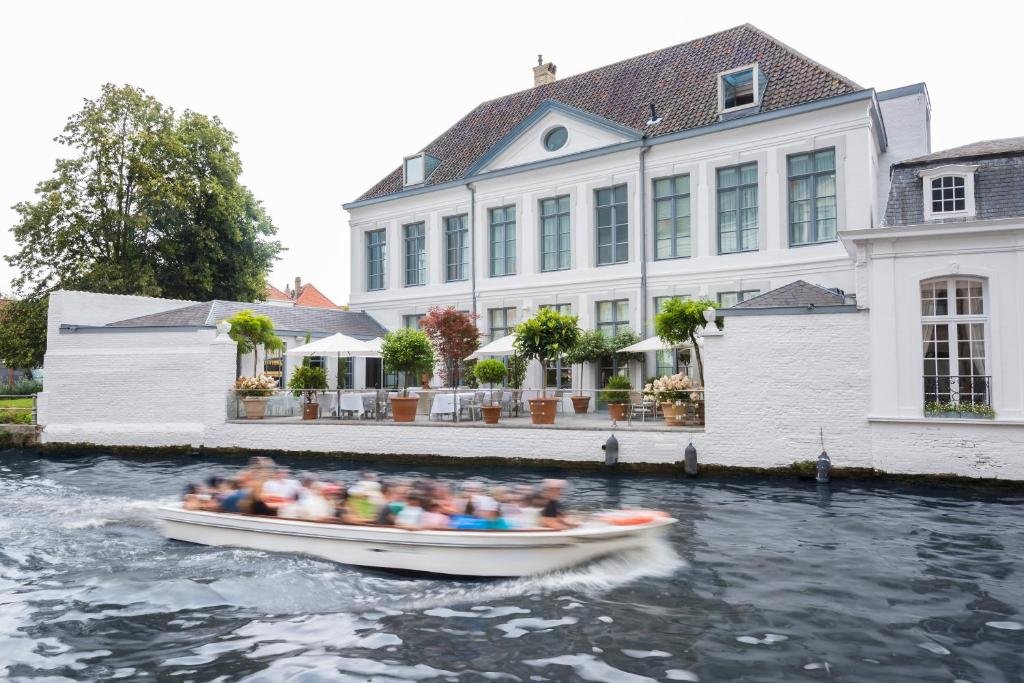
Where the Canal Does the Talking
Arriving at Molenmeers 11, you ring a bell before entering. That detail is not incidental. It signals the operating register of Hotel Van Cleef before you have seen a single room: this is a property whose scale demands a different rhythm from the moment you step off the cobblestones. Bruges has always attracted a particular strain of small, characterful hotel, and Van Cleef sits within that tradition — a 16-room house on one of the city's quieter canal stretches, where the water moves slowly enough to watch from a breakfast table.
The broader pattern in Bruges's premium accommodation market is worth understanding before you book. The city's medieval street plan, UNESCO-protected building stock, and year-round visitor pressure have produced two distinct hotel types: large converted palaces operating at institutional scale (the Dukes' Palace Brugge being the clearest example), and smaller canal-side properties where the room count is low enough that the house genuinely adapts to its guests rather than the other way around. Van Cleef belongs firmly to the second category, with 16 rooms and a format that positions it against peers like The Pand Hotel, Hotel de Tuilerieën, and Hotel Heritage rather than the city's larger operations.
The shortlist, unlocked.
Hard-to-book tables, cellar releases, and concierge-planned trips.
Get Exclusive Access →The Logic of 16 Rooms
There is a practical consequence to operating at this scale that larger properties cannot replicate. At 16 rooms, occupancy is close enough to full-house that staff ratios remain high and the team can hold meaningful information about each guest's preferences across a stay. The Bruges properties that sustain strong reputations in this sub-50-room tier tend to share that characteristic: service is a function of the building's dimensions, not a programme bolted onto a larger operation.
At Van Cleef, that logic plays out most visibly at breakfast. The à la carte format on the canal terrace is a meaningful differentiator from the buffet-line approach that becomes operationally necessary once room counts climb. An à la carte breakfast in this context means you order what you want, when you want it, with a view of the water — the kind of morning ritual that is, in Bruges at least, difficult to replicate at higher-volume addresses. The canal terrace specifically frames the city the way Bruges frames leading: from the water level, at a pace that accommodates looking.
Heritage in the Walls
The building's character is the editorial subject here, not merely its backdrop. Bruges's protected cityscape means that the properties with genuine architectural interest are those that have maintained, rather than modernised away, the features that make the city worth visiting in the first place. The Van Cleef building contributes to a street-level texture on Molenmeers that has survived remarkably intact , the canal-facing aspect, the proportions, the sense of entering a private residence rather than checking into a hospitality unit.
That architectural inheritance places Van Cleef in a specific lineage of Bruges accommodation. The city's smaller luxury hotels have historically occupied former merchant houses, guild buildings, and private mansions whose floor plans were never designed for hotel use. The result is rooms of irregular shape, staircases that make luggage interesting, and a spatial personality that purpose-built hotels cannot produce. Hotel De Orangerie and Boutiquehotel 't Fraeyhuis operate within the same tradition. Van Cleef's particular claim is the canal position and the intimacy that 16 rooms permits within a building of this kind.
For visitors whose primary interest is the heritage fabric of Bruges itself, the location on Molenmeers delivers direct access to the canal network without the foot-traffic exposure of properties closer to the Markt. The quieter stretches of the canal system are where the city's medieval infrastructure is most legible, and where the evening atmosphere differs meaningfully from the more visited zones.
Planning a Stay
Rates at Hotel Van Cleef run from approximately $417 per night, placing it in the mid-to-upper tier of Bruges's boutique hotel market. At that price point, the comparison set includes The Notary and the small-luxury addresses listed above, each of which makes different trade-offs between room modernity, public space, and location. Van Cleef's case rests on canal position, breakfast format, and the operational advantages of its room count.
Seasonally, Bruges rewards visits outside the peak summer window. The shoulder months , late March through May, and September into October , bring manageable visitor numbers, softer light on the canals, and the kind of atmospheric conditions that the city's winter and summer extremes can obscure. Canal-terrace breakfasts in particular benefit from the mild mornings of spring and early autumn, when the terrace is usable without the heat or crowd pressure of July and August.
Booking directly with the property is the standard approach for a house of this size, where room allocation and small preferences are better communicated outside an intermediary layer. For broader context on dining, the markets, and what the city rewards at different times of year, see our full Bruges restaurants guide.
In the Belgian Context
Bruges does not stand alone as a destination for this style of accommodation. Across Belgium, the pattern of small, character-led properties in historic urban fabric repeats: B&B; The Verhaegen in Ghent occupies a similar niche in that city's patrician housing stock, while Hotel Julien in Antwerp operates at comparable scale in a different architectural register. Brussels offers a wider spread of options, from the design-led Pantone Hotel Brussels to the grand-hotel formalism of the Corinthia Grand Hotel Astoria Brussels and the neighbourhood-anchored Le Louise Hotel Brussels. Further afield, Domaine La Butte aux Bois in Lanaken and Kasteel van Ordingen in Sint-Truiden represent the rural Belgian end of the same instinct toward intimate, architecturally grounded stays.
What Bruges specifically offers within this national pattern is density: a city small enough to walk entirely, with a canal system that organises the geography and a heritage building stock dense enough that almost every smaller hotel has a legitimate architectural story. Van Cleef's 16-room count and canal-terrace breakfast are the operational expression of that advantage, delivered at a scale where the house can mean it.
Frequently Asked Questions
- What is Hotel Van Cleef leading at?
- Among Bruges's smaller hotels, Van Cleef's most defensible strengths are its canal-side position on Molenmeers and the operational intimacy that comes with 16 rooms. The à la carte canal-terrace breakfast is a format that only works at this scale, and the building's character reflects the heritage fabric that makes the city worth visiting. At rates from around $417, it sits in the upper-mid tier of Bruges boutique accommodation, where service attentiveness is a structural rather than an aspirational quality.
- What is the leading room type at Hotel Van Cleef?
- Specific room categories are not published in our current data. Given the canal position and the terrace breakfast, rooms with a direct water-facing aspect are the logical priority at a property of this type. At 16 rooms in a heritage building, the floor plan likely varies considerably between units. Direct contact with the property before booking is the practical way to confirm which rooms hold the canal view, and to communicate any preferences the team can accommodate at this scale.
- Is Hotel Van Cleef reservation-only?
- At 16 rooms and rates from $417 per night, Van Cleef operates in a tier where advance booking is necessary rather than optional, particularly during Bruges's peak visitor periods from Easter through August and around the winter market season in December. Walk-in availability at this room count is rare. Contact the property directly to book; for a hotel of this character and size, a direct conversation also allows you to communicate preferences that third-party platforms cannot relay with the same specificity.
Peers Worth Knowing
A fast peer set for context, pulled from similar venues in our database.
| Venue | Cuisine | Price | Notes |
|---|---|---|---|
| Hotel Van Cleef | This venue | ||
| Hotel Heritage | |||
| Boutiquehotel 't Fraeyhuis | |||
| Dukes' Palace Brugge | |||
| Hotel De Orangerie | |||
| Hotel de Tuilerieën |
Preferential Rates?
Our members enjoy concierge-led booking support and priority upgrades at the world's finest hotels.
Get Exclusive AccessThe shortlist, unlocked.
Hard-to-book tables, cellar releases, and concierge-planned trips.
Get Exclusive Access →